
IN Brief:
- India and South Korea have signed new agreements covering defence cyber, military education, and UN peacekeeping cooperation.
- The cyber agreement sits alongside discussions on defence production, emerging technologies, joint development, and joint exports.
- Stronger digital trust could support future industrial partnerships across secure platforms, infrastructure, and military information systems.
India and South Korea have signed new defence cyber agreements as both countries move to strengthen military information-sharing, infrastructure protection, and strategic technology cooperation.
The agreements were concluded during Indian Defence Minister Rajnath Singh’s visit to Seoul, where discussions with South Korean defence leaders covered cyber defence, military education, UN peacekeeping cooperation, defence production, maritime security, emerging technologies, logistics, and regional security. The cyber element now sits inside a broader industrial relationship rather than apart from it, giving the two countries a more structured basis for secure cooperation on future military systems and defence supply chains.
The agreement reflects the growing role of digital assurance in defence manufacturing and procurement. Modern platforms carry software, encrypted links, embedded processors, diagnostic tools, mission data, and through-life update pathways. A vehicle, aircraft, naval system, or missile battery is no longer secured only at the point of delivery; security runs through design environments, production data, configuration control, test records, sustainment systems, and the companies approved to touch them.
India and South Korea already have a substantial defence industrial relationship. South Korean companies have gained international momentum in armoured vehicles, artillery, naval systems, aerospace, electronics, and precision weapons, while India continues to build domestic manufacturing capacity through Make in India, export growth, and co-development arrangements. A defence cyber framework gives that relationship a stronger foundation where sensitive design data, operational information, and controlled technologies need to move between trusted partners.
The two countries also discussed routes for joint development, joint production, and joint exports through South Korea’s Defence Acquisition Program Administration. That adds a practical industrial layer to the visit. Cyber cooperation is useful only if it feeds into programme delivery, supplier accreditation, secure data handling, and confidence between companies working on controlled military systems.
The same pattern is visible in South Korea’s own aviation and maritime modernisation, including the South Korea helicopter package that has strengthened the country’s rotary-wing and naval aviation pathway. As Korean defence programmes become more export-facing and India seeks deeper technology partnerships, both sides need mechanisms that reduce friction around information-sharing and sensitive engineering collaboration.
The cyber agreement also arrives as defence supply chains become more exposed to compromise before hardware reaches the armed forces. Attackers increasingly target suppliers, engineering service providers, test houses, cloud environments, software repositories, and maintenance networks. That widens the security perimeter from the prime contractor to a much larger industrial community, including smaller companies that may hold valuable technical data without the cyber resources of a major defence group.
India’s scale and South Korea’s established manufacturing base create a useful match, but scale alone will not secure future programmes. Shared standards, trusted communications, secure engineering environments, and clear rules around access to sensitive information will determine whether the relationship moves beyond conventional procurement into deeper co-development. Without those controls, cyber cooperation risks staying at policy level; with them, it becomes part of the production system.
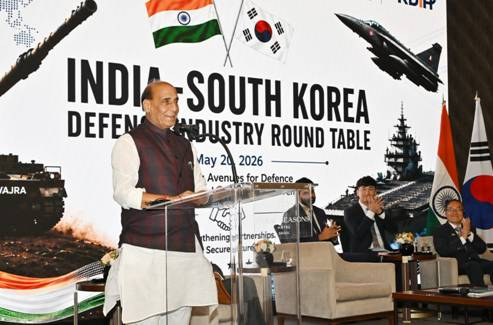
The defence industry roundtable held during the visit points in that direction. Senior government officials and industry representatives from both countries discussed manufacturing, co-development, co-production, and supply-chain partnerships. The cyber agreement gives those ambitions a security frame, especially where collaborative programmes involve electronic systems, command networks, unmanned platforms, and exportable digital capability.
The Indo-Pacific setting also gives the partnership a strategic edge. Both countries are operating in a region where defence production, supply-chain resilience, maritime security, and digital sovereignty are becoming closely linked. Industrial partnerships now need to withstand political pressure, export controls, cyber attack, and shifting technology dependencies. Trust between governments has to be reinforced by trust between factories, engineering teams, and digital infrastructure providers.
India and South Korea have therefore moved beyond a narrow defence cooperation agenda. Cyber security is becoming part of the industrial base itself, shaping which suppliers can participate, how programmes are shared, and how military systems are sustained through life. The countries able to align digital trust with production capacity will be better placed to build platforms that survive both technical complexity and geopolitical strain.

