IN Brief:
- India is examining autonomous conversion kits for T-72 tanks under its iDEX ADITI 4.0 innovation framework.
- The work would require remote operation, autonomous mobility, sensor fusion, safety systems, mesh communications, and vehicle-control integration.
- The plan reflects a wider shift toward reusing legacy heavy armour as robotic or expendable combat mass.
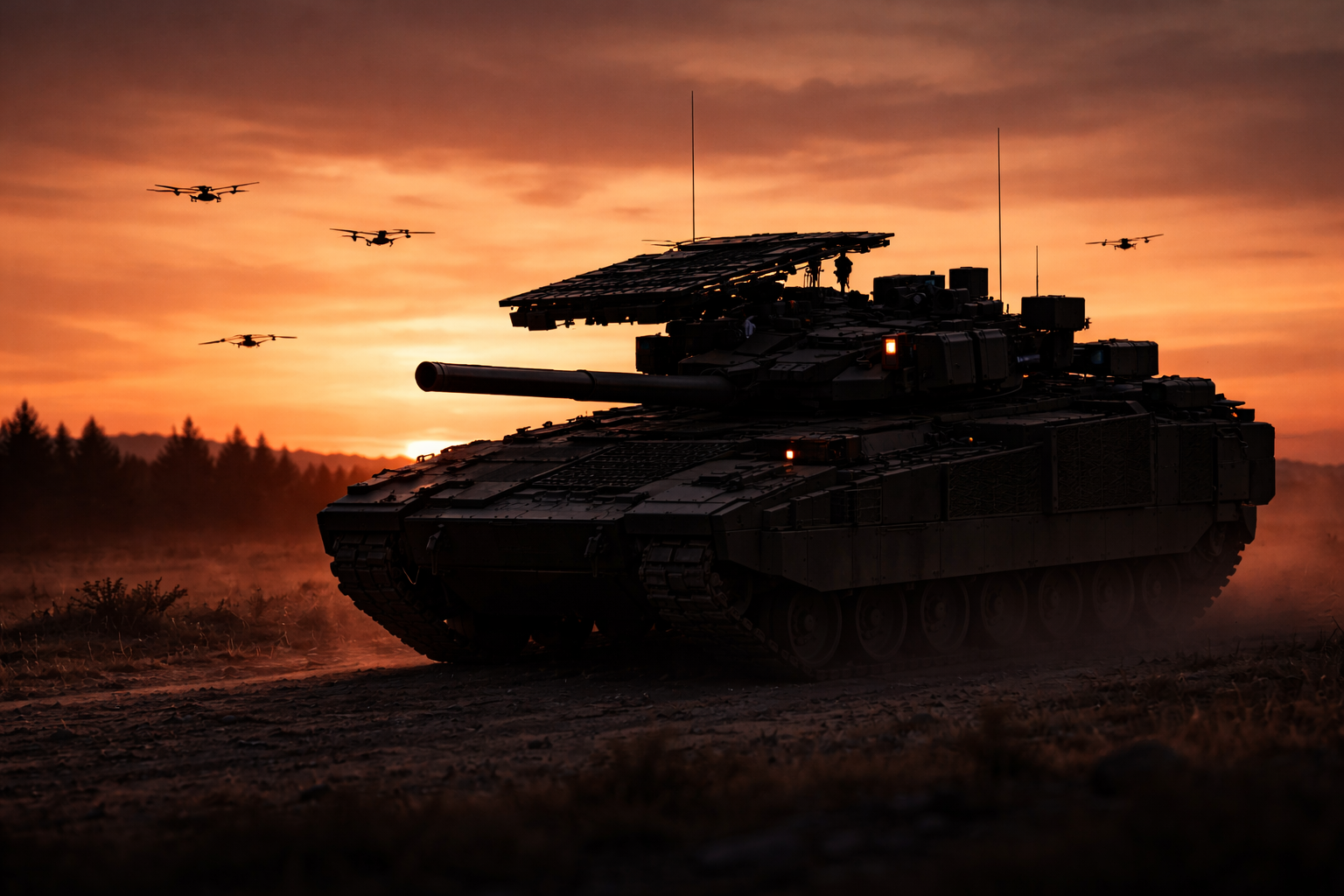
India is examining how its legacy T-72 tanks could be converted into autonomous or optionally manned armoured fighting vehicles, turning an ageing fleet into a platform for robotic combat, high-risk missions, and manned-unmanned teaming.
The requirement has emerged under India’s iDEX ADITI 4.0 innovation framework and is focused on conversion kits rather than a clean-sheet vehicle. The technical ambition is considerable. A T-72 would need to be digitised, remotely controlled, and given enough autonomous mobility to perform useful military tasks while operating under battlefield communications, terrain, safety, and electronic-warfare constraints.
The T-72 has served India for decades, giving the army a large installed base of heavy armoured platforms. Many vehicles are approaching the end of their conventional front-line relevance, but their hulls, automotive systems, protection, and battlefield presence still hold value. Converting selected vehicles into unmanned or optionally manned platforms would preserve some of that value without placing crews inside every hull.
The conversion architecture will define the industrial opportunity. A tank designed in a different era does not become autonomous through cameras and radios alone. The vehicle needs electronic control over steering, braking, acceleration, gear selection, turret functions where relevant, and emergency shutdown. It also needs actuators rugged enough for heavy armour, sensor suites able to cope with dust and vibration, navigation that can function when satellite signals are degraded, and communications resilient enough for a contested spectrum.
The trials framework is expected to test laboratory and bench performance, actuator validation, sensor fusion, low- and high-speed autonomous mobility, route repetition, emergency-stop behaviour, communications-loss safety, and mesh network resilience. Those requirements show how much of the problem belongs to production engineering rather than robotics display. A one-off demonstrator can impress on a test track; a conversion kit for military use must be manufacturable, installable, maintainable, and safe across a varied fleet.
India’s land-systems ambitions are also being shaped by domestic production and heavy-platform reuse. The same environment has already produced expansion pressure around K9 Vajra self-propelled artillery and electronic-warfare production through naval GNSS jamming systems. T-72 autonomy would sit between those themes: heavy mechanical engineering on one side, military electronics and software on the other.
Possible roles include minefield entry, breach support, decoy missions, reconnaissance, advance-guard tasks, and other high-risk work where crew protection is central to the conversion. The goal does not have to be a perfect robotic tank. It has to be a useful remote or autonomous armoured system able to exploit existing mass in environments where drones, anti-tank guided weapons, mines, and artillery make crewed exposure increasingly costly.
That distinction will shape the manufacturing model. A converted T-72 does not need the same autonomy stack as a clean-sheet robotic combat vehicle. It needs an upgrade kit that can work with existing mechanical systems, tolerate platform variation, and be installed without rebuilding the tank from first principles. The design trade-offs will involve cost, autonomy level, operator workload, reliability, and the extent to which the legacy turret and weapon system remain useful.
A scalable conversion programme would also require documentation, training, field support, spares, diagnostics, and software update infrastructure. Remote and autonomous vehicles are maintenance-heavy in different ways from traditional armour. Cameras get damaged, connectors fail, sensors drift, software needs patches, and networks require configuration control. Support arrangements must be built into the programme rather than added after trials.
Battlefield experience in Ukraine has pushed armies toward more expendable unmanned systems, but heavy armour still offers protection, mobility, and physical presence that small robots cannot match. The harder question is whether old tanks can be converted into useful robotic assets at a cost that preserves the logic of reuse. Excessive conversion cost weakens the case; fragile low-cost retrofits create battlefield liability.
India’s T-72 fleet gives the country scale for experimentation. Even a limited conversion programme could create a domestic supply chain around rugged autonomy kits, vehicle-control electronics, remote weapon interfaces, battlefield networking, and testing services. Companies that solve those interfaces on a legacy tank may also find routes into future Indian armoured vehicle programmes.
The work remains at an innovation and requirement stage rather than a production award, yet the direction is unlikely to disappear. Armies hold large inventories of legacy vehicles, autonomy ambitions are rising, and the battlefield continues to punish crewed exposure. Turning old armour into robotic mass may be inelegant, but defence manufacturing is often pulled forward by cost, survivability, and urgency long before it is refined by elegance.