IN Brief:
- Israel’s Ministry of Defense has ordered additional SMASH Hopper remote-controlled weapon stations from SMARTSHOOTER.
- The agreement includes systems, spares, and support services, with delivery expected by the end of 2026.
- Lightweight remote weapon stations are becoming part of a wider production shift toward distributed precision-fire and counter-UAS equipment.
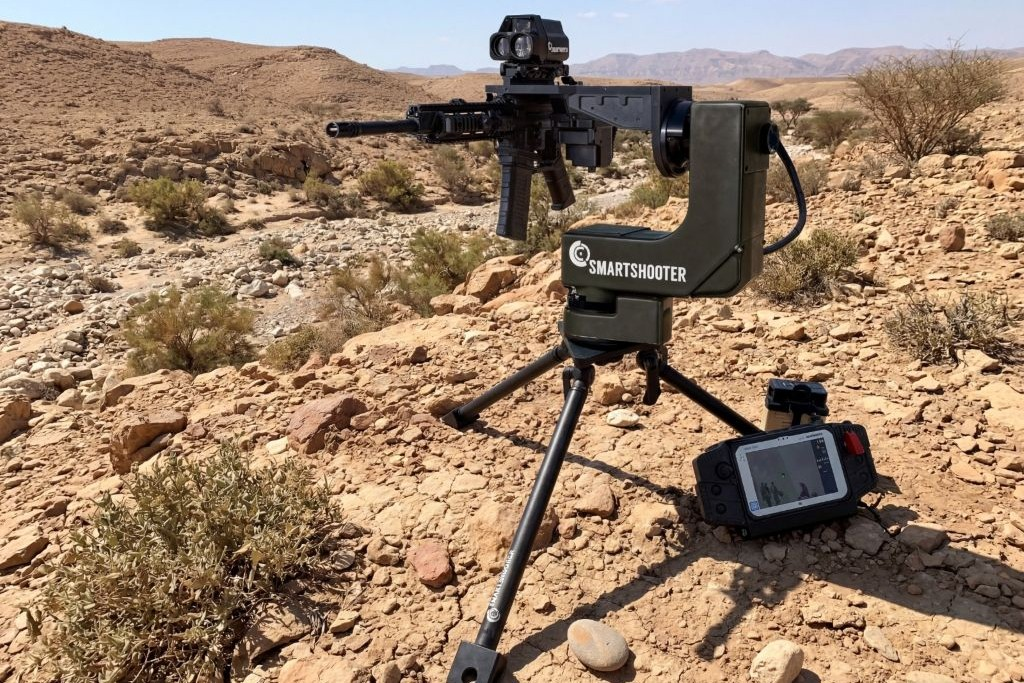
SMARTSHOOTER has secured a further Israeli Ministry of Defense order for SMASH Hopper lightweight remote-controlled weapon stations, extending demand for a compact fire-control system designed for vehicles, robotic platforms, border positions, and sensitive-site protection.
The agreement is valued at approximately NIS 5.8 million, with a six-month option for additional spare parts and related services that could increase the total value to around NIS 7.4 million. Deliveries are expected by the end of 2026, giving SMARTSHOOTER a defined production window across assembled systems, support items, and service activity.
Although the contract is modest beside major platform procurements, it reflects a steady move toward smaller remote weapon systems that can be installed across dispersed operating environments. SMASH Hopper is designed to give operators a remotely controlled firing position without the mass, installation burden, or vehicle redesign associated with larger remote weapon stations. Its value sits in the combination of precision fire-control, compact mounting, remote operation, and compatibility with different tactical layouts.
In production terms, the system depends on more than the weapon mount itself. A compact remote fire-control unit brings together optics, stabilisation, mechanical actuation, rugged electronics, operator controls, communications links, software, power interfaces, and environmental sealing. Each element has to survive dust, vibration, heat, repeated handling, and field maintenance. The production task is to keep those systems repeatable across batches while preserving alignment, reliability, and integration flexibility.
Remote fire-control systems are also being pulled into the counter-drone market. Small UAVs have changed the density of protection required around bases, borders, vehicles, and forward positions, while FPV drones have made exposed weapon operation more dangerous. Systems that allow personnel to engage from protected locations, with improved targeting and remote control, sit naturally alongside jammers, sensors, airburst weapons, and interceptor drones.
Across the wider defence market, compact precision-fire equipment is increasingly being treated as a scalable product category rather than an accessory. The same pressure is visible in work on counter-UAS rockets, anti-jam navigation equipment, and distributed short-range air-defence systems. As militaries add more layers against drones and dispersed ground threats, small remote weapon stations are becoming one of the physical nodes in a larger defensive network.
For procurement teams, the appeal of systems such as SMASH Hopper is the ability to add capability without committing to a major platform modification. Fixed positions can be strengthened, light vehicles can gain remote engagement options, and unmanned platforms can be given a controlled weapon interface. That flexibility does not remove integration work, but it keeps the installation burden lower than larger turrets or bespoke vehicle weapon fits.
The manufacturing pressures are likely to sit around repeatability and support. Optical assemblies must remain aligned, actuation systems need consistent response, and rugged electronics have to tolerate environments that are less controlled than factory qualification labs. As orders move beyond small batches, suppliers must protect component availability, manage sub-tier quality, and make sure configuration changes do not fragment the support base.
That creates a different manufacturing profile from conventional small arms or vehicle-mounted weapons. The demand is not only for hardware, but for a supported system that can be maintained across multiple user groups and deployment patterns. Spare parts, diagnostics, software support, field training, technical documentation, and mounting kits all become part of the production offer. For customers, availability depends on how quickly damaged optics, control boxes, motors, or connectors can be replaced.
The same pattern is likely to appear across other armed forces as they seek lower-cost ways to harden sites and vehicles. Heavy remote weapon stations will remain essential for protected vehicles and naval craft, but smaller systems can spread protected fire-control across more points. That fits a battlefield shaped by drones, loitering munitions, dispersed observation, and the constant need to reduce exposed manpower.
The Israeli order therefore points to a wider production opportunity for suppliers able to combine precision targeting, compact engineering, low operating burden, and through-life support. As small drones continue to multiply and force protection becomes more distributed, the industrial base behind remote engagement systems will be judged on reliability and volume as much as accuracy.