IN Brief:
- LeoLabs has received a $20.68 million Prototype Other Transaction Agreement from the US Space Force.
- The company will deliver a modified version of Scout, its family of containerised, transportable three-dimensional search radars.
- The agreement is a prototype and demonstration programme rather than a production or operational fielding contract.
LeoLabs has received a $20.68 million Prototype Other Transaction Agreement from the US Space Force to deliver a modified version of its Scout transportable radar, extending an architecture already deployed for space-domain awareness into another defence test programme. The company has not disclosed the new mission set, location, delivery date, or exact configuration required under the award.
The agreement is therefore a prototype contract rather than a production order. LeoLabs has an opportunity to demonstrate that an existing commercial radar architecture can be modified for a further national-security requirement, but the 26 August award does not commit the Space Force to operational procurement or specify how many systems could eventually be acquired.
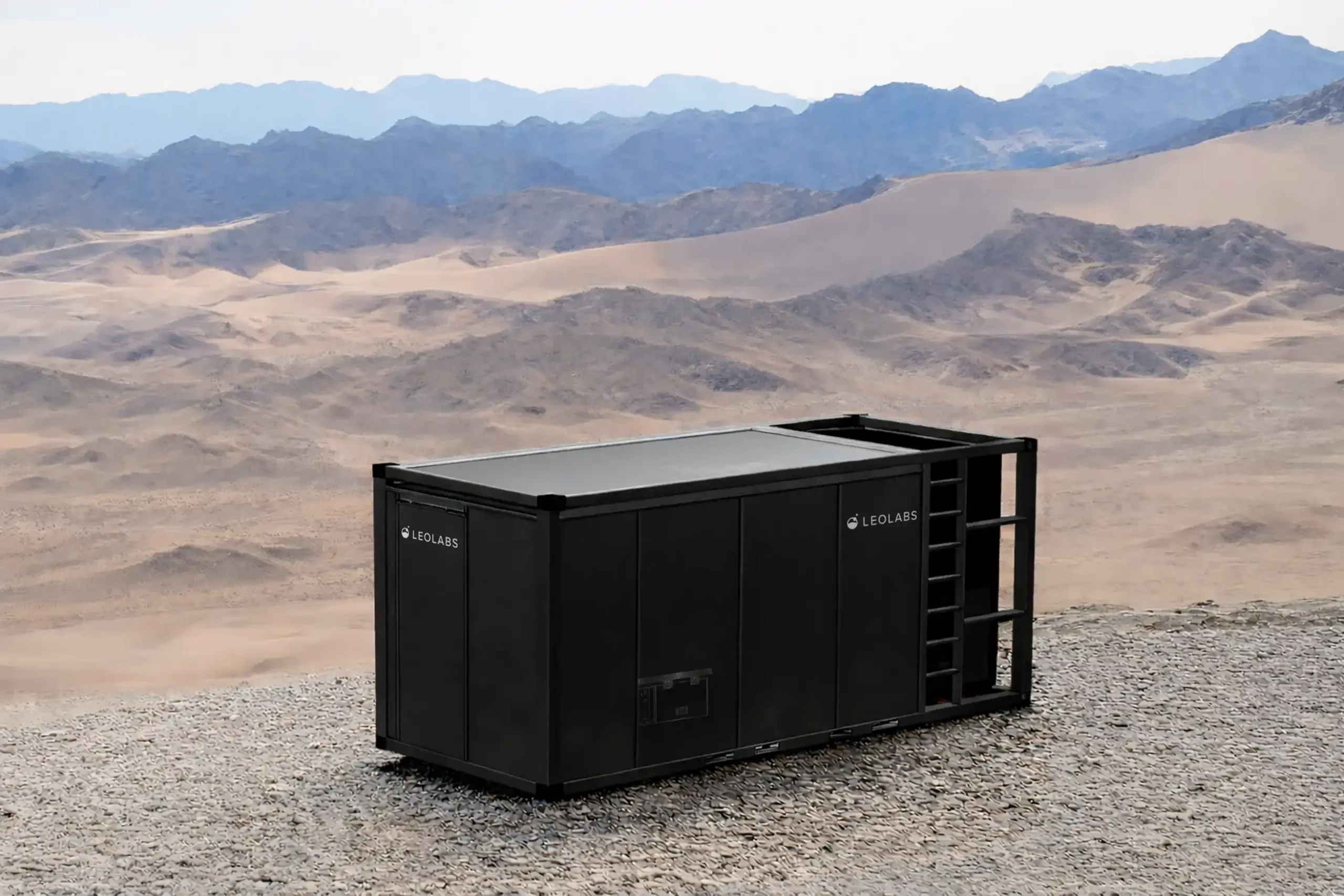
Scout is a family of transportable three-dimensional search radars designed around containerisation and rapid deployment. LeoLabs’ current Scout architecture uses modular S-band electronics and direct-radiating-array technology, with the equipment intended to move by land, sea, or air and integrate with wider distributed sensing networks. The company says a Scout system can be established in less than two hours once it reaches its operating location.
The first operational variant, Scout-S, is optimised for space-domain awareness. LeoLabs deployed the first system in the Indo-Pacific earlier in 2026, where it contributes observations to the company’s wider catalogue of more than 26,000 tracked objects. The radar has also been used as a testbed for further capabilities, including participation in activity associated with the US Indo-Pacific Command’s Valiant Shield exercise.
That earlier deployment changes the engineering starting point for the new Space Force programme. LeoLabs does not first have to demonstrate that the underlying container, array, processing chain, and deployment concept can operate outside a laboratory. Instead, work can concentrate on modifications required by the undisclosed mission — potentially involving sensor performance, processing software, interfaces, communications, or deployment arrangements, depending on the requirement.
Transportability has become more important as military sensing architectures move towards larger numbers of distributed nodes. Fixed radars can provide persistent coverage, but their locations are known and relocation is difficult once foundations, power, communications, and associated infrastructure have been established. A transportable system offers another layer of capacity that can be repositioned, replaced, or added when a specific area requires additional sensing.
That mobility does not remove supporting infrastructure entirely. A radar still requires electrical power, communications, calibration, physical security, site preparation, and maintenance, while each relocation creates another integration task with the network receiving its data. The usefulness of a distributed radar therefore depends on how rapidly it can reconnect with wider command, processing, and data architectures after it arrives at a new location.
Scout-S illustrates the balance. LeoLabs lists an optimal slant range of 50km to 1,000km for the space-domain-awareness variant and describes functions including autonomous search, detection of new objects, tracking of high-interest objects, and cued launch observation. Those specifications apply to the existing Scout-S configuration and should not be assumed to describe the modified radar being delivered under the new prototype agreement.
The company has already outlined plans to extend the family beyond orbital surveillance. Scout-X, currently in development, is intended for missile warning and tracking, while LeoLabs has also discussed broader multi-domain battlespace-awareness applications. The 26 August announcement does not identify the Space Force prototype as Scout-X or connect it explicitly to a named future product, leaving the new mission deliberately unspecified.
For the Space Force, the prototype route provides a way to evaluate a commercially developed sensor without committing immediately to a long production programme. For LeoLabs, it tests whether a radar architecture built around repeatable, containerised hardware can be modified without losing the rapid deployment that differentiates it from a fixed installation.
The $20.68 million award is therefore best viewed as an integration and demonstration milestone. No production quantity, operational deployment, or follow-on procurement has been announced. The next useful evidence will come from what the modified Scout is asked to detect, how quickly it can be deployed, and whether its data can be integrated into the Space Force architecture without creating another isolated sensing system.