IN Brief:
- MBDA has unveiled the NCM-LCM MK2 at Eurosatory.
- The missile is designed for more than 1,000km range and improved survivability.
- A mobile Ground Launch System is being developed for availability from 2029.
MBDA has unveiled the NCM-LCM MK2, a new-generation cruise missile intended to extend European deep-strike options across naval and land-launch environments.
The weapon builds on MBDA’s Naval Cruise Missile family while adding a land-launch route through a mobile Ground Launch System planned for availability from 2029. The missile is designed for a range of more than 1,000km, with improved anti-jamming capability, survivability features, stealth characteristics, and flight performance.
The programme gives Europe another route into very-long-range precision strike as governments rebuild deterrence through munitions depth as much as platform procurement. Deep-strike weapons are no longer niche assets held in limited numbers for rare use. They are becoming part of a wider fires architecture that includes artillery rockets, cruise missiles, loitering munitions, drones, hypersonic weapons, and cyber-electronic disruption.
The NCM-LCM MK2 sits close to several linked European developments. France’s ASN4G hypersonic work occupies the higher-speed strategic layer, while European-Ukrainian deep-strike cooperation shows how industry is also pursuing more adaptable production routes. MBDA’s MK2 gives that wider trend a conventional cruise-missile pillar.
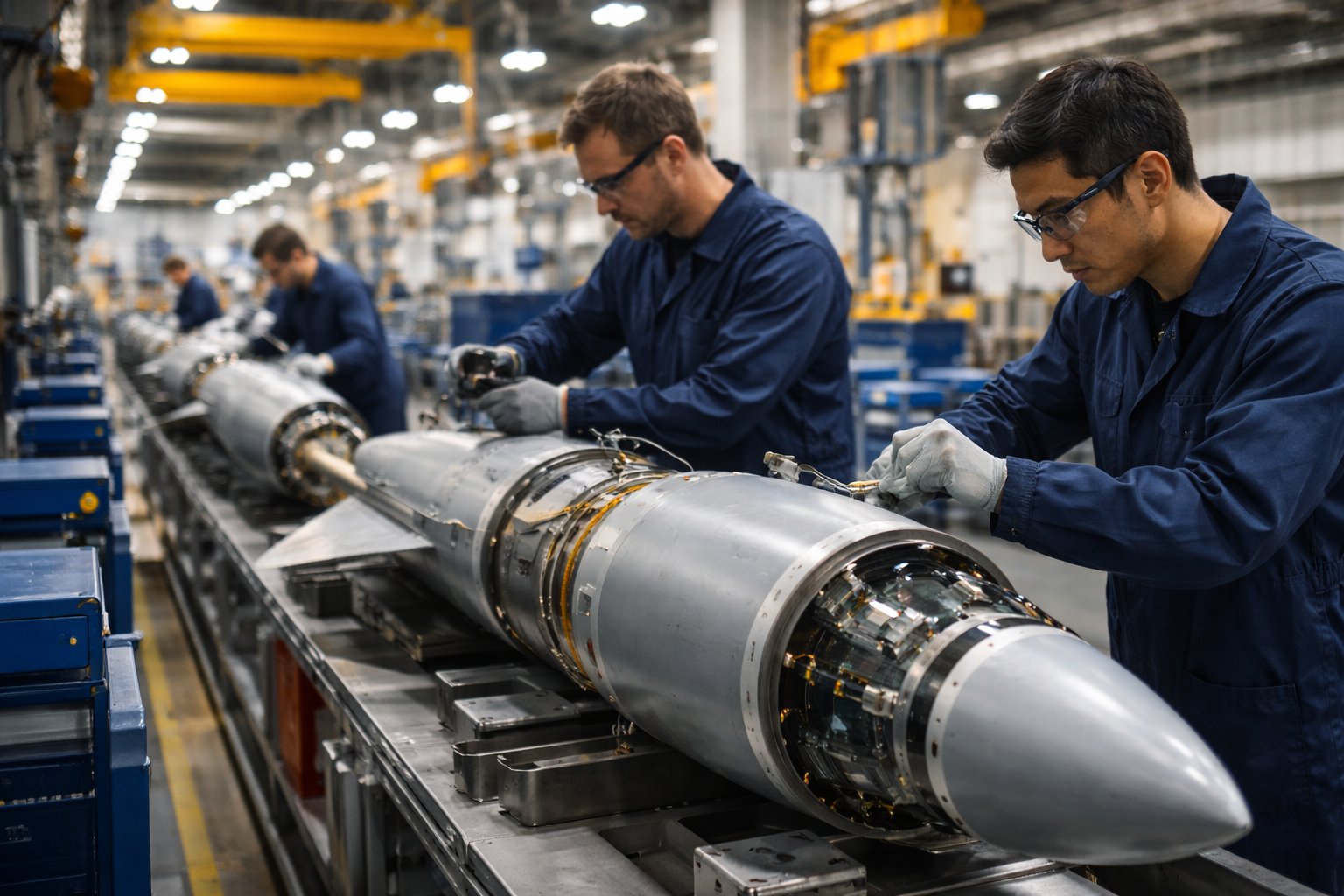
Cruise-missile production is demanding because the munition behaves more like a compact aircraft than a simple projectile. Propulsion, airframe structures, navigation, guidance, mission planning, flight-control software, stealth shaping, warhead integration, storage containers, and launch systems all need tight qualification. The missile must remain reliable after long storage, transport, loading, and mission-data preparation.
The land-launch element expands the industrial workload. MBDA’s mobile Ground Launch System is designed to carry four ready-to-fire missiles, operate from unprepared positions, and deploy rapidly in battery form. That brings vehicle integration, power systems, stabilisation, command interfaces, communications, reload logistics, safety systems, camouflage, and training into the programme.
For armed forces, mobility changes survivability. A ground-launched cruise-missile battery has to move, hide, communicate securely, receive mission data, launch, and displace before it can be targeted. The launcher therefore needs to be rugged and maintainable, but also digitally connected enough to receive high-grade targeting and mission-planning inputs.
The anti-jamming element reflects the electronic environment in which long-range weapons now have to operate. GNSS denial, spoofing, radar coverage, decoys, passive sensors, and electronic attack are no longer specialist exceptions. A deep-strike missile has to maintain navigation and mission reliability when satellite signals are degraded or contested. That places more demand on inertial systems, sensor fusion, software, and hardened electronics.
Production scale will be central. Very-long-range cruise missiles are expensive, but holding them in tiny numbers weakens deterrence and limits military planning. European buyers will need to balance cost against inventory depth, while manufacturers will need to preserve quality on lines that may be asked to increase output faster than historic demand would have justified.
The use of a proven naval missile lineage may lower technical risk, but land-launch qualification cannot be assumed. Ground environments create different transport, vibration, storage, temperature, and handling conditions. Mission planning also shifts from a naval combat-system environment to land-force workflows, requiring new interfaces and operational processes.
European cooperation could improve the industrial base if customers align requirements early. Shared components, coordinated purchasing, common training, and pooled sustainment can lower cost and improve readiness. Fragmented national variants would have the opposite effect, creating bespoke software, launcher, and support paths that undermine production efficiency.
The NCM-LCM MK2 gives Europe a sovereign long-range strike option in a category where reliance on foreign systems has often been the default. Its success will depend on more than missile performance. The manufacturing test will be whether MBDA can qualify the ground-launch system, protect sensitive software, build sufficient inventory, and sustain production across a European market now rediscovering that deterrence requires stockpiles as well as technology.