IN Brief:
- NATO will open formal negotiations with Saab for up to ten GlobalEye AEW&C systems.
- GlobalEye combines Erieye ER radar, mission sensors, C2 systems, and the Bombardier Global 6500 aircraft.
- The production burden sits in missionisation, sensor integration, certification, support, and fleet availability.
NATO’s move to open formal negotiations with Saab for up to ten GlobalEye airborne early warning and control aircraft gives the Alliance’s surveillance renewal effort a much clearer industrial path.
The system combines Saab’s Erieye Extended Range radar, a multi-domain command-and-control suite, additional mission sensors, and the Bombardier Global 6500 aircraft. No contract has yet been signed, but the decision places GlobalEye ahead in NATO’s effort to replace ageing E-3A AWACS capability with a modern airborne surveillance fleet able to support air, maritime, and land-domain awareness.
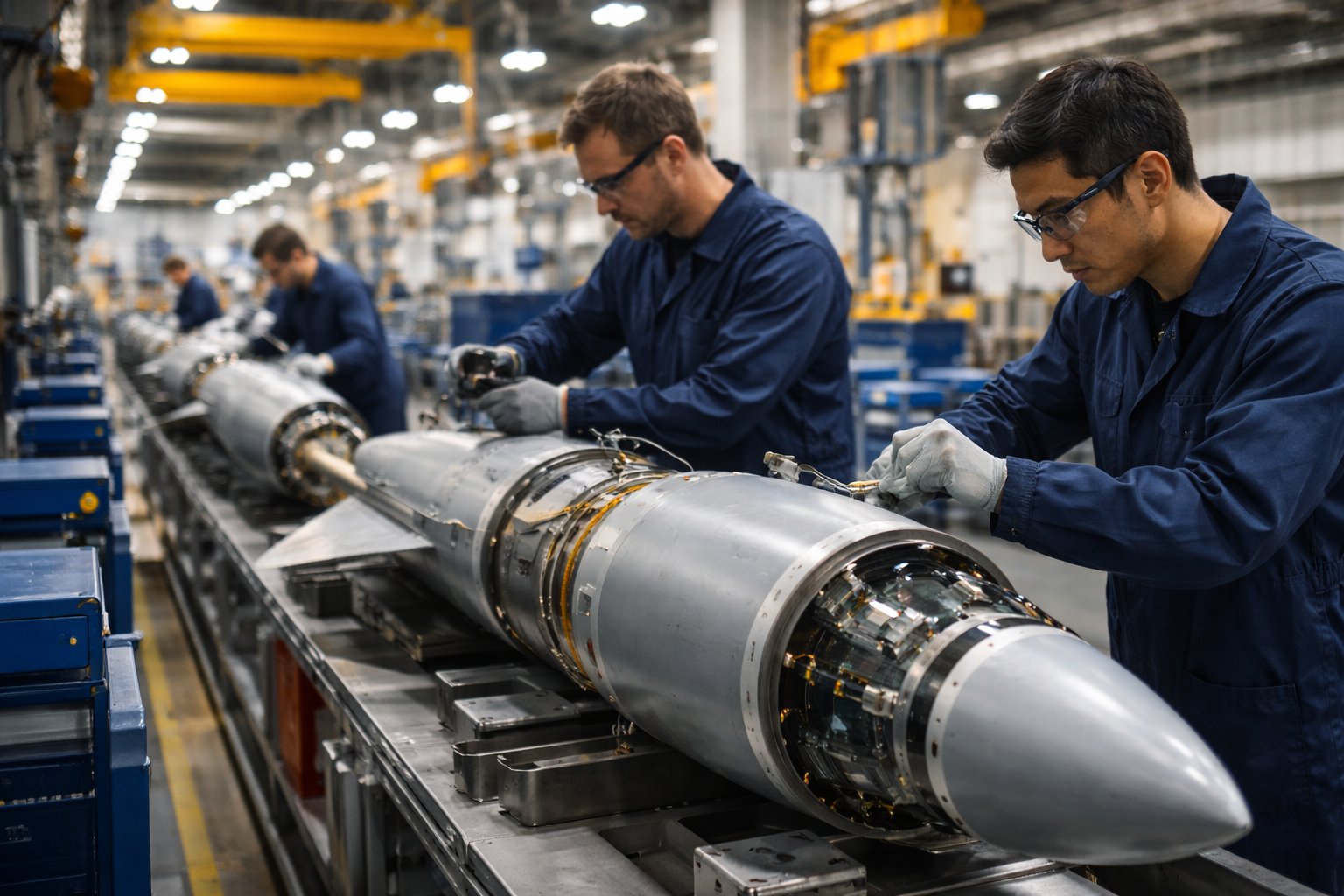
Replacing the E-3A fleet is not a standard aircraft procurement. It requires mission-aircraft conversion, structural modification, radar and sensor integration, secure communications, operator workstations, software baselines, electromagnetic compatibility work, certification, simulators, ground-support equipment, spares, and long-term upgrade planning. GlobalEye’s selection route gives Saab the lead on that whole production and support chain.
The aircraft’s earlier position in NATO surveillance renewal rested on the maturity of its sensor architecture and business-jet-based platform. Moving into formal negotiation makes the production question sharper. Saab will need to convert aircraft, deliver mission systems, maintain configuration control, support multinational operation, and provide a credible path for upgrades as the airborne threat picture changes.
Business-jet-derived mission aircraft can reduce some operating burdens compared with larger legacy platforms, but the conversion work remains technically demanding. The airframe must carry a high-power radar and sensor suite while maintaining reliability, maintainability, range, and certification. Power, cooling, cable routing, structural load, and electromagnetic compatibility decisions made in production will shape the aircraft’s service life.
For NATO, common operation adds complexity. A shared Alliance AEW&C capability cannot be treated like a single national fleet. Training, maintenance, mission-data handling, software standards, spare parts, and security accreditation must support multinational crews, multinational tasking, and missions across several operational theatres. A capable aircraft with fragile support arrangements would not solve the Alliance’s surveillance problem.
The GlobalEye decision also strengthens Europe’s position in high-end airborne mission systems. The US remains dominant across many ISR and C2 aircraft segments, but Saab’s system gives NATO a European-led option built around advanced radar, sensor fusion, and a commercially supported airframe. That will strengthen Saab’s export case and may create wider opportunities for European radar, electronics, simulation, maintenance, and mission-system suppliers.
NATO’s surveillance requirement has expanded beyond the classic image of a radar aircraft orbiting behind friendly lines. The fleet will need to support drone tracking, cruise-missile warning, maritime surveillance, air defence, electronic surveillance, and coalition command-and-control. Those missions push production demand into software, datalinks, cybersecurity, operator tools, and sensor processing as much as into airframe work.
Airborne surveillance also now sits beside wider allied C2 modernisation. Five Eyes and NATO partners are investing in digital command systems, long-range sensing, and data fusion because aircraft, ships, ground radars, satellites, and unmanned systems must feed a common operational picture. GlobalEye will only reach its full value if its output can move securely and quickly into those networks.
Support capacity could become one of the decisive parts of the programme. NATO will require aircraft availability across peacetime surveillance, crisis response, exercises, and deterrence missions. That means spares, trained maintainers, mission-system support, software update mechanisms, and airframe service arrangements must be ready with the aircraft, not developed later as separate fixes.
Saab’s stated production capacity and existing GlobalEye experience provide a foundation, but a NATO fleet would carry a different scale of expectation. The aircraft must fit Alliance procedures, security standards, interoperability requirements, and long-term upgrade cycles. That is a long industrial commitment, not a single delivery campaign.
The AWACS era was defined by large aircraft, specialist crews, and Cold War surveillance assumptions. GlobalEye would take NATO into a more compact, sensor-dense, software-heavy model. The advantage now belongs not only to the radar, but to the company and supply chain able to turn that sensor package into a dependable multinational fleet.