IN Brief:
- Denmark, Finland, Germany, and Norway plan to procure up to five MQ-4C Triton aircraft.
- The aircraft will support NATO-owned ISR across maritime, Arctic, High North, and sea-line missions.
- Northrop Grumman will build the aircraft, while European partners support ground, data, C2, infrastructure, and mission support.
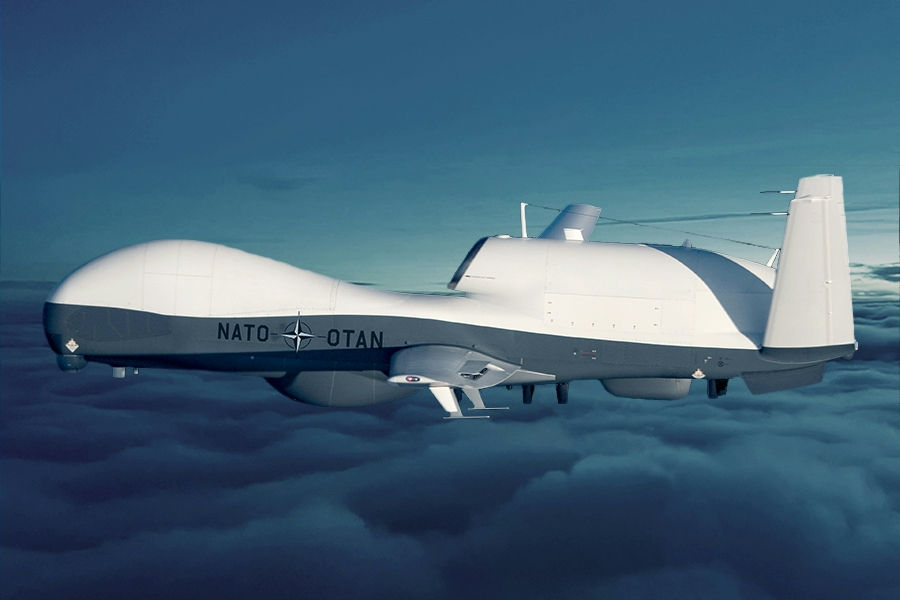
NATO’s planned MQ-4C Triton procurement gives the Alliance’s northern surveillance requirement a clearer production structure, with four European allies preparing to acquire up to five high-altitude, long-endurance uncrewed aircraft.
Denmark, Finland, Germany, and Norway are moving to procure Northrop Grumman’s MQ-4C Triton for a NATO-owned intelligence, surveillance, and reconnaissance force. The aircraft will complement the Alliance Ground Surveillance fleet at Sigonella and strengthen maritime coverage across the Arctic, the High North, and key sea lines of communication. Triton’s long endurance and high operating altitude make it suited to wide-area maritime ISR.
The industrial arrangement is transatlantic. Northrop Grumman will build the air vehicles, while Airbus Defence and Space and other European companies are expected to support the ground segment, data management, command-and-control, infrastructure, and mission support. That division reflects how modern ISR programmes are being built: aircraft production on one side, data exploitation and operational integration on the other.
Persistent maritime surveillance has become a demanding manufacturing and systems-integration problem. Triton requires a high-altitude airframe, maritime radar, electro-optical and electronic payloads, satellite communications, ground control systems, mission planning software, data links, and support infrastructure. Keeping the aircraft flying is only part of the requirement. NATO must be able to move, process, protect, and share the intelligence it collects.
The Arctic and High North focus makes that difficult. Long distances, demanding weather, sparse infrastructure, sensitive airspace, and undersea infrastructure concerns all increase the value of persistent uncrewed surveillance. Those same conditions increase the burden on communications resilience, maintenance support, airworthiness, and mission planning.
The four-nation structure should help distribute cost, but it will also require disciplined governance. ISR data is sensitive, and multinational ownership does not automatically produce easy sharing. Ground systems, data standards, security rules, mission priorities, and national intelligence restrictions must be aligned early. A high-end aircraft that produces data faster than NATO can distribute and exploit it would underperform despite strong sensor capability.
European workshare could be particularly important in the ground and mission layers. Secure data handling, C2 integration, infrastructure, mission support, and analytical tools all offer European companies routes into the programme without duplicating US airframe production. Those areas are also likely to evolve throughout the aircraft’s service life, especially as AI-enabled processing and automated maritime pattern recognition mature.
The procurement also sits beside allied digital command-and-control work. New Zealand’s Arcadia programme, aligned with Five Eyes C2 modernisation, shows the same structural pressure: sensors and platforms increasingly rely on networks able to turn collected data into operational decisions. Triton gives NATO another powerful sensing layer, but its value will be measured by how quickly maritime commanders can use its output.
Maintenance and sustainment should not be understated. Long-endurance unmanned aircraft can create the impression of reduced manpower, yet they require trained ground crews, spares, software support, airworthiness management, mission payload servicing, and communications infrastructure. A NATO-owned fleet will need a support model that works across national boundaries and operating locations.
There is also a production-rate question. Triton is a mature US Navy aircraft, but a NATO procurement adds another customer with specialised requirements. Integrating European ground systems and multinational operational procedures will require careful configuration management. Small differences in software, data handling, or support equipment can create large sustainment problems over time.
For northern European allies, the capability offers a way to cover maritime approaches without relying solely on crewed patrol aircraft, surface ships, satellites, or shore-based sensors. Triton will not replace those assets, but it can add persistence and reach in areas where human-crewed sorties are expensive and finite.
The procurement gives industry a concrete architecture around which to build: Northrop Grumman air vehicles, European mission infrastructure, NATO ownership, and a northern maritime ISR mission set. The aircraft may be the visible part of the programme, but the harder work will sit in the systems that turn long flights into reliable, shareable intelligence.