IN Brief:
- Northrop Grumman will produce M1147 Advanced Multi-Purpose 120mm rounds for the US Army’s M1 Abrams fleet.
- The munition is designed to replace several legacy round types with a single programmable tank round.
- Production will place pressure on fuze electronics, energetic materials, quality assurance, and long-term ammunition supply.
Northrop Grumman has received a five-year US Army contract to produce M1147 Advanced Multi-Purpose 120mm tank ammunition for the M1 Abrams fleet, supporting a shift toward fewer munition types with broader battlefield effects.
The M1147 AMP is designed to consolidate roles previously handled by several Abrams rounds, including high-explosive anti-tank, multipurpose anti-tank, canister, and obstacle-reduction munitions. For tank crews, the attraction is tactical flexibility. For logisticians and manufacturers, the programme represents a move toward programmable ammunition that can reduce the number of round types carried, stored, transported, and supplied.
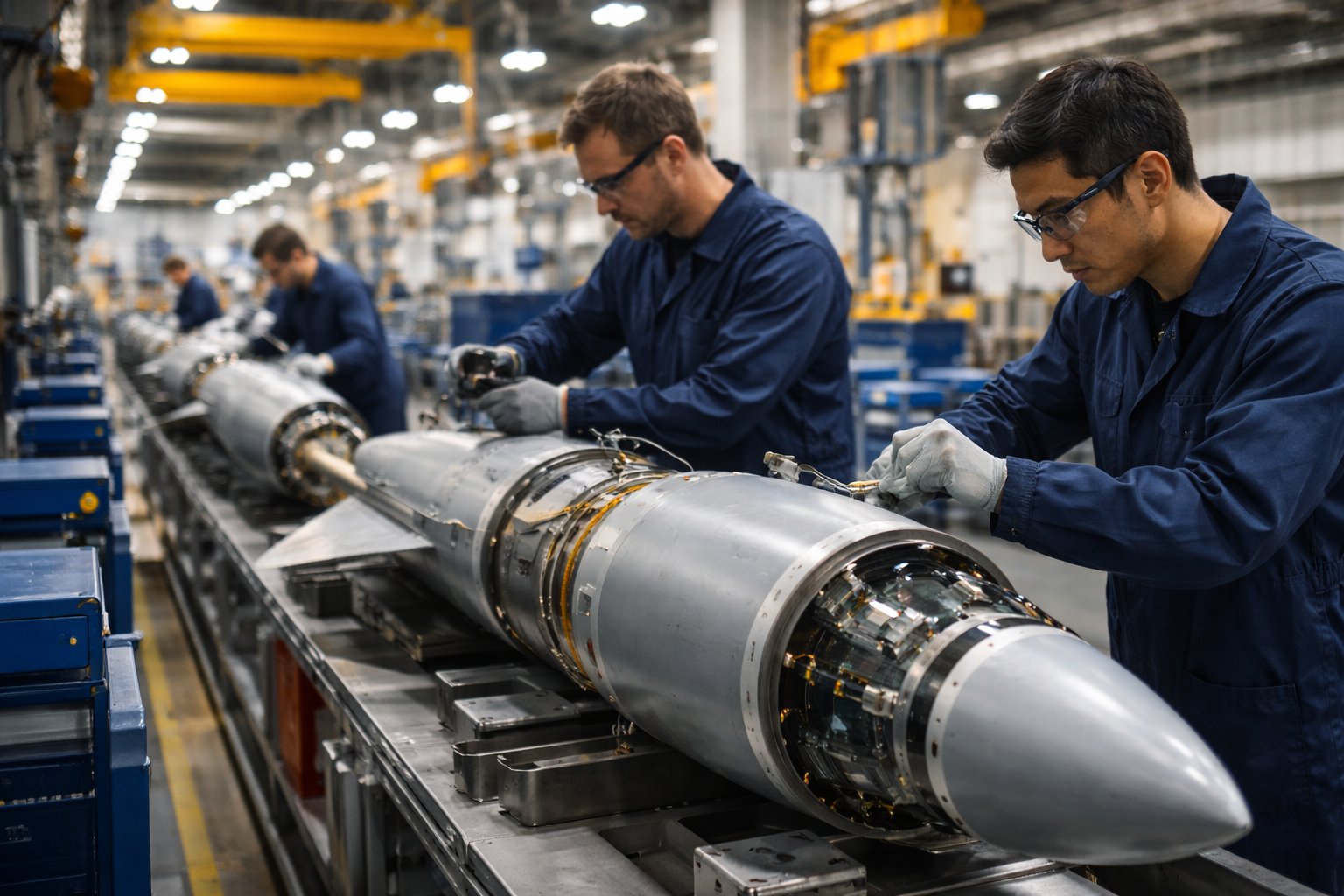
A multi-role round does not necessarily simplify production. It may ease logistics at unit level, but it concentrates more complexity inside the munition. Programmable effects require fuze electronics, reliable data transfer from the fire-control system, precise timing, safe handling, environmental robustness, and consistent lot-to-lot behaviour. In tank ammunition, those requirements sit alongside propellant manufacture, projectile-body production, warhead integration, cartridge-case tolerances, ballistic stability, and insensitive-munitions controls.
The US Army has been moving the M1147 through full-rate production, positioning the round as a key improvement for Abrams lethality across varied target sets. Its role is especially relevant as heavy armour returns to the centre of NATO planning. Tanks are again being assessed for high-intensity operations involving drones, mines, anti-tank guided missiles, artillery, electronic warfare, and fortified positions. A round able to service more targets without changing ammunition type offers clear operational and logistic advantages.
Ammunition production has become one of the most visible stress points in Western defence manufacturing. The war in Ukraine exposed limits in artillery shell, rocket, missile, and propellant output, but tank ammunition faces the same structural pressures: specialist materials, qualified production lines, long certification cycles, and safety-critical testing. A five-year production contract gives industry a firmer basis for supplier planning, workforce retention, and equipment investment.
Northrop Grumman’s armaments portfolio gives it an established base in 120mm Abrams ammunition, including propellant handling, projectile assembly, fuze integration, and acceptance testing. The M1147, however, puts greater emphasis on programmable effect reliability. A round that replaces multiple legacy types must perform consistently across all intended modes, rather than excelling in one narrow role.
That reliability requirement spreads across the supply chain. Electronics inside ammunition have to survive shock, vibration, storage, temperature cycling, and launch acceleration. Energetic materials must remain stable and consistent across batches. Test regimes have to prove safety and performance without consuming excessive live rounds. Fire-control integration must ensure that the crew’s selected mode is transmitted correctly and executed under battlefield conditions.
Ammunition rationalisation changes stockpile management as well. Fewer round types can simplify storage, reduce training complexity, and lower the risk of units carrying the wrong mix for a mission. Larger buys of one round can improve production economics. The trade-off is concentration risk. If one multi-purpose round becomes central to armoured operations, any production issue, component shortage, or quality hold can affect a wider portion of the fleet’s combat load.
The Abrams fleet remains central to US heavy force structure and to several allied armies, particularly as European and Indo-Pacific partners reassess armoured capability under renewed threat conditions. M1147 production will therefore be watched beyond the US Army. International operators often look to US ammunition programmes for compatibility, availability, and upgrade direction.
The contract also reinforces a wider shift in platform modernisation. More lethality can now be delivered through ammunition, software, sensors, and fire-control integration without redesigning the whole vehicle. The Abrams does not need a new turret to change its battlefield effect if the ammunition family evolves. That places more industrial weight on the factories producing the rounds, the suppliers making the electronics, and the test systems certifying each batch.
Programmable ammunition has become a manufacturing discipline in its own right. M1147’s promise is versatility, but its operational value will depend on whether that versatility can be produced safely, consistently, and in the quantities heavy forces require.