IN Brief:
- Chinese defence footage shows an apparent airburst effect during a PHL-191 live-firing exercise.
- The rocket type, fuze, warhead, range, and guidance configuration remain unidentified.
- Repeatable production would require dependable fuzes, controlled fragmentation, sealed canisters, and integration with a wider targeting network.
China’s latest PHL-191 firing footage appears to show at least one munition detonating above the ground, producing an effect consistent with an airburst warhead. The ammunition has not been identified, and the available imagery does not establish its calibre, range, guidance method, fuze type, or internal construction.
Because the PHL-191 accepts different sealed launch modules, the vehicle is better understood as a common firing platform than a launcher built around one specific rocket. Its modular architecture can accommodate several ammunition classes, allowing new effects to be introduced without the cost and disruption of developing a separate vehicle for every weapon.
Although the imagery cannot establish whether the round is new, modified, guided, or unguided, it does illustrate the industrial value of a flexible launcher. A common chassis, fire-control system, and support fleet can reduce duplicated manufacturing, provided each ammunition variant complies with tightly controlled electrical, mechanical, software, and handling interfaces.
Across any airburst munition, the fuze is responsible for converting trajectory data or sensor input into a detonation at the intended height. It must continue functioning after years of storage, rough transport, temperature cycling, vibration, electromagnetic exposure, and the severe acceleration of launch.
Small timing errors can shift the burst point sufficiently to alter the distribution and density of fragments at ground level. The fuze, power source, safe-and-arm mechanism, processor, sensors, and explosive train must therefore be produced with repeatability that is difficult to achieve once output moves beyond small development batches.
Where preformed fragments, scored casings, or controlled fragmentation sleeves are used, warhead manufacture adds another layer of precision. Variations in metallurgy, wall thickness, explosive filling, concentricity, or initiation can create irregular patterns, reducing the predictable coverage that distinguishes an airburst round from a basic impact weapon.
From visible effect to repeatable output
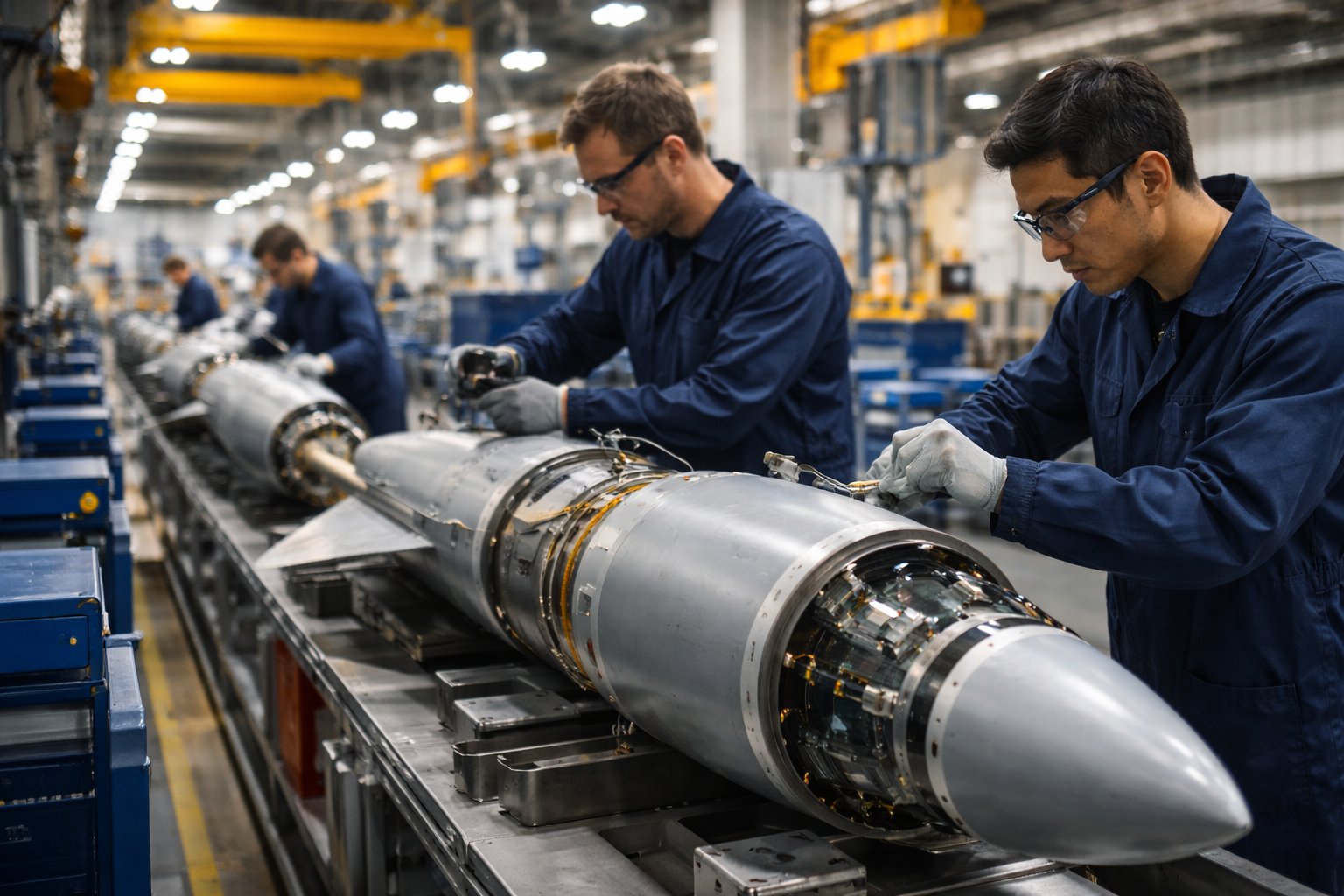
Turning a successful firing into a production-standard munition requires far more than reproducing the external dimensions. Energetic material must be mixed, cast, cured, inspected, and handled through controlled processes, while every supplier of electronic components, batteries, sensors, and actuators must meet environmental and shelf-life requirements.
Whether the fuze relies on proximity sensing, programmed time, trajectory calculation, or several methods together, each approach carries a distinct manufacturing burden. Radar-based proximity systems require radio-frequency components, antennas, calibration equipment, and controlled assembly; programmed fuzes require dependable data transfer and rigorous management of software versions.
On a modular launcher, the fire-control system must recognise the fitted canister, load the correct ballistic and fuze data, and prevent incompatible commands from reaching the ammunition. Introducing another round therefore requires software development, launcher trials, electrical-compatibility work, and configuration control alongside the physical production programme.
Sealed canisters simplify storage and field handling, yet they move more responsibility into the factory. Moisture control, environmental sealing, structural integrity, connectors, internal restraints, and built-in test functions must remain effective throughout the munition’s service life, because opportunities for routine inspection are limited once the round has been packaged.
Reload vehicles, transport equipment, depots, and inventory systems must also accommodate a wider ammunition portfolio. A launcher capable of carrying several types offers little operational flexibility when logistics units cannot identify, position, inspect, and replenish the correct canisters at the required rate.
Beyond ammunition manufacture, airburst effects depend on a targeting network capable of locating and classifying objectives quickly enough to exploit them. Drones, counter-battery radars, reconnaissance aircraft, satellites, communications links, mission computers, and digital command systems all contribute to the firing chain.
A comparable integration burden is visible in China’s Type 076 drone-carrier programme, where hull construction represents only one element within a larger system of sensors, aircraft, launch equipment, power, and data. The PHL-191 follows the same industrial logic at a smaller scale: modular hardware gains value only when ammunition, software, targeting, and support mature together.
Until China identifies the round, firm conclusions about its guidance, range, or warhead would exceed the evidence. Further firings, clearer canister configurations, official ammunition designations, and signs of deployment across multiple units would provide stronger indications that the capability has moved beyond demonstration.
For competing defence industries, the most consequential development would be evidence of sustained volume production. China has already established considerable capacity in rocket motors, military electronics, explosives, vehicles, and precision machining; adding a dependable airburst family would broaden the effects available from an existing launcher base without requiring an entirely new fleet.
The detonation captured in the footage is the visible end of a longer industrial sequence. Fuze repeatability, fragmentation control, software assurance, component availability, canister integrity, and production testing will determine whether the effect can be supplied consistently rather than reproduced under selected exercise conditions.