IN Brief:
- Pratt & Whitney has begun building a 6,500-square-metre facility in Rzeszów following an investment decision announced in April.
- The $100 million expansion will add processing and inspection capacity for critical rotating engine components.
- The factory is expected to open in 2028 and create more than 120 jobs.
Pratt & Whitney has started construction of a $100 million advanced manufacturing facility in Rzeszów, Poland, intended to expand its capacity to process critical rotating components for aircraft engines. The 6,500-square-metre building will support commercial and military propulsion programmes, including F135 and F100 engines, with operations scheduled to begin in 2028.
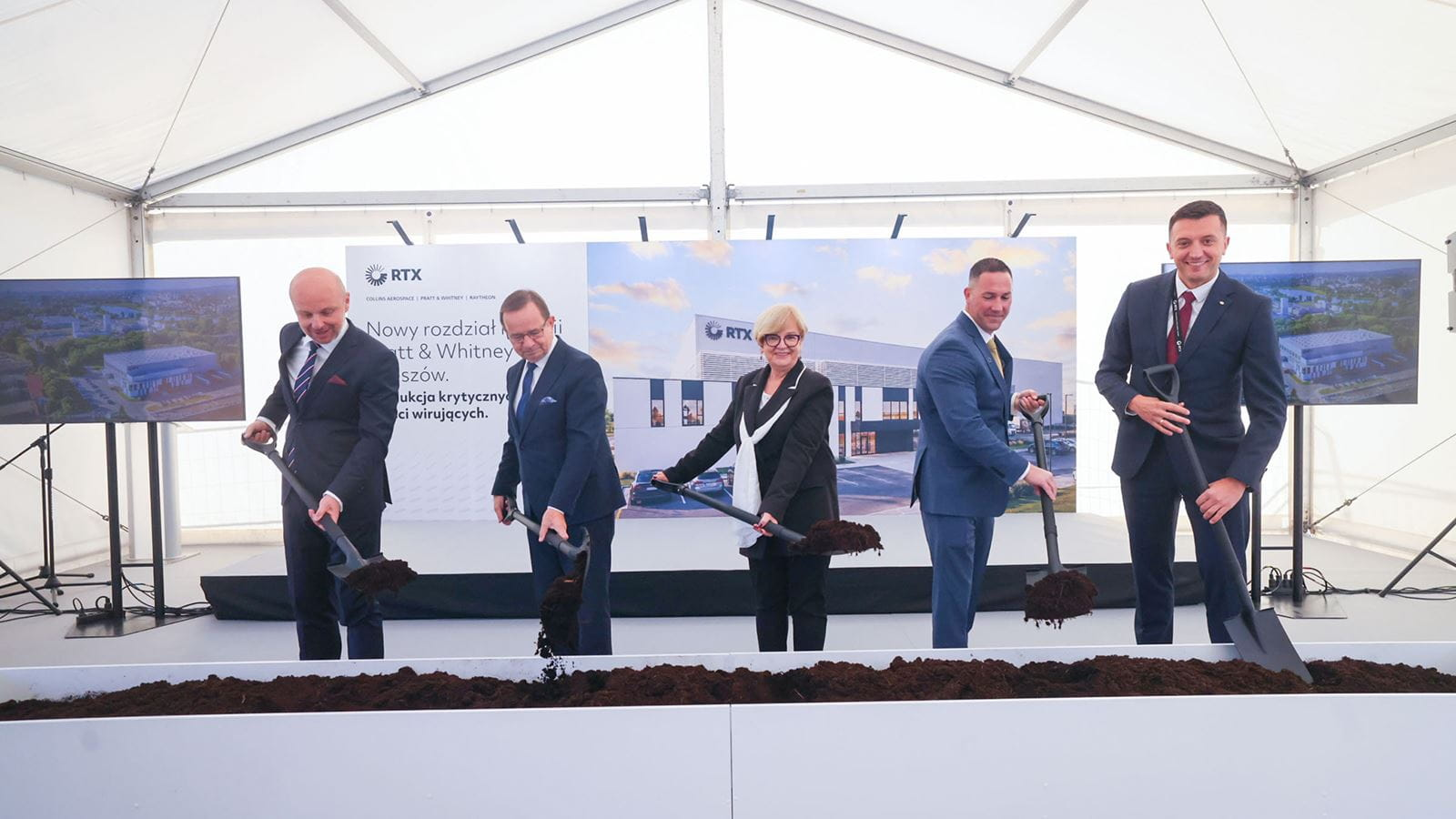
Construction began on 23 October, six months after the original investment announcement in April, making it a physical milestone rather than an additional $100 million commitment. RTX values the project at approximately PLN375 million and expects the new building to become operational in 2028, bringing more than 120 jobs. The additional facilities will process and inspect parts destined for engines with demanding geometric and materials requirements.
The new building will sit within an established manufacturing and technology operation in Rzeszów. Pratt & Whitney already makes components associated with the GTF fan drive gear system, F100 static structures and F135 engines there, alongside work on turboprop engines and auxiliary power units. The expansion adds specialised processing for rotating components to an existing industrial base rather than establishing a separate Polish engine manufacturer.
In the F135 and other advanced gas turbine engines, rotating components such as compressor and turbine discs form part of the assemblies that transfer energy through the engine. They operate at high rotational speeds and can experience demanding thermal and mechanical loads during service. Manufacturing such parts requires control over their geometry and material properties, followed by inspection capable of identifying defects that could affect service performance.
The manufacturing sequence outlined when the project was announced includes heat treatment, sonic machining and inspection of isothermally forged parts. Heat treatment establishes specified material properties after forming, while machining controls part geometry and surface requirements. Inspection then checks that components satisfy the applicable acceptance criteria. Pratt & Whitney has not published a detailed machine list or capacity for each process for the new building.
Isothermal forging forms metal while controlling the temperatures of the tooling and workpiece, helping shape difficult alloy components before they are heat treated, machined and inspected. The engineering requirements depend on the material and final component design, but both forming and finishing need validated process controls where parts will operate under high mechanical and thermal stresses.
The Polish construction project complements Pratt & Whitney’s $200 million investment in a seventh isothermal forging press at Columbus Forge, Georgia, announced in February. Forging produces the required metal forms, but they must still pass through subsequent treatment, finishing and inspection. Expanding only the forging stage would leave those downstream operations as a potential constraint, which explains the paired investments across the United States and Poland.
Together, the two investments are expected to support a 30 per cent increase in output of selected critical engine parts, including rotating compressor and turbine discs, once fully operational in 2028. That is Pratt & Whitney’s combined capacity target, not an increase already recorded at Rzeszów, and no separate production rate has been published for the Polish extension. Both facilities must be equipped and qualified before any sustained increase can be assessed.
Because the Rzeszów expansion supports both the GTF commercial engine family and the F135 and F100 military engines, the processing equipment will serve distinct product specifications rather than one standard component range. The same industrial methods can be applied across those programmes, although materials, tolerances, inspection records and qualification requirements depend on the part and its intended application.
Before components from the new line can be accepted, manufacturing equipment must be installed and commissioned, personnel trained and process controls qualified against the applicable engine specifications. For highly stressed rotating components, repeatable treatment conditions and traceable inspection records are essential elements of production approval. The intended 2028 operating date allows time for those steps following building construction.
RTX says Poland is its largest employment and investment base outside the United States, with more than 9,500 people working for its Collins Aerospace, Pratt & Whitney and Raytheon businesses in the country. Rzeszów’s existing component, engine and auxiliary power unit work gives the expansion access to established engineering capability. Staffing the new production processes will nevertheless require training, documentation and manufacturing controls specific to the components being made.
A separate $25 million expansion announced in September at Pratt & Whitney’s Niepołomice facility concerns precision tubular assemblies and should not be counted as part of the Rzeszów construction budget. The next milestones in Rzeszów are completion of the building, installation and qualification of production equipment, and the planned start of operations during 2028. The company has not released a date for the first accepted rotating component from the new line.