IN Brief:
- Saab presented its first Swedish GlobalEye on 15 October, ahead of flight testing and customer delivery.
- Sweden contracted two aircraft in 2022 and exercised an option for a third in 2024.
- The surveillance platform integrates Erieye ER radar, complementary sensors and airborne command-and-control functions.
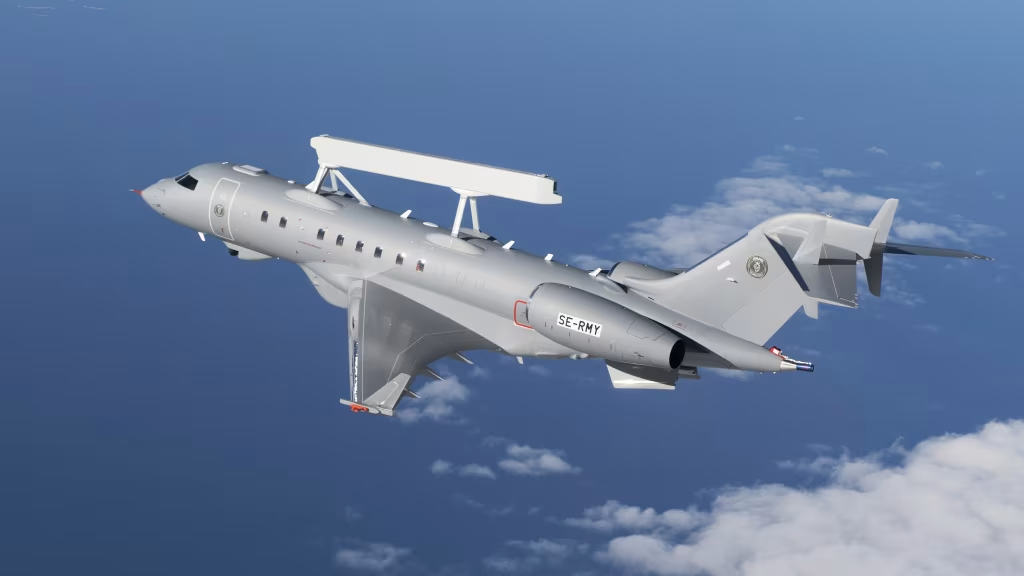
Saab has presented Sweden’s first GlobalEye airborne early warning and control (AEW&C) aircraft, moving the programme into testing and verification ahead of its maiden flight and eventual customer delivery. The 15 October presentation marks completion of a visible aircraft integration milestone, not the handover of an operational surveillance system to the Swedish Air Force.
Sweden has contracted three GlobalEye systems through the Swedish Defence Materiel Administration, FMV. The initial 2022 agreement covered two aircraft and options for another two; a third was ordered in June 2024. GlobalEye carries the Swedish designation S 106. Saab has not announced that the newly presented aircraft has flown or that its acceptance process is complete.
GlobalEye combines a modified Bombardier Global-series business jet with airborne radar, other surveillance sensors, mission computing and command-and-control equipment. Saab identifies the Global 6000/6500 family as the programme’s aircraft basis, although it does not specify the airframe variant or final configuration of Sweden’s newly presented example in the October announcement. Converting a long-range jet into a surveillance aircraft involves structural provisions, electrical power distribution, cooling, communications and workstations for a specialist mission crew.
Saab’s Erieye Extended Range radar, mounted in a prominent installation above the fuselage, is an active electronically scanned array (AESA). Rather than rotating a large antenna mechanically to revisit each direction, an AESA changes the pointing direction of its radar beam electronically within its designed field of regard. That permits controlled revisit patterns for different surveillance tasks. The overall detection and tracking performance still depends on target characteristics, propagation conditions, processing and the wider sensor configuration; Saab has not released acceptance-test figures for this Swedish aircraft.
GlobalEye also brings together active and passive equipment for maritime and land observation, including sensor functions that can help interpret contacts detected by radar. Saab describes the overall capability as multi-domain surveillance rather than a single radar operating over three environments. The mission system must correlate observations with different update rates, positions and levels of confidence before operators can work from a coherent recognised picture.
Information from those sensors can be distributed to authorised air, naval and land users, but the command system must distinguish an initial detection from a maintained track and accommodate changes as contacts move or sensors lose visibility. Data formats, communications links and operator displays have to support that process. The publicly available description does not establish the exact Swedish software baseline or the detailed list of installed sensors.
Saab must now establish through ground checks that flight-critical systems, modified structures, mission power supplies and onboard equipment behave acceptably together before the aircraft flies. External sensor installations create aerodynamic and structural demands, while mission electronics bring electrical load, cooling and electromagnetic-compatibility questions that cannot be resolved through equipment-level testing alone.
Subsequent flight testing will examine the aircraft as an integrated platform under aerodynamic loads and real operating conditions. Mission-system trials can then demonstrate whether sensors, processing equipment and communications perform together within the accepted configuration. Saab has confirmed the broad sequence of testing, first flight and delivery, but has disclosed neither a flight date nor a detailed Swedish acceptance-test schedule.
GlobalEye is an established product family: Saab has previously delivered aircraft to the United Arab Emirates, providing experience in complex integration and support. Swedish acceptance is nevertheless a separate activity governed by its own customer requirements. Earlier deliveries offer production experience, but do not replace qualification and documentation for the airframes, software and equipment delivered under the Swedish contracts.
The industrial programme began with Sweden’s order for two aircraft in 2022. In June 2024 FMV exercised an option for a third, worth approximately SEK 2.6 billion and associated with a 2024–2029 delivery period. Those are historical terms of the third-aircraft contract; Saab’s 15 October statement sets out no new date for handing over the particular aircraft presented.
Producing several AEW&C aircraft requires coordination across airframe modifications, radar electronics, mission software, integration testing and later sustainment. A change to a hardware assembly or software load can affect interface and acceptance evidence elsewhere. Controlled configuration records, traceable installations and repeatable test procedures therefore influence both the pace of initial handover and the effort involved in maintaining the fleet.
Sweden is acquiring a surveillance platform intended to support multiple services rather than a dedicated fighter sensor. Operating above the surface increases the area visible to radar compared with ground-based installations, while the aircraft’s movement allows coverage to be repositioned. These characteristics do not eliminate line-of-sight, terrain or atmospheric limits; they create additional options for coverage that can be coordinated with other military sensors.
The next confirmed milestone is testing and verification before first flight, followed by customer delivery. Only after those stages can the Swedish aircraft be regarded as delivered rather than presented. The three-aircraft order gives Saab a defined production programme, while the remaining tests will establish the status of this first Swedish GlobalEye as a complete airborne surveillance system.