IN Brief:
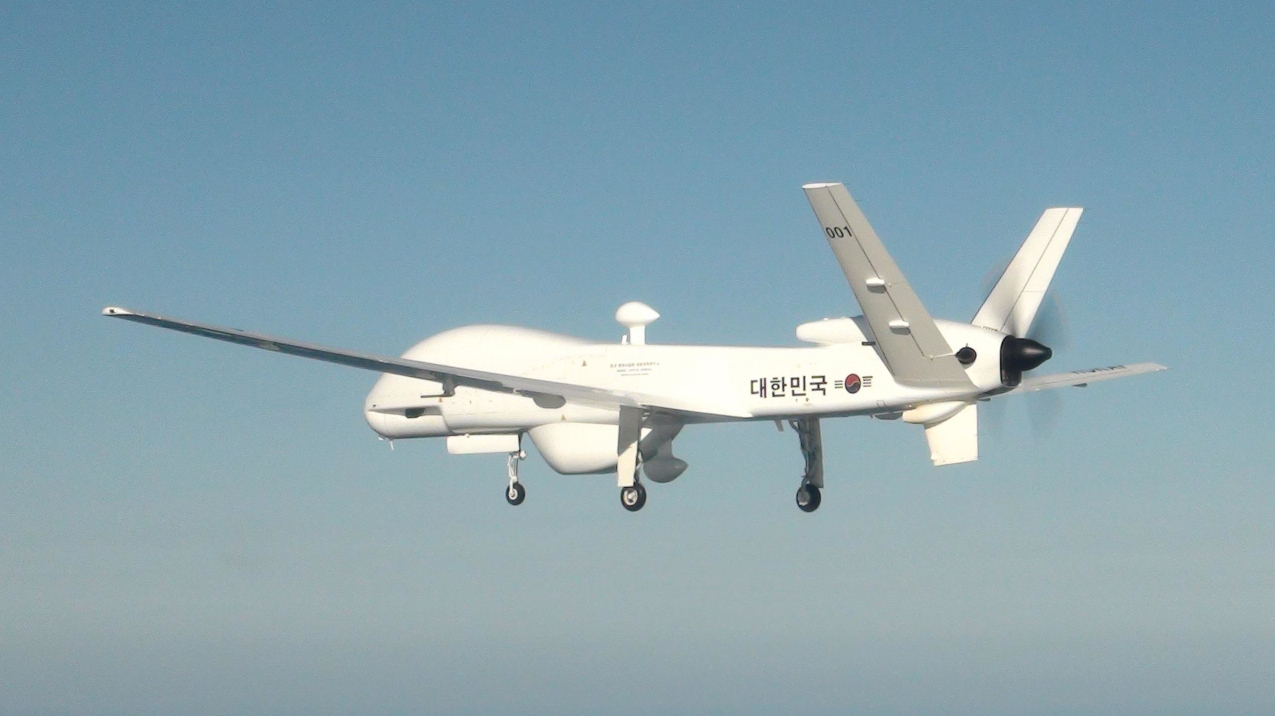
- South Korea has rolled out the first production KUS-FS medium-altitude unmanned aircraft at Korean Air’s Busan site.
- The system is built with nearly 90% domestic components and brings together Korean Air integration work with subsystems from LIG D&A and Hanwha Systems.
- The production challenge now moves to integration testing, flight qualification, and proving that local content can be translated into a dependable in-service ISR fleet.
South Korea has unveiled the first production example of its KUS-FS medium-altitude unmanned aircraft, giving the country one of its clearest recent demonstrations of sovereign aerospace system integration. The rollout took place in Busan under a programme led by the Defense Acquisition Program Administration, with Korean Air acting as system integrator and domestic defence suppliers contributing major mission and subsystem elements.
The aircraft is intended to strengthen long-endurance surveillance and reconnaissance coverage, particularly against high-value targets and command nodes, and South Korean officials say it incorporates nearly 90% domestically produced components. That figure is notable in its own right. Indigenous content claims can sometimes be little more than assembly language, but the KUS-FS programme appears to involve meaningful domestic contribution across sensors, avionics, data links, ground systems, and overall aircraft integration.
The production aircraft rolled out on 8 April is reported at 13 metres in length with a 26-metre wingspan and a 1,200-horsepower turboprop engine, giving the platform the size and endurance profile expected of a strategic-class ISR drone rather than a small tactical system. Final flight testing is still ahead before operational fielding from 2027, so the programme remains at the point where manufacturing success must be proven through verification, not presentation.
Integration is the real industrial achievement
The most useful way to read this programme is not simply as a new drone entering service, but as a systems-integration exercise for South Korea’s aerospace base. Medium-altitude ISR platforms rely on far more than airframe competence. They require stable data links, sensor fusion, mission computers, electro-optical and radar payload management, ground control architecture, and sufficient software maturity to operate as a coherent whole.
Korean Air’s role therefore matters as much as the aircraft itself. System integration is where sovereign programmes either establish real independence or reveal how much capability still depends on imported subsystems and external technical support. If the KUS-FS reaches service on schedule, South Korea will have done more than build a drone. It will have expanded the national industrial capacity to produce, integrate, and sustain a complex unmanned aircraft family.
Serial production brings a different set of pressures
Moving from development into production also changes the nature of the challenge. Suppliers have to deliver repeatable quality, not one-off prototypes. Airframe tolerances, engine installation, environmental qualification, payload integration, and software baselines all have to stay stable across multiple aircraft if the fleet is to remain supportable over time.
That is why the KUS-FS rollout matters to defence manufacturers beyond South Korea. It reflects how mid-sized powers are using unmanned aircraft programmes to grow domestic industrial depth, not merely to fill an operational gap. The platform’s service record will determine its military value, but its production maturity will say just as much about the strength of the country’s aerospace sector.