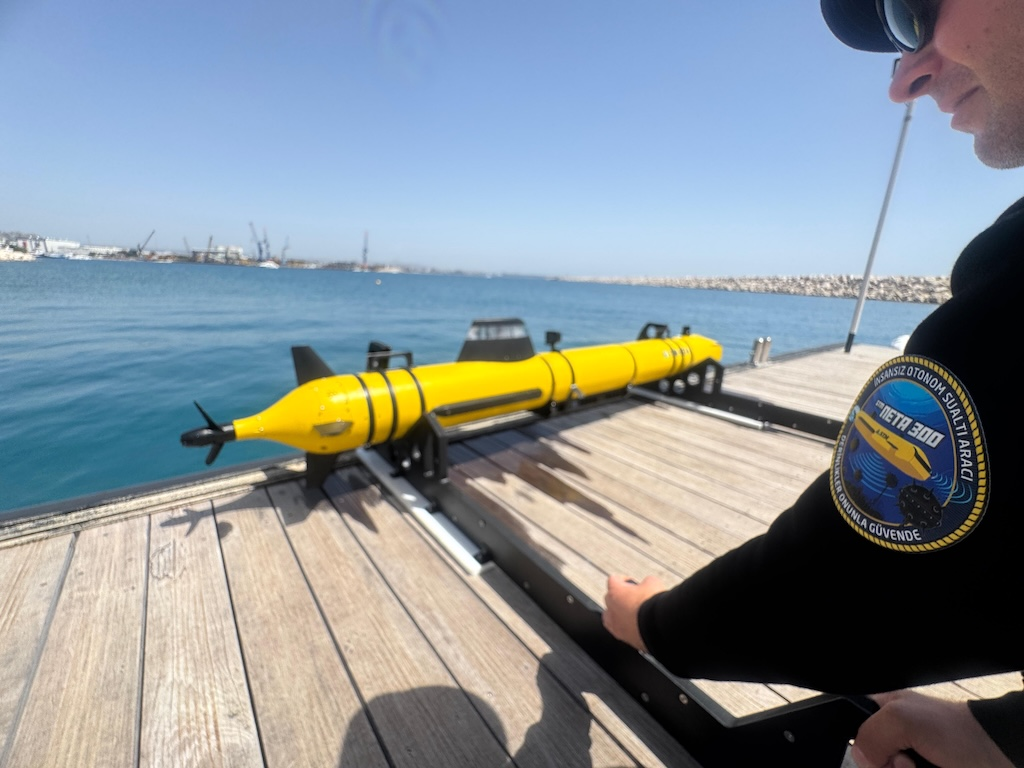
IN Brief:
- STM's NETA 300 autonomously surveyed and imaged a submerged tank near Kaş, Antalya.
- The vehicle offers operating depths up to 300 metres and endurance up to 24 hours, depending on battery configuration.
- Earlier mine countermeasure trials and an existing domestic contract support its development towards Turkish Navy service.
STM has demonstrated further autonomous underwater reconnaissance capabilities with its NETA 300 vehicle, completing a survey near Kaş, Antalya, during which the platform detected and captured images of a submerged tank.
The Turkish defence engineering company confirmed the activity on 11 November 2026. NETA 300 operated near Güvercin Island in the Mediterranean, using sonar and high-resolution imaging equipment to examine an underwater object deliberately placed in the area several years earlier.
The tank had previously served with the Turkish Armed Forces before being submerged in 2017 to create an artificial reef and support diving tourism. Its known presence provided an identifiable underwater target, although STM has not disclosed the survey conditions, detection distance, operating depth, or accuracy achieved during the mission.
The demonstration adds to the manufacturer’s earlier work developing NETA 300 for autonomous seabed reconnaissance, mine countermeasures, and maritime surveillance. In October, the vehicle participated in the TURNAs-2026 naval exercise, conducting underwater surveys along a transit route and detecting mines or mine-like objects.
STM also reported seabed inspection activity during that exercise, including tasks associated with maritime infrastructure security. The company has not released independently assessed detection statistics for either the October trials or the latest Antalya mission, so the demonstrations establish reported capabilities rather than quantified operational performance.
NETA 300 is the first member of STM’s autonomous underwater vehicle family. Developed using the company’s own engineering resources, the platform combines a compact hull, modular sensors, onboard navigation, and battery-powered propulsion for missions that can be conducted without continuous direct control from a surface vessel.
The vehicle is designed for operations at depths of up to 300 metres and speeds reaching five knots. Its published specifications identify an endurance of up to 24 hours, dependent on the selected battery arrangement and operating conditions.
STM offers a 2.1kWh lithium-ion battery configuration providing up to twelve hours of operation, alongside a 4.2kWh arrangement intended to extend endurance to 24 hours. The manufacturer lists vehicle weights of approximately 70kg and 85kg respectively, allowing the system to be transported by two personnel.
Mission endurance is influenced by the relationship between stored electrical energy and demand from propulsion, sensors, communications, and onboard processing equipment. The published maximum figures do not establish how long the vehicle can operate at full speed or with every optional payload activated simultaneously.
Underwater autonomy presents particular navigation difficulties because conventional satellite navigation signals cannot be relied upon while a vehicle remains submerged. A survey platform must estimate its position, follow a planned route, and collect sensor observations while managing uncertainty in its location.
Onboard navigation and control equipment enables the vehicle to undertake survey activities without requiring constant operator instructions. The level of autonomy available during a particular mission depends on the approved operating configuration, the programmed task, and the vehicle’s ability to respond to conditions encountered underwater.
For seabed reconnaissance, NETA 300 can carry side-scan sonar and gap-filling sonar. Side-scan equipment transmits acoustic energy towards the seabed and processes the returning signals to construct images of objects and terrain along the survey route.
Gap-filling sonar provides complementary coverage of areas that may be inadequately represented in the main side-scan imagery. Combining different acoustic observations can help survey operators examine features that would otherwise require additional vehicle passes or a different sensor arrangement.
STM also offers optional synthetic aperture sonar integration. This technique combines acoustic observations collected as a platform moves to improve image resolution along its direction of travel. Its performance depends on the selected equipment and the quality of the motion and navigation information used during processing.
Optical imaging adds another source of information once a vehicle is positioned sufficiently close to an underwater object. Cameras and lighting can provide visual detail that complements acoustic observations, although water clarity, illumination, and distance constrain the quality of the resulting images.
The Antalya mission brought those reconnaissance functions together around a known submerged structure. STM has not published the complete sequence of acoustic detection, classification, and optical inspection, making it inappropriate to attribute a particular measurement or automated recognition accuracy to the demonstration.
Mine countermeasure applications require reliable distinction between potential hazards and harmless seabed objects. Acoustic imagery can identify features requiring investigation, but an object’s appearance alone may not establish whether it contains explosive material or poses an operational threat.
NETA 300 is intended to support several stages of underwater reconnaissance and inspection, including searching suspected minefields and examining objects detected during a survey. The manufacturer has not claimed that the Antalya demonstration involved the neutralisation of a live mine.
STM’s wider maritime autonomy programme includes TENGİZ, an extra-large uncrewed underwater vehicle, and YAKTU, an uncrewed surface platform. These systems address different payload and mission requirements, with NETA 300 occupying the compact, portable end of the underwater vehicle range.
The company announced its first domestic sales contract for NETA 300 in May 2025 and identified the Turkish Navy as the intended operator. That agreement predates the November reconnaissance activity, and STM has not released the contract quantity, delivery schedule, or final naval acceptance status.
Development of the vehicle also provides a route into civilian seabed surveys, pipeline inspection, underwater infrastructure assessment, and marine research. These applications draw on similar navigation and sensing functions, although each requires equipment and procedures appropriate to its operating environment.
The latest mission supplies another reported demonstration of the vehicle’s ability to inspect underwater objects autonomously. Further qualification results, naval delivery milestones, and published performance data will establish how the NETA 300 programme progresses towards wider operational use.