IN Brief:
- The MCOTS-F-28-T-HE supports continuous input from -40Vdc to 40Vdc and high-energy transients up to 210Vdc.
- The half-brick filter can deliver up to 600W or 40A continuously and incorporates surge, spike, and reverse-polarity protection.
- SynQor positions the module for defence and aerospace systems designed around standards including MIL-STD-1275 and MIL-STD-704.
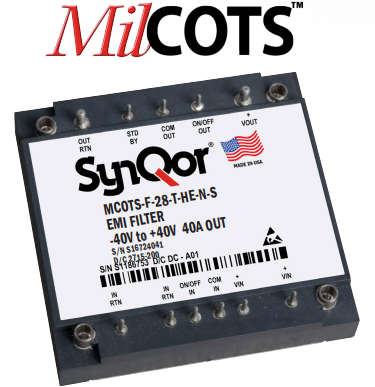
SynQor has expanded its Military COTS power-conversion family with the MCOTS-F-28-T-HE, a half-brick transient filter intended to protect 28V defence and aerospace electrical systems against high-energy surges, spikes, and reverse-polarity events.
The module supports continuous input from -40Vdc to 40Vdc and is designed to withstand transient conditions up to 210Vdc. SynQor rates it for continuous output of up to 600W or 40A, placing the filter between a platform power bus and downstream converters or mission electronics that would otherwise have to tolerate the disturbance directly.
Military 28V electrical architectures are widely used to distribute power to avionics, communications equipment, sensors, computers, electronic warfare systems, and other loads. Nominal voltage alone gives a misleading impression of the environment those devices encounter, because switching, generators, batteries, inductive loads, wiring, and external electrical events can drive the bus well outside its steady operating range.
Transient suppression therefore has to be designed as part of the power architecture rather than left to individual downstream loads. A short surge that exceeds the input rating of a DC-DC converter can damage the converter or cause it to shut down, while repeated disturbances can complicate the behaviour of several interconnected loads even where permanent damage does not occur.
The MCOTS-F-28-T-HE uses an input buck stage to limit its output to below 50Vdc when exposed to spikes and surges. Once started, SynQor says the module can continue delivering power at input voltages down to 5.8Vdc, giving downstream electronics additional tolerance during severe bus droop or brownout events.
Startup is another design condition. Large input capacitors and several converters energising simultaneously can create a substantial inrush current and pull down a weak source or trip upstream protection. SynQor limits the filter’s startup inrush to approximately 4A and quotes standby consumption of 12mA.
The module also includes pass-through ON/OFF control, allowing downstream converters to be switched while the filter remains part of the electrical architecture. That is relevant where mission equipment is sequenced by a platform power-management system but still has to maintain the designed electromagnetic-interference behaviour.
SynQor positions the filter for systems working towards several military and aerospace power and environmental standards, including MIL-STD-461, MIL-STD-1275 B/D, MIL-STD-704, MIL-STD-810G, DO-160E, and DEF-STAN 61-5.
The distinction between component capability and platform compliance is important. Fitting a compliant or characterised filter does not make an entire vehicle, aircraft, or mission system compliant automatically. Wiring, grounding, enclosure design, source impedance, downstream loads, cable routing, and the complete test configuration all affect the behaviour measured at system level.
An off-the-shelf filter can nevertheless reduce the amount of circuit development required before those tests begin. Designing a bespoke transient-protection stage means selecting switching devices and passive components, setting protection thresholds, controlling thermal behaviour, proving startup performance, characterising EMI, documenting the design, and reproducing the result consistently in production.
A Military COTS module moves much of that work into a characterised building block. The integrator remains responsible for selecting the correct device and validating the finished system, but it does not need to begin every programme by creating another protection circuit from individual components.
The HE variant is rated at 40A in SynQor’s current MCOTS filter range. The company’s technical brochure lists 2,250V isolation to common-mode pins, differential-mode attenuation above 80dB at 250kHz, and common-mode attenuation above 36dB at the same frequency.
Those figures matter because power quality and electromagnetic compatibility increasingly intersect on defence platforms. Radar, communications, electronic warfare, processors, electro-optical sensors, and electrically driven subsystems can place high dynamic loads on a shared electrical bus while remaining sensitive to conducted noise generated by other equipment.
As the number and power of onboard electronic systems increase, engineers have to manage more than total generating capacity. Load steps, startup sequencing, converter interactions, electromagnetic emissions, fault isolation, brownout behaviour, and surge protection all determine whether the available electrical power can be used reliably.
The MCOTS-F-28-T-HE was formally launched by SynQor on 2 June. Astute, an authorised SynQor distribution partner, subsequently highlighted the filter for defence and aerospace customers and provides a route for technical and commercial support around the product.
The distributor’s role is useful where engineers need to compare the filter against an existing 28V architecture, but the device should not be treated as a drop-in guarantee of standards compliance. Source characteristics, expected transient waveforms, load current, thermal environment, cooling, downstream capacitance, and system-level EMI requirements still need to be assessed against the actual platform.
The product is also a reminder that electrification does not end at generators and batteries. As military platforms add higher-power mission electronics, attention moves progressively into the conversion and protection layers that determine whether sensitive equipment receives stable, usable power.
SynQor’s new filter addresses one comparatively narrow part of that architecture, but it does so at a higher continuous power level within a compact half-brick format. Its practical value will be measured less by the component specification in isolation than by how much engineering and qualification effort it removes when incorporated into real ground, naval, and airborne 28V systems.