IN Brief:
- Two Tobyhanna-assembled brushless motors powered a Group 1 UAS for 8h 41m 43s.
- The aircraft was rapidly designed and fabricated using a mobile production facility and commercial 3D printers.
- Army Materiel Command is expanding domestic production and qualification of small-UAS motors, batteries, frames, and other components.
Tobyhanna Army Depot supplied the propulsion hardware for a battery-powered Group 1 uncrewed aircraft that remained aloft for eight hours, 41 minutes and 43 seconds during the US Army’s Game of Drones 26-2 event at Edwards Air Force Base.
Two brushless direct-current motors assembled at the Pennsylvania depot powered the aircraft for approximately 300 miles before it landed safely. Army Materiel Command says the result exceeded the previous endurance benchmark it was using by 50 minutes, with the performance data subsequently submitted to Guinness World Records for verification.
The distinction between a claimed record and formal verification is worth retaining. The more important defence-industrial point is that the flight provided the first major outdoor operational test of Tobyhanna-assembled motors on an active aircraft only weeks after the depot opened its new brushless-motor assembly capability.
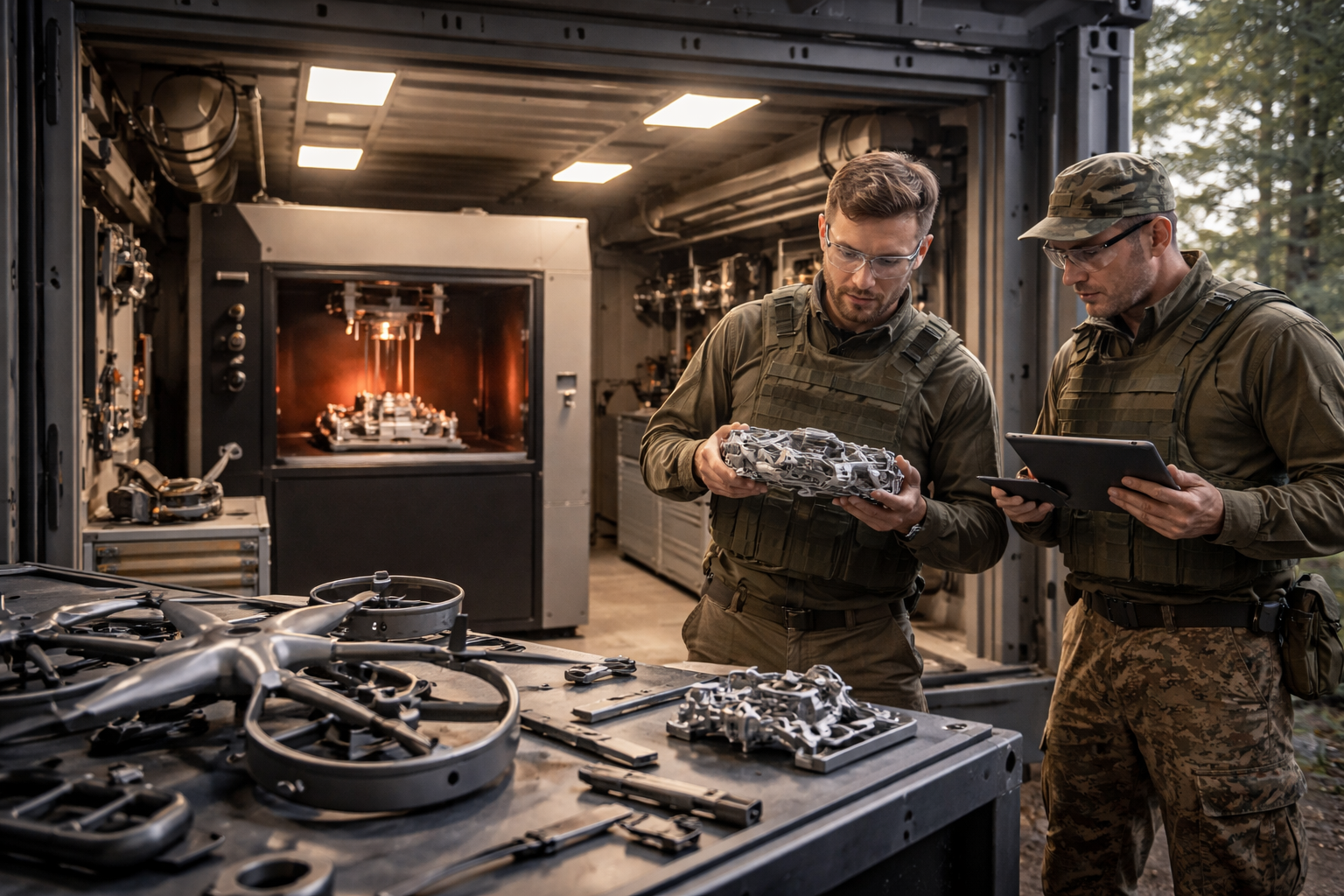
The aircraft itself was produced on an equally compressed timetable. Army Materiel Command says the design was generated in less than ten minutes using computer prompts and adaptability software, after which the airframe was fabricated in a mobile containerised production facility using commercial 3D printers.
A three-person team assembled the aircraft on site, combining the printed structure with the Tobyhanna motors and a battery supplied by an industry partner. The complete vehicle was produced within 24 hours of take-off, turning the endurance flight into a test of distributed manufacturing and component availability as well as aerodynamic efficiency.
That matters because small-UAS production has become a supply-chain problem rather than merely a design problem. Airframes can be comparatively inexpensive and quick to fabricate, but production still depends on motors, batteries, electronic assemblies, propellers, flight-control hardware, communications components, and materials that have to be available at the required scale and quality.
The Army is therefore using its Organic Industrial Base to establish domestic sources for several of those components. Tobyhanna is concentrating on brushless motors, Rock Island Arsenal-Joint Manufacturing and Technology Center is developing frame-production capability, and Red River Army Depot is working on batteries.
Army Materiel Command is also testing multiple motor form factors and lithium-ion battery configurations across different aircraft at Redstone Test Center. That work is necessary because a motor performing efficiently on one lightweight endurance aircraft may not provide the same result once propeller size, battery chemistry, payload, flight speed, or airframe drag changes.
The Edwards result illustrates those interactions. Endurance depends on the complete propulsion chain rather than motor efficiency alone: battery discharge, motor control, propeller matching, aerodynamic drag, aircraft mass, flight profile, thermal conditions, and onboard electrical demand all affect the time an aircraft can remain airborne.
For that reason, an eight-hour flight is useful evidence of system performance but not a universal qualification result for the motor. Military users will still need data on reliability, vibration, environmental limits, repeated operation, manufacturing consistency, maintainability, and compatibility with different UAS configurations.
Production repeatability becomes the larger issue if demand rises. A demonstration team can select and inspect a small number of components closely, whereas sustained manufacture requires controlled windings, magnets, bearings, housings, electronic interfaces, materials, traceability, and end-of-line testing across much larger batches.
The Army is linking that manufacturing work to the Defense Contract Management Agency’s Blue List, an aggregated reference for compliant, cybersecure, US-manufactured UAS platforms and components. The objective is to make qualified domestic equipment easier for defence users to identify and procure without repeating basic supply-chain assurance work for every purchase.
That approach gives government depots a role alongside private industry rather than necessarily replacing it. Organic production can provide qualified domestic components, support rapid experimentation, and give the Army an internal manufacturing option, while commercial suppliers remain critical for technology development, materials, batteries, electronics, and volume production.
The rapid-manufacturing element creates its own discipline problem. If an airframe can be redesigned and printed within hours, engineering teams still need to record exactly which structural design, motor, battery, propeller, software baseline, and manufacturing settings produced the tested result. Speed becomes considerably less useful if a successful configuration cannot be reproduced.
Army Materiel Command says organically assembled small UAS have already been sent to Army units for training, while additional component configurations are undergoing testing. That begins to move the effort beyond one endurance demonstration and towards a broader qualification and feedback cycle.
The Edwards flight has therefore given Tobyhanna’s new motor capability a practical proof point without settling the scale question. The next indicators will be repeatable motor output, Blue List qualification, performance across several airframes, unit feedback, and whether the Organic Industrial Base can turn rapid component manufacture into dependable supply rather than another impressive prototype exercise.