IN Brief:
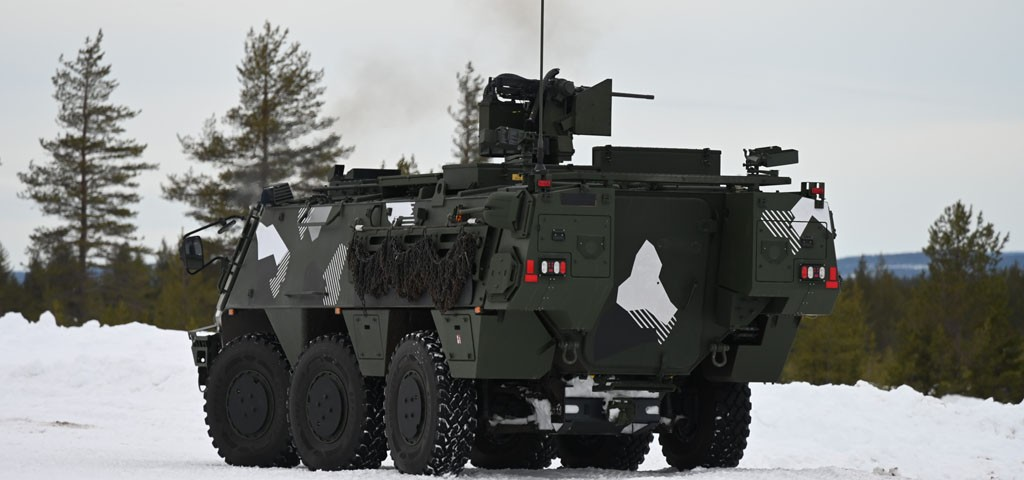
- MKE’s Tolga short-range air-defence system has been integrated on HT Division’s Katica 6×6 UGV.
- The configuration combines mobile counter-UAS firepower with unmanned ground mobility.
- The product reflects rising demand for affordable, distributed, and supportable drone-defeat layers.
MKE has integrated its Tolga short-range air-defence system onto HT Division’s Katica 6×6 unmanned ground vehicle, creating a Turkish-Hungarian counter-UAS configuration aimed at mobile protection for dispersed land forces.
The Eurosatory display places a gun-based air-defence payload onto a robotic carrier rather than a fixed site or crewed vehicle. The configuration uses MKE’s Tolga weapon element on the Hungarian Katica unmanned platform, with targeting supported by sensor cueing and onboard optics. The broader Tolga architecture has been developed around layered counter-UAS work, combining detection, tracking, electronic attack, and hard-kill defeat options.
Integrating an air-defence payload onto a UGV turns mobility into a systems-engineering problem. The platform is not a passive trolley. Power management, recoil, stabilisation, remote operation, data latency, cyber protection, safety interlocks, ammunition handling, thermal management, and sensor alignment all have to operate as one fielded product. Each layer must survive vibration, movement, weather, electronic interference, and operator handover.
Small drones have forced land forces to search for cheaper and more numerous air-defence layers. Missile interceptors remain essential against larger and faster threats, but using them against low-cost UAVs, quadcopters, FPV drones, and loitering munitions strains budgets and magazine depth. Gun-based and hybrid counter-UAS systems therefore occupy a production-sensitive part of the market. They need to be affordable, maintainable, upgradable, and available in quantity.
Mounting that capability on an unmanned ground vehicle changes the risk and support balance. The platform can be pushed closer to exposed areas, positioned around high-risk sites, or used to extend coverage around manoeuvre units without placing a crew inside the vehicle. The same advantage creates recovery and maintenance demands. A robotic air-defence platform that fails in a contested area can become a logistics problem and a source of sensitive technology exposure.
Mobile counter-UAS systems are already moving into mixed manned and unmanned architectures. Vehicle-mounted air-defence configurations and robotic ground systems for eastern-flank defence show how drone protection is moving from base defence into manoeuvre units, logistics areas, and dispersed force protection.
The Tolga-Katica configuration will need to prove repeatable integration rather than a one-off exhibition fit. Safe firing envelopes, mobility under payload weight, operator workload, electromagnetic compatibility, maintenance access, and remote-control resilience all become decisive. Where the system connects to external sensors or command networks, communications security and interoperability add further qualification work.
Joint production and export potential give the programme another dimension. Turkish defence manufacturers have become increasingly active in air defence, UAVs, weapons stations, and electronic systems, while European buyers are seeking faster routes to counter-UAS capability. A Turkish-Hungarian product could appeal to customers looking for European-facing support and a mobile, modular system that can be adapted to national sensor and command architectures.
The configuration points toward a broader shift in land air defence. Future counter-UAS layers are likely to mix guns, rockets, electronic attack, passive detection, and unmanned carriers. The winners will be the systems that can be built, repaired, upgraded, and networked without becoming too expensive for the threats they are designed to defeat.