IN Brief:
- BAE Systems has completed a Typhoon firing of the APKWS 70 mm guided rocket in a UK trial.
- The activity is intended to inform a lower-cost precision weapon option for counter-UAS work.
- Moving from a successful shot to fielded capability will depend on integration, software, launcher, and certification work.
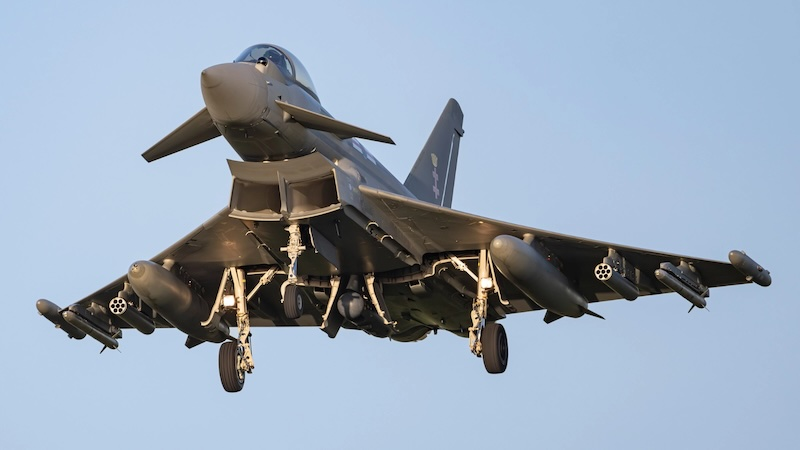
BAE Systems has completed a Typhoon firing trial of the APKWS precision-guided rocket, giving the platform a lower-cost option for engaging uncrewed threats and adding another strand to the UK’s current combat-air enhancement work. The trial took place in March from BAE Systems’ flight-test development centre at Warton, using a Royal Air Force Typhoon test and evaluation aircraft to strike a ground target at a UK military range.
The shot marks more than a one-off weapons demonstration. BAE has framed the work as a step toward integrating a low-cost precision weapon on Typhoon for counter-UAS use, with further trials expected to expand the target set beyond the initial ground-based firing. For an air force that has increasingly had to contend with one-way attack drones and cheaper aerial threats, the attraction is straightforward: a fighter does not always need to spend premium missiles on low-cost targets.
That shift in cost logic is now feeding directly into platform engineering. Typhoon has been on a wider upgrade path across radar, mission systems, and weapons, and the APKWS work fits into that broader pattern. The appeal is not simply cheaper rounds. It is a different way of building magazine depth and giving operators a layered engagement mix, especially when combat-air platforms are being asked to stay relevant across a wider spread of threat types.
Integration work after the first shot
A successful firing is only the start of the engineering effort. Turning APKWS into a usable Typhoon capability means expanding the release envelope, validating carriage and separation with the launcher fitted, updating software and stores-management behaviour, and proving the weapon in more operationally realistic profiles. Test data now becomes the hard currency of the programme. Without that, there is no route to formal qualification, no dependable training package, and no stable support case for fleet use.
Production and support pressures
If the concept progresses, the industrial burden will spread well beyond a rocket pod. Weapon integration draws in airframe engineers, mission-system teams, flight-test specialists, certification authorities, launcher suppliers, sustainment planners, and the deeper munitions chain behind the rocket and guidance kit. For Typhoon users, a low-cost interceptor only works if it can be bought in useful volume, supported without friction, and folded into existing maintenance and training rhythms without creating a parallel burden that cancels out the price advantage.