IN Brief:
- Britain will contribute £100 million through NATO’s PURL mechanism for Patriot missiles and other air-defence equipment.
- The equipment is intended for delivery before winter alongside continuing UK drone and artillery-ammunition commitments.
- Repeated air-defence orders are increasing demand across interceptor propulsion, guidance, electronics, energetic materials, and final assembly.
The UK Ministry of Defence has committed another £100 million through NATO’s Prioritised Ukraine Requirements List to fund Patriot missiles and other air-defence equipment for Ukraine, with the equipment intended for delivery before winter.
The contribution was announced at the 36th Ukraine Defence Contact Group and adds another procurement tranche to Britain’s 2026 military-support programme. The government has not disclosed the number or type of Patriot interceptors involved, nor how the £100 million will be divided between missiles and other air-defence equipment.
That distinction matters because Patriot is a system family rather than a single missile. Different interceptor variants draw on different production lines and suppliers, while the wider system also depends on launchers, radar, command equipment, communications and sustainment support. Without quantities or variants, the direct production effect of today’s package cannot yet be calculated.
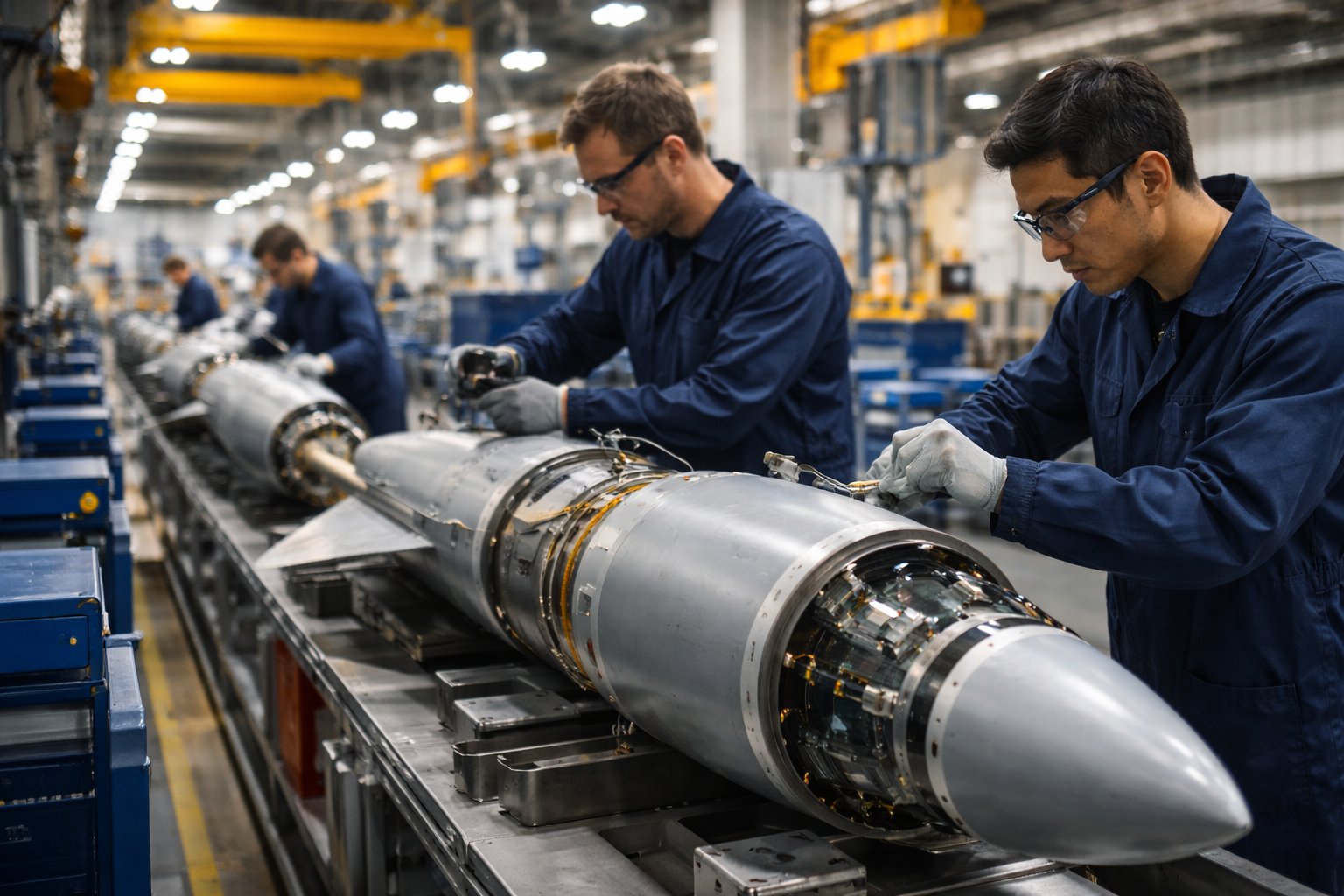
The new contribution nevertheless adds confirmed demand to an interceptor supply chain that is already being expanded to support the United States and allied operators. Air-defence missile production depends on propulsion, guidance electronics, seekers, control hardware, energetic materials, structures, specialist test equipment and final assembly increasing together.
A bottleneck in any one of those areas can constrain the number of complete missiles available. Rocket motors and energetic materials are particularly difficult to expand quickly because new production buildings require specialist safety infrastructure, environmental controls, trained workers and qualification before output can be accepted for operational weapons.
Ukraine has also said that monthly US Patriot interceptor deliveries have been agreed, adding a more regular replenishment requirement alongside individual allied funding packages. Public details of that arrangement have not identified monthly quantities or interceptor variants.
Britain’s latest commitment is therefore part of a wider procurement pattern rather than an isolated donation. In February, the UK committed £150 million to PURL as part of an air-defence package worth more than £500 million, while a further £100 million in air-defence support was announced in March.
The February package also included more than 1,000 Lightweight Multirole Missiles manufactured in Belfast. That provided a direct UK production component alongside the PURL funding, illustrating how support packages can combine equipment drawn from multinational procurement channels with weapons ordered from domestic manufacturing lines.
Today’s package sits beside continuing commitments in drones and artillery. The MOD says Britain intends to provide more than 120,000 drones to Ukraine during 2026, with 25,000 delivered so far. The mix includes interceptor, reconnaissance and attack systems.
The scale of that drone requirement creates a different production problem from Patriot. Smaller uncrewed systems use commercial and defence electronics, communications equipment, sensors, motors, batteries, airframes and payloads that can often be manufactured in larger quantities and on shorter cycles than high-end missile interceptors.
Using several equipment tiers also reflects the economics of air defence. A Patriot-class interceptor is designed for targets that justify its performance and cost; using high-end missiles against every small uncrewed aircraft would consume finite stocks quickly. Interceptor drones, guns, electronic warfare and shorter-range missiles can deal with other parts of the threat set while preserving higher-tier weapons.
Artillery demand adds another manufacturing stream. Britain says it has now delivered its millionth round of large-calibre artillery ammunition to Ukraine and will provide tens of thousands of additional long-range rounds in the coming months with funding from the UK and European partners.
Ammunition production places pressure on explosives, propellant, metal bodies, fuzes and filling capacity, several of which overlap with the supply base required for missile production. Expansion plans therefore compete for some of the same skilled labour, energetic-material facilities and specialist inputs even when the finished weapons are substantially different.
The UK is also backing more production inside Ukraine. The government recently agreed that MBDA could release classified information concerning UK components in SCALP, also known as Storm Shadow, to support local assembly lines. That represents a different industrial model from supplying complete weapons from existing Western stock or production.
Local assembly can shorten parts of the logistics chain and increase Ukrainian production capacity, but it still depends on controlled components, manufacturing documentation, quality assurance and secure supply from partner countries. Moving final assembly does not remove the need to sustain the upstream industrial base.
Repeated orders provide manufacturers with a stronger reason to invest than isolated emergency packages. Buildings, tooling, long-lead materials and trained production staff take time to establish, so suppliers need confidence that demand will persist long enough to recover those investments.
The £100 million commitment adds another signal of that continuing demand. Its immediate output cannot be measured until quantities and interceptor variants are known, but the procurement requirement is concrete: additional Patriot missiles and air-defence equipment are expected before winter, while drone and ammunition deliveries continue in parallel.
For the industrial base, the central problem remains throughput. Governments can allocate funding faster than missile motors, seekers or energetic materials can be qualified and produced, leaving sustained production capacity — rather than another headline funding figure — as the limiting factor in replenishing air-defence inventories.