IN Brief:
- The U.S. Air Force has awarded CCA Increment 1 air vehicle contracts to General Atomics and Anduril.
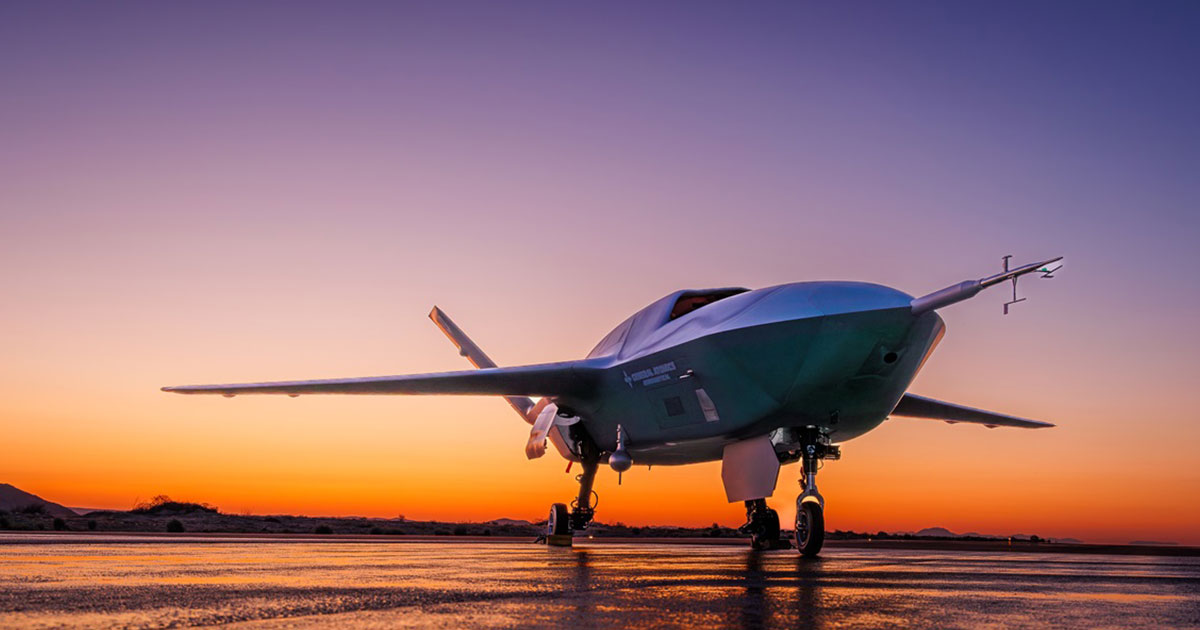
- General Atomics’ FQ-42 and Anduril’s FQ-44 are moving through the first production phase.
- The programme separates air vehicle production from mission-autonomy software, creating a more modular industrial model.
The U.S. Air Force has awarded Collaborative Combat Aircraft Increment 1 contracts to General Atomics and Anduril, moving the FQ-42 and FQ-44 closer to production while building mission autonomy through a separate software framework.
The air vehicle awards cover General Atomics’ FQ-42 and Anduril’s FQ-44. The programme is intended to deliver more than 150 combat-capable collaborative aircraft by the end of the decade, with the first increment forming the industrial and operational base for autonomous fighter-teaming concepts.
Mission autonomy is being handled through a separate vendor structure. A pool covering Anduril, General Atomics, Lockheed Martin, Northrop Grumman, RTX Collins Aerospace, and Shield AI sits alongside production options awarded to Anduril, RTX Collins Aerospace, and Shield AI for the first phase. The Air Force is using a government-owned Autonomy Government Reference Architecture to help decouple software from hardware.
That separation is one of the programme’s most important industrial choices. Traditional aircraft development often binds platform, avionics, mission systems, and software tightly together. CCA requires a more modular approach because autonomy, sensors, datalinks, electronic warfare, payloads, and tactics will evolve faster than airframes. If the software layer is locked to one aircraft provider, the fleet risks ageing before it reaches scale.
General Atomics has described the FQ-42A as moving through manufacturing after a rapid development cycle that took the aircraft to first flight in 2025. Anduril’s FQ-44 occupies the other major Increment 1 air vehicle route. Both aircraft reflect a shift in airpower production: uncrewed combat aircraft built to complement crewed fighters, absorb risk, carry payloads, and operate as part of a wider sensor and weapons network.
Autonomous combat aviation is also moving into international industrial workshare debates. Poland’s interest in X-BAT has already shown how allied customers are looking at autonomous combat aircraft as both capability and production opportunity: Poland courts X-BAT as autonomous combat air moves into industrial workshare. The US CCA awards put the same issue on a larger scale, moving the category from demonstrator language into supplier capacity, software governance, and fleet planning.
The manufacturing task remains demanding because “affordable mass” still needs aviation-grade discipline. Airframes may be cheaper than crewed fighters, but they require controlled composite or metal structures, propulsion integration, flight-control systems, secure avionics, thermal management, environmental testing, software assurance, and maintainability. If hundreds of aircraft are required, suppliers must build repeatability into a programme that remains technically fluid.
Autonomy creates its own acceptance problem. A combat aircraft can be inspected physically, but autonomy behaviour has to be validated through simulation, flight test, mission scenarios, safety cases, data pipelines, and software configuration control. Updating autonomy across a fleet becomes a sustainment task as much as a development task. The industrial base will need tools for testing and approving software at a tempo closer to digital systems than traditional aircraft block upgrades.
The decoupled software approach may also preserve competition. If mission autonomy can be upgraded independently of the aircraft, the Air Force can avoid locking the entire fleet to a single supplier’s software roadmap. That could improve innovation, but it demands strict interface standards, disciplined cybersecurity, clear data rights, and enough integration testing to prevent modularity from becoming fragmentation.
Supply chains will face pressure from the blend of aerospace and electronics demand. CCAs need engines, actuators, flight computers, radios, sensors, payload bays, antennas, wiring, secure processors, and ground-control infrastructure. Many of those components are already in demand across missiles, drones, satellites, and crewed aircraft. Production planners will have to manage a market where autonomy programmes compete with other urgent defence needs for the same electronics and skilled labour.
The programme also changes the economics of combat air. Crewed fighters are produced in limited numbers because cost, pilot training, survivability, and sustainment loads are high. CCAs are intended to shift some risk and capacity into uncrewed systems, but affordability depends on design restraint. If requirements creep upward, the aircraft could become too expensive to buy in useful numbers.
The CCA awards show the Air Force attempting to avoid that trap by splitting hardware, autonomy, and architecture. The result could become one of the most influential defence production models of the decade: aircraft built at higher volume than crewed fighters, upgraded through modular software, and integrated into a combat-air system where the platform is only one part of the capability.