IN Brief:
- The US Navy has selected Sea Machines, Leidos, Saronic, Galliano Marine Services, PacMar Technologies, Birdon, and HII for MUSV demonstrations.
- Successful companies will receive $15m and become eligible for follow-on production.
- The marketplace approach opens naval production to non-traditional shipyards, commercial autonomy suppliers, and modular manufacturing models.
The US Navy has selected seven companies to advance to at-sea testing under its Medium Unmanned Surface Vessel marketplace, creating a rapid evaluation phase for autonomous naval craft.
Sea Machines, Leidos, Saronic Technologies, Galliano Marine Services, PacMar Technologies, Birdon, and Huntington Ingalls Industries have been selected for the MUSV Family of Systems development effort. At-sea testing is due to begin in June and conclude by October 2026. Companies whose vessels complete the tests successfully will receive $15m and become eligible for follow-on production.
The marketplace model changes the usual rhythm of naval procurement. Instead of funding bespoke prototypes from the outset, the Navy is drawing on mature or near-mature industry-developed designs. That places more early development risk on companies, but it could shorten the path from test activity to leasing or procurement if vessels meet operational and integration standards.
Medium unmanned vessels are not simply small ships without crews. They need hull, mechanical, and electrical systems capable of operating for extended periods without onboard maintainers, while carrying modular payloads and navigating under autonomous or remotely supervised control. Endurance, sea-state performance, containerised payload carriage, and operational availability by FY2027 all pull shipbuilding, robotics, software, sensing, communications, and payload integration into one production problem.
The containerised payload element deserves close attention. The Navy is moving towards vessels that can be reconfigured through mission packages, rather than ships permanently built around one role. That can reduce dependence on fixed classes, but only when power, cooling, deck strength, data links, safety systems, physical interfaces, and command architecture are standardised. Carrying a container is relatively straightforward. Powering, controlling, securing, and maintaining a complex mission package at sea is much harder.
The Royal Navy’s Ariadne mine-hunter trial showed how allied navies are using autonomous platforms to add capability without increasing crew demand. The US MUSV programme works at a different scale, but the industrial logic is similar: naval forces want persistence, payload flexibility, and lower-cost mass without recreating the cost structure of traditional crewed ships.
The supplier list also shows how broad the unmanned maritime market has become. It includes major defence companies, naval technology specialists, commercial autonomy providers, and shipbuilders outside the traditional combatant-ship pipeline. That diversity could help expand production capacity at a time when large US shipyards are already heavily loaded with submarines, destroyers, aircraft carriers, frigates, and auxiliary programmes.
Qualification remains the difficult step. A commercial or industry-funded prototype can demonstrate autonomy and range, while still falling short of naval requirements for corrosion resistance, shock, vibration, electromagnetic compatibility, cyber protection, maintainability, documentation, and logistics support. Uncrewed vessels still need fleet-level dependability, even if they do not carry sailors.
Autonomy will shape the manufacturing model as much as the vessel design. An MUSV operating across long distances must handle route planning, collision avoidance, degraded communications, sensor fusion, mission replanning, safe recovery, and cyber defence. Software becomes part of the ship’s production baseline. Hull construction, autonomy development, payload integration, and digital support tools need to mature in parallel.
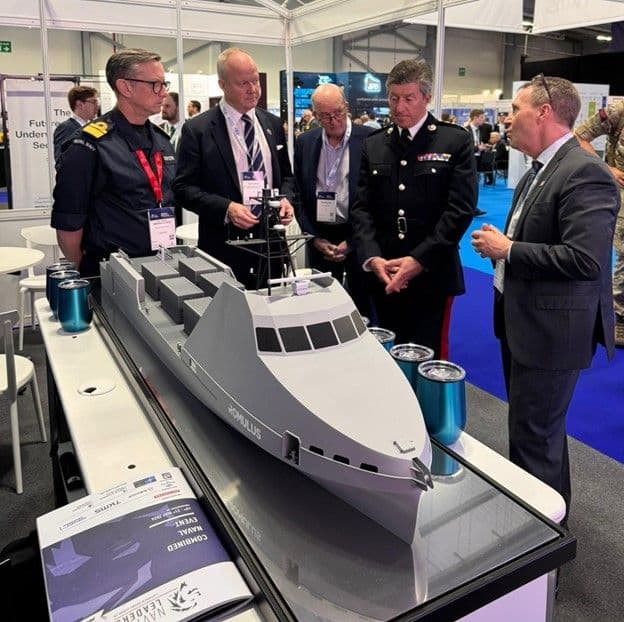
HII’s ROMULUS work shows where part of the sector is heading. The company has been developing an assembly model using automation, digital quality systems, and standardised workflows to move unmanned surface vessels from prototype construction towards repeatable production. If the MUSV marketplace succeeds, similar manufacturing ideas may spread across other autonomous maritime programmes.
The Navy’s objective is to add operational persistence and create dilemmas for adversaries at lower cost. That ambition will only be met if production can move beyond small batches of demonstrators. Useful numbers require stable hull builds, modular mission systems, maintainable autonomy, training packages, spares, support contracts, and data infrastructure. Without those, autonomy remains a set of trials rather than fleet capacity.
The next stage will test both the vessels and the acquisition model. At-sea performance will decide which companies remain in contention, but the longer-term measure will be whether the Navy can turn industry-funded innovation into equipment that can be bought, supported, upgraded, and deployed in quantity. Autonomous shipbuilding is now being asked to prove that it can scale.