IN Brief:
- The US Navy has selected L3Harris to deliver VAMPIRE systems for littoral counter-uncrewed defence.
- VAMPIRE combines electro-optical targeting, mission-management software and laser-guided effectors in a modular architecture.
- Engineering work will adapt and ruggedise the system for maritime environmental stresses, with deployment platforms still undisclosed.
The US Navy has selected L3Harris Technologies to deliver VAMPIRE counter-uncrewed systems for littoral defence, extending the modular sensor-and-effector architecture into a maritime operating environment.
L3Harris has not disclosed contract value, system quantity or delivery timing. It has confirmed that engineering work will adapt the equipment to Navy requirements and ruggedise VAMPIRE against environmental stresses associated with maritime operations.
That work is more consequential than simply repainting an existing land system. Salt spray, humidity, corrosion, vibration, shock, water ingress and electromagnetic conditions can affect launch equipment, electro-optical sensors, electronics, connectors and structural mounts, particularly when equipment originally designed around vehicle deployment is moved into a littoral role.
The company has also not said where the Navy intends to install the systems. Its announcement refers to littoral counter-uncrewed defence, so the award should not be described as a shipboard installation until the Navy or L3Harris identifies the host platform.
VAMPIRE — Vehicle-Agnostic Modular Palletized ISR Rocket Equipment — is designed as a self-contained, modular weapons package rather than a purpose-built combat vehicle. Existing configurations combine a targeting sensor, mission software, launcher, power and supporting hardware in a package that can be transferred between suitable platforms.
The system’s WESCAM MX-10D RSTA electro-optical and infrared sensor provides surveillance, tracking and laser designation. Mounted on a telescopic mast, it gives the operator an elevated line of sight while keeping the main system package below it.
Mission management is handled through L3Harris’ Widow software, which is Forward Area Air Defense Command and Control compliant and uses modular interfaces for sensors, effectors, radios, navigation and mapping. That software architecture becomes increasingly important as VAMPIRE moves into a Navy network rather than operating as a stand-alone weapon station.
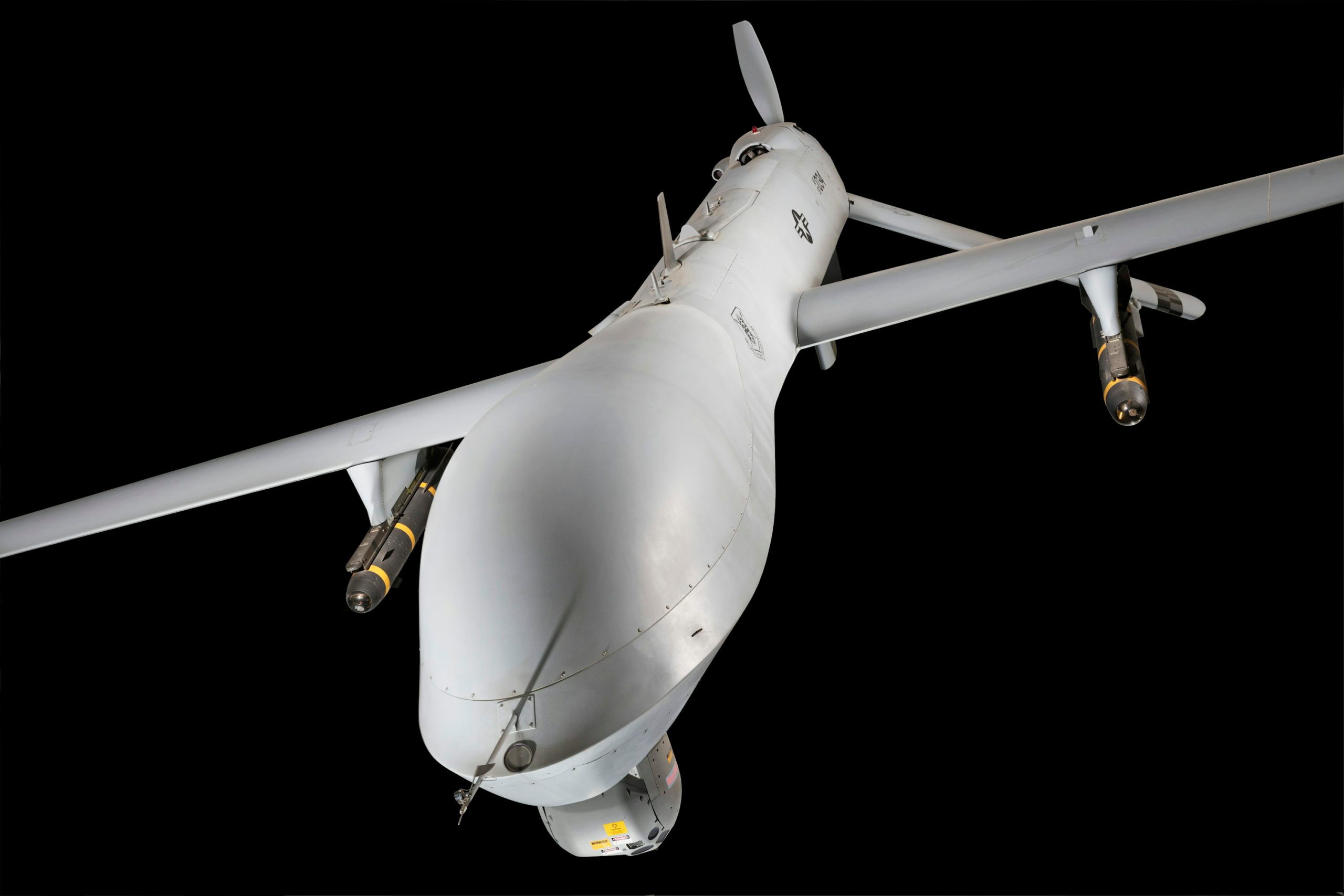
The system can fire Advanced Precision Kill Weapon System rockets or other laser-guided munitions. Its basic logic is to pair relatively compact precision effectors with a targeting and command architecture suited to smaller uncrewed threats, preserving more expensive air-defence weapons for targets that require their range or performance.
VAMPIRE’s modular electronics architecture has already placed sensors, software, communications and effectors inside the same counter-UAS discussion. The Navy award adds another integration problem: making those elements function reliably in a littoral environment and within a different service command structure.
Maritime qualification will involve more than environmental sealing. Connectors, cabling, electronics enclosures and sensor windows have to tolerate corrosive conditions, while mounts and mechanical assemblies may face repeated shock and vibration. Materials and coatings suitable for dry land use are not automatically appropriate near salt water.
Electromagnetic compatibility also becomes important when a counter-UAS system operates close to naval communications, radar, electronic warfare and other emitters. A new sensor-and-weapon package has to function in that environment without interfering with existing systems or becoming excessively vulnerable to their emissions.
If VAMPIRE is eventually installed aboard a vessel, further engineering would be required around deck loads, power, firing arcs, weapon safety, magazine arrangements and interfaces with ship combat systems. A shore-based littoral configuration would avoid some of those constraints but introduce its own requirements for mobility, expeditionary power and rapid deployment.
The current announcement does not resolve that choice. Keeping the deployment description deliberately broad is therefore more accurate than assuming that a Navy customer necessarily means a warship installation.
L3Harris is also delivering VAMPIRE to the US Army, giving the company a route to higher production volume across more than one service. Common hardware can improve manufacturing efficiency and simplify spares, but only if Navy-specific ruggedisation does not create an extensively divergent configuration.
Configuration discipline is particularly important for modular systems. The commercial attraction of a common platform is weakened if every customer requires unique sensors, launchers, software baselines and support equipment that have to be manufactured and sustained separately.
The Navy selection sits within a broader layered counter-UAS approach. L3Harris also offers Drone Guardian for multi-sensor detection and tracking, while Wraith Shield uses tactical radios as radio-frequency sensing and electronic-attack nodes. Different effectors can then be applied according to target type, range and cost.
That layered structure reflects the variety of uncrewed threats. A small commercial-derived aircraft may be vulnerable to electronic attack, while another system may require a kinetic intercept. Using the same high-cost weapon against every target would consume finite magazines and create an unfavourable cost exchange.
For VAMPIRE, the Navy contract is therefore as much an integration programme as an equipment sale. The system has an established architecture, but the customer needs it to survive a maritime environment, connect into wider command-and-control arrangements and fit whatever littoral platform is eventually selected.
Quantity and contract value remain undisclosed, so the manufacturing scale cannot yet be assessed. The more useful milestones will be completion of maritime qualification, disclosure of the Navy configuration and confirmation of its host platform.
Those details will show how far VAMPIRE can preserve its vehicle-agnostic architecture when moved between services. The engineering advantage of modularity is not that every installation is identical, but that enough hardware and software remain common for a new environment to require adaptation rather than a fresh weapons programme.