IN Brief:
- NSPA has awarded Diehl Defence a contract for Vulcano 155mm guided ammunition.
- Initial deliveries are scheduled for 2027 through NATO’s Ammunition Support Partnership.
- Scaling production will depend on guidance electronics, sensors, energetic materials, precision manufacturing, and multinational configuration control.
NATO’s procurement agency has awarded Diehl Defence a contract for Vulcano 155mm guided ammunition, bringing one of Europe’s principal precision-artillery rounds into a multinational purchasing mechanism.
Placed through the NATO Ammunition Support Partnership, the order is expected to produce initial deliveries in 2027. Participating countries can consolidate requirements through the partnership rather than negotiating every purchase independently, giving manufacturers a clearer view of aggregated demand.
Developed by Diehl Defence and Leonardo, with Leonardo holding design authority, the guided long-range Vulcano configuration combines aerodynamic range extension with inertial and satellite navigation. Terminal sensor options can support engagements against designated or moving targets.
Depending on configuration and operating conditions, the projectile can reach up to 70km when fired from a 52-calibre 155mm system. A programmable fuze and insensitive high-explosive warhead containing preformed tungsten fragments complete a package substantially more complex than a conventional artillery shell.
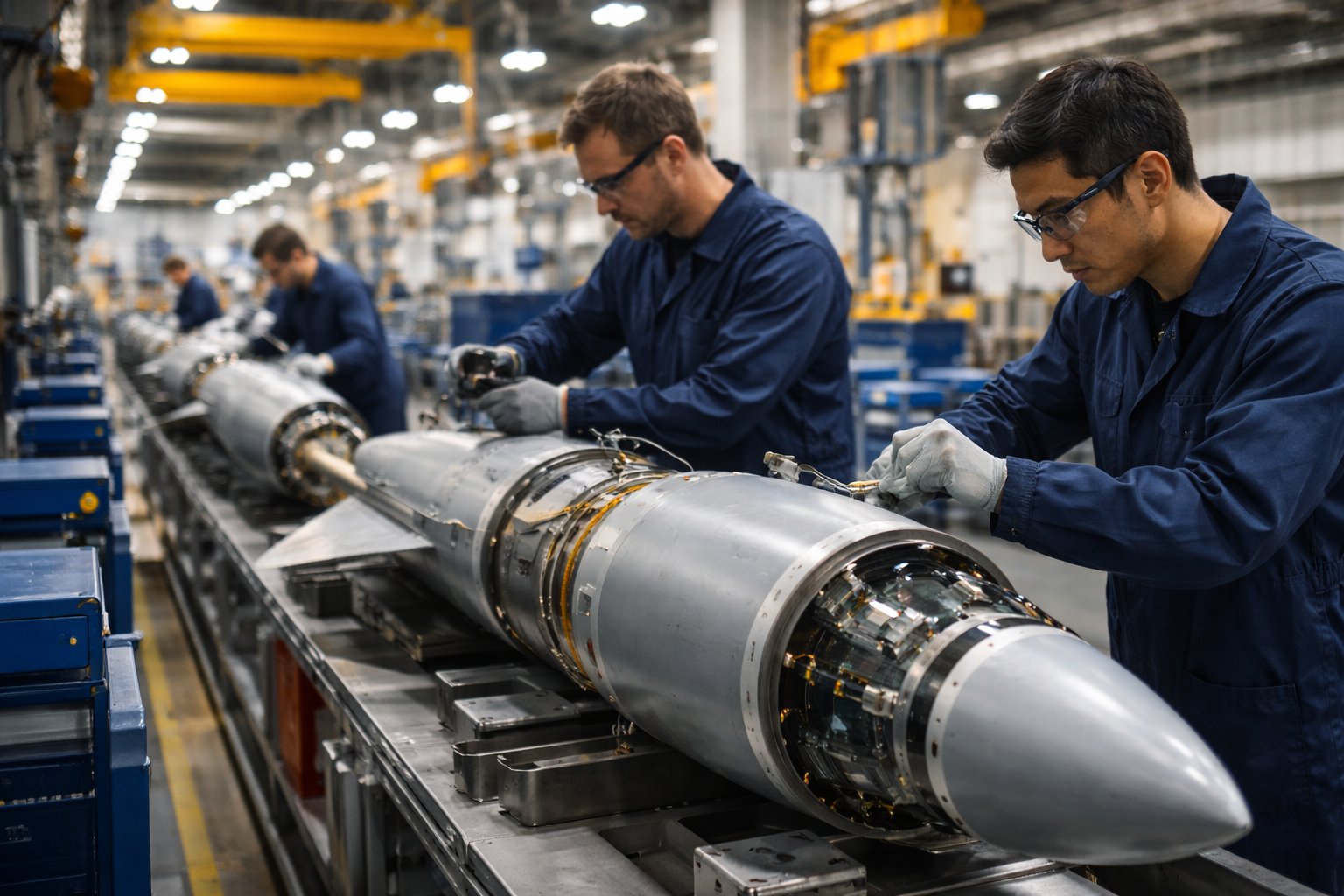
Although standard high-explosive ammunition already requires controlled forging, machining, filling, fuzing, inspection, and proof testing, a guided projectile adds navigation electronics, power, actuation, software, sensors, and tighter control over assembly variation.
Electronics-grade ammunition production
Guidance equipment must survive launch acceleration, barrel pressure, vibration, temperature change, and rotational forces before operating accurately after muzzle exit. Electronics and connectors designed for ordinary vehicles may fail immediately under artillery firing conditions, requiring hardened components, specialised packaging, and extensive qualification.
Every alteration to a processor, sensor, battery, semiconductor, or manufacturing process must be assessed against the qualified baseline. Component obsolescence can therefore become expensive, even when a proposed replacement appears technically superior.
Energetic materials create a parallel production stream governed by strict safety requirements. Insensitive-munition standards limit the choice of compounds and processes, while filling, fuzing, and warhead assembly require dedicated facilities that cannot be expanded as readily as general-purpose metalworking.
Diehl’s work includes integration, terminal-sensor activity, safety and arming equipment, and industrial manufacture, while Leonardo supplies central design and guidance expertise. Shortages in a comparatively inexpensive part can still halt delivery of the complete munition, making coordination across both industrial groups essential.
Pooled purchasing should improve demand visibility. Fragmented national orders often appear temporary, discouraging investment in specialist tooling, staff, automation, and advance material purchases. A longer multinational pipeline can support capacity growth and allow suppliers to plan production in larger, more efficient batches.
That advantage will weaken if participating countries request different terminal sensors, fuzes, software settings, documentation, or acceptance procedures. A common baseline, with national variation kept to a minimum, would preserve the economies available through aggregated demand.
Precision and mass production
European ammunition plants are already expanding conventional 155mm output as governments rebuild stockpiles and support Ukraine. The country’s demand for longer-range shells has increased pressure on propellant, explosives, shell bodies, fuzes, qualified labour, and proof facilities across the continent.
Guided rounds cannot replace the volume provided by conventional ammunition. Their role lies in engaging selected targets with fewer shots, extending effective reach, and reducing the number of firing platforms exposed during a mission.
Factories must therefore support two different production models. Conventional-shell lines prioritise throughput and unit cost, while guided-ammunition cells depend on high-value electronics, controlled assembly, calibration, testing, and traceability. Both may draw on the same energetic-material, metalworking, and skilled-labour base.
The US Army’s selection of a Vulcano-derived solution for its Extended Range Artillery Projectile requirement adds another potential demand stream. Transatlantic orders could justify larger investments, although export configurations, US integration work, and separate qualification standards may limit direct commonality.
Affordability will remain central because operators need enough guided rounds for training, testing, contingency reserves, and sustained operations. A projectile treated as too valuable to fire regularly can leave crews, maintainers, planners, and ammunition handlers without sufficient experience.
Shelf life and surveillance must also be built into the support system. Guidance electronics, seals, batteries, energetics, and sensors age at different rates, so long-term stockpile management must establish which components can be inspected, refurbished, or replaced without discarding the complete round.
A pooled NATO framework can support shared technical data, coordinated surveillance, and common replenishment, reducing the risk that national inventories develop incompatible maintenance histories. The arrangement could also provide stronger evidence for future production investments if recurring demand is visible across several budget cycles.
Deliveries beginning in 2027 will reveal whether Europe’s precision-ammunition base can expand alongside conventional-shell production without creating new shortages in electronics, energetics, test capacity, and specialist labour.