IN Brief:
- DRDO has unveiled tracked and wheeled Advanced Armoured Platforms for infantry combat vehicle and armoured personnel carrier roles.
- The Vikram VT-21 integrates a 30mm crewless turret, 7.62mm PKT gun, anti-tank missile capability, and STANAG Level 4/5 protection.
- Tata Advanced Systems and Bharat Forge are supporting manufacture, with indigenous content planned to rise from 65% to 90%.
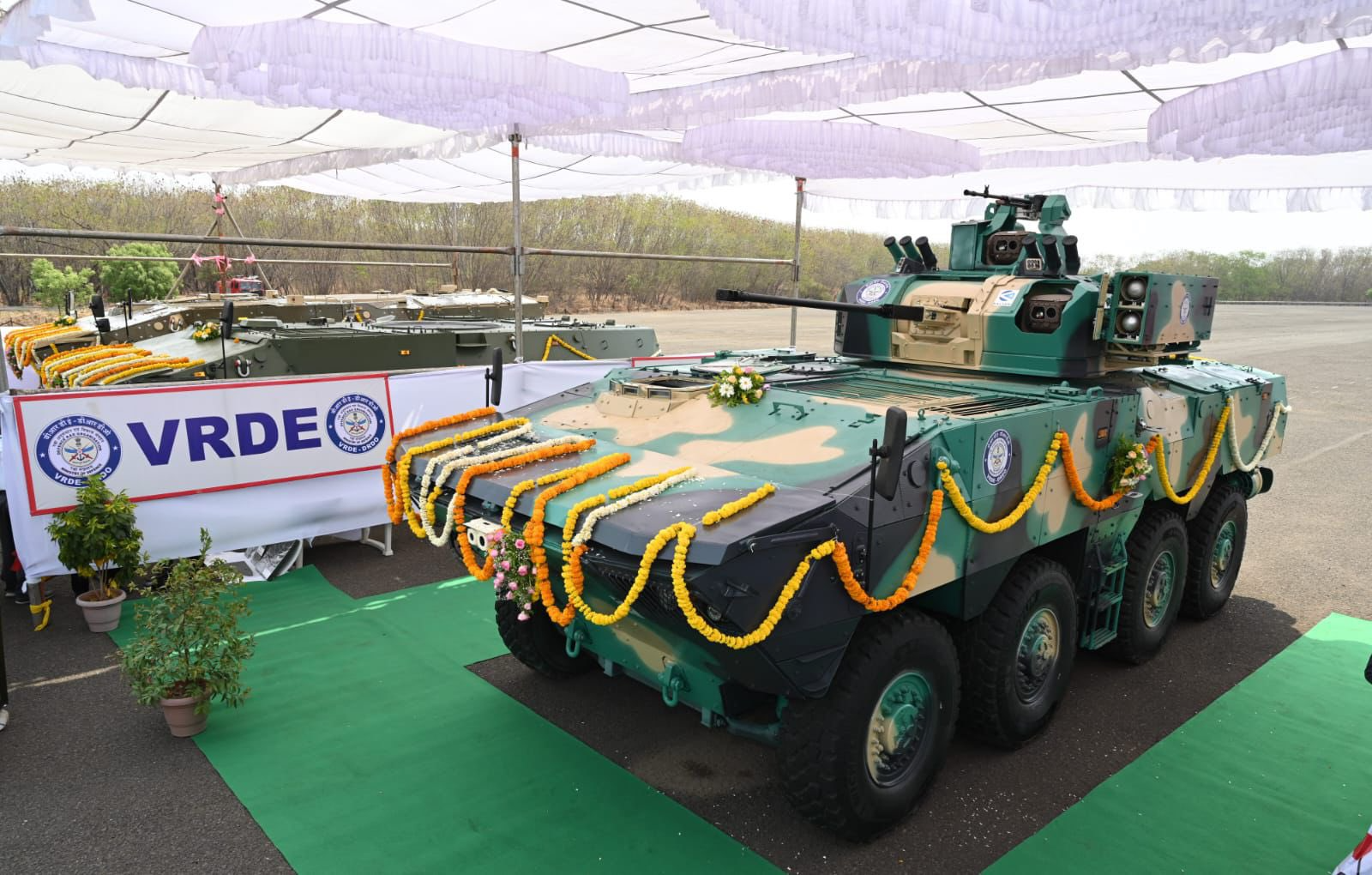
India’s Defence Research and Development Organisation has unveiled the Vikram VT-21 Advanced Armoured Platform in tracked and wheeled configurations, advancing the country’s programme to modernise its mechanised infantry vehicle base.
The platforms were unveiled at the Vehicle Research and Development Establishment in Ahilyanagar, Maharashtra, where the design has been developed for infantry combat vehicle and armoured personnel carrier roles. Both versions are based on a common armoured architecture that can be adapted for different battlefield applications.
The vehicles integrate an indigenously designed and developed 30mm crewless turret, supported by a 7.62mm PKT gun and anti-tank guided missile launch capability. The design also includes a high-power engine, automatic transmission, high power-to-weight ratio, improved obstacle negotiation, and amphibious mobility supported by hydro jets.
Protection is specified around STANAG Level 4 and 5 requirements, with modular blast and ballistic protection fitted around the vehicle. The combination of mobility, protection, and remote weapon integration places the platform in the class of armoured vehicles now expected to operate alongside drones, long-range fires, and increasingly sensor-heavy land formations.
Production route and supplier depth
The manufacturing work is being carried out by Tata Advanced Systems Limited and Bharat Forge Limited, supported by MSMEs. Current indigenous content is listed at 65%, with plans to increase that figure to 90%.
That target creates a demanding production route. Armoured vehicle manufacture depends on armour-grade materials, specialist welding, mobility systems, turret stabilisation, electronic architecture, power management, environmental qualification, and repeatable assembly processes. A tracked and wheeled family also requires careful configuration control to avoid creating two separate logistics burdens under one programme.
The next stage will depend on how the prototypes perform through mobility, firing, amphibious, blast, and user trials. Weapon fit and protection levels will attract attention, but serial production will be shaped by quality consistency, supplier capacity, field maintainability, and the ability to hold design changes under control.
Fleet replacement pressure
The Vikram VT-21 arrives as India continues to build greater domestic content into land systems. A modular base vehicle gives the armed forces room to develop multiple variants, from troop transport and reconnaissance to command, support, and weapon-carrier roles.
A vehicle family of that kind only works if the production base can support it across decades. Spares availability, repair routes, upgrade capacity, and documentation discipline will carry as much weight as the first vehicle configuration. Tata Advanced Systems, Bharat Forge, DRDO laboratories, and smaller suppliers now have a platform that could test the maturity of India’s armoured vehicle supply chain at scale.