IN Brief:
- China has conducted live-fire drills with a new missile-based air-defence system linked to the HQ-16 family.
- The configuration includes a six-pod launcher, command-and-control element, and multi-function radar.
- The development reinforces China’s investment in mobile layered air defence against aircraft, drones, cruise missiles, and precision weapons.
China has conducted live-fire drills with a new missile-based air-defence system that appears to be derived from the HQ-16 surface-to-air missile family, extending the People’s Liberation Army’s mobile medium-range ground-based air-defence architecture.
The system has been shown with a 6×6 launcher vehicle carrying six missile pods, supported by command-and-control and multi-function radar elements. Its designation, fielding status, and detailed performance data have not been publicly confirmed, although the configuration follows China’s established pattern of developing mobile systems to protect manoeuvre forces, command infrastructure, and high-value sites.
The HQ-16 family occupies a middle layer in China’s air-defence network, between shorter-range point-defence systems and larger strategic surface-to-air missile platforms. A truck-mounted derivative gives commanders a mobile option against aircraft, cruise missiles, drones, precision weapons, and other low-to-medium altitude threats.
Mobility changes the survivability equation. Static air-defence sites are vulnerable to surveillance, targeting, electronic attack, and long-range precision strike. A truck-based system can disperse, relocate after firing, and operate with a smaller footprint, reducing the time available for detection, classification, and engagement.
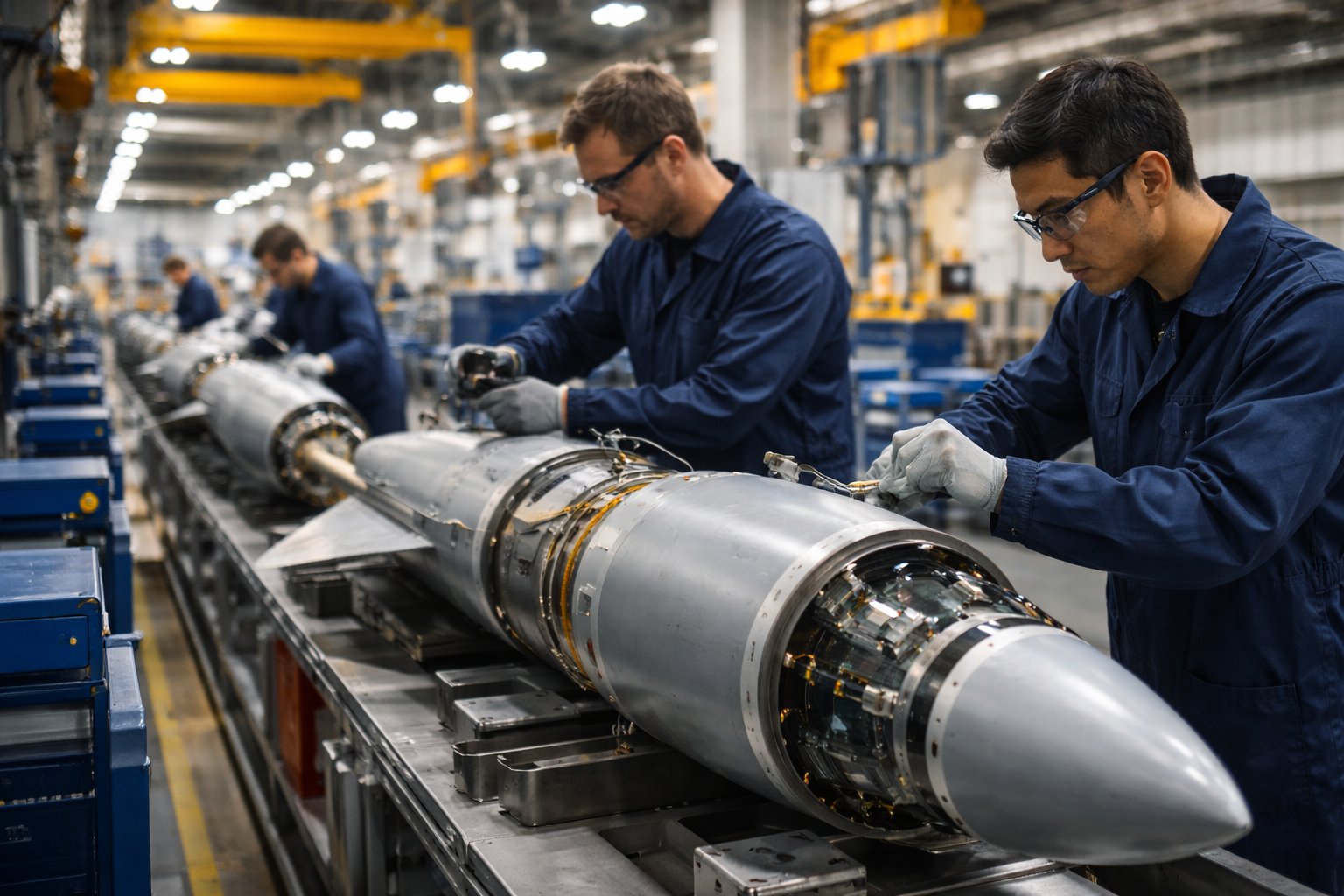
Behind the launcher sits a demanding production chain. A mobile air-defence battery needs radar vehicles, power systems, reload equipment, communications links, command software, maintenance tools, training systems, spare parts, and secure electronic components. The complete system has to operate through vibration, temperature swings, dust, electromagnetic interference, and contested communications.
China’s defence-industrial base gives the PLA scope to iterate across families of missiles, launchers, radars, vehicles, and command systems. That pattern can produce variants without the long public procurement cycles often seen in Western programmes, allowing incremental improvements to emerge through testing and exercises before formal designation details become clear.
Each new mobile air-defence development complicates the operating environment around Chinese forces. Suppression campaigns, air operations, ISR activity, and stand-off strike planning all become harder when defended units can move, disperse, and connect into wider air-defence networks. Medium-range systems rarely dominate headlines, but they shape the cost of operating near contested ground forces.
Drones and loitering munitions have also changed the scale of the air-defence problem. High-performance interceptors remain essential against aircraft, cruise missiles, and precision weapons, while cheaper aerial threats demand deeper stocks and more varied engagement options. That has pushed air defence from a niche procurement line into a production contest across missiles, radars, electronic warfare, and command systems.
Comparable pressures are already visible across allied markets. Lockheed Martin’s containerised C-UAS kill chain reflects a modular approach to counter-drone defence, while Saab’s Swedish brigade air-defence order shows brigade-level protection returning as a funded capability requirement. China’s HQ-16-derived system points to the same shift from another industrial base.
The radar and command elements carry as much weight as the missile itself. Modern air defence depends on sensor quality, track continuity, target identification, datalink resilience, and fire-control speed. Interceptors cannot deliver their designed performance if the battery cannot build a reliable air picture, pass target data, and coordinate with adjacent systems.
Chinese investment in mobile air defence also supports wider force protection. Long-range strike, naval expansion, and combat aviation programmes all benefit from a thicker protective architecture around bases, manoeuvre units, and supporting infrastructure. Offensive reach and mobile protection are advancing together rather than as separate tracks.
As mobile air-defence systems become more numerous and networked, the counter-system burden grows. Strike platforms, electronic-warfare tools, decoys, stand-off weapons, and loitering munitions all have to account for radars and launchers that can shift position, alter emissions, and operate inside layered coverage.
China’s latest HQ-16-derived system adds another increment to that pattern. The system may not be as visually prominent as a new fighter or warship, but medium-range mobile air defence changes the operating assumptions around them. Matching mobility, sensor performance, electronic resilience, and interceptor output is now part of the broader defence production contest.