IN Brief:
- Lockheed Martin’s Next Generation Hypersonic Glide Body has completed preliminary design review.
- A flight demonstration is planned for 2027.
- The programme is being shaped around affordability, producibility, scalability, and launch flexibility across multiple domains.
Lockheed Martin’s Next Generation Hypersonic Glide Body has completed preliminary design review, moving the programme toward a planned 2027 flight demonstration with manufacturing scale built into the design conversation from the outset.
The weapon, known as NXGB, is being developed as a long-range hypersonic strike option designed for affordability, rapid production, and use across multiple launch platforms. Those priorities reflect a maturing hypersonic market in which speed and manoeuvrability are no longer the only measures of progress. Defence customers now want weapons that can be produced in credible numbers, stored, integrated, upgraded, and replenished.
Although hypersonic systems still depend on extreme performance, the production challenge is becoming just as decisive. Glide bodies must survive severe aerodynamic heating, structural loads, guidance demands, vibration, and high-speed manoeuvre while retaining precision and reliability. Materials, coatings, thermal protection, electronics packaging, inspection methods, and test processes all have to work repeatedly, not only on a handful of development articles.
The preliminary design review gives NXGB a formal checkpoint against design maturity, manufacturing assumptions, and programme readiness. Passing that stage does not remove later risk, but it signals that performance and producibility are being considered together before the flight-test phase. For hypersonic weapons, that sequencing is important because retrofitting a complex design for affordable production can become expensive and slow.
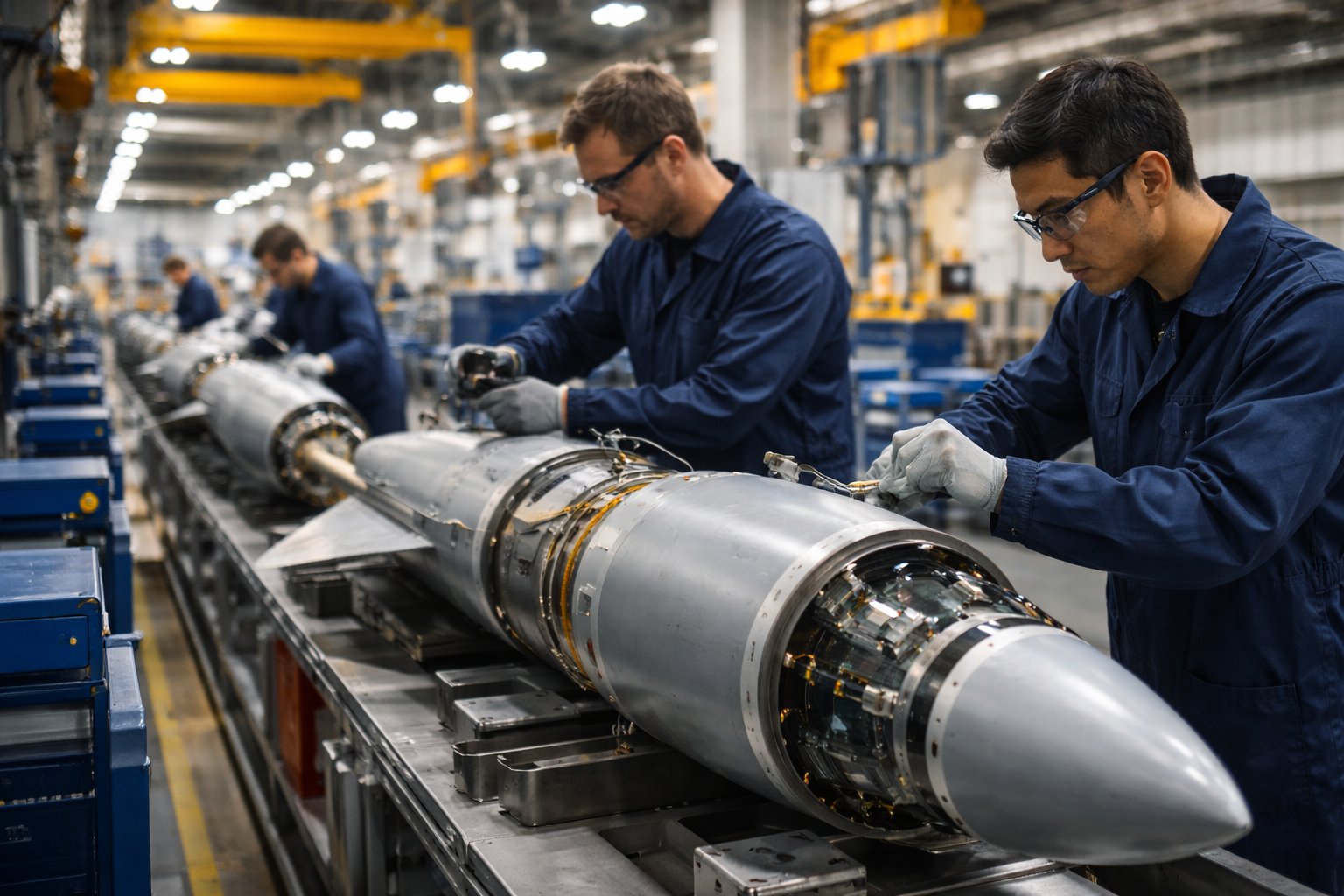
A manufacturing-first approach requires discipline around part count, material availability, process control, supplier qualification, inspection access, and configuration management. Hypersonic components cannot be produced with loose tolerances or uncertain materials. Every unit needs traceability and repeatability, and every design change can affect qualification evidence across thermal, structural, and aerodynamic behaviour.
Lockheed Martin’s emphasis on scalable production also reflects a wider shift in strike-weapon procurement. Long-range precision weapons have become central to deterrence planning, but stockpile depth remains a hard constraint. Work on affordable extended-range precision strike and the UK’s low-cost long-range strike effort shows the same pressure from different ends of the market. Customers want advanced effects, but they also want weapons that can be built in sufficient volume.
Hypersonics occupy the most technically demanding end of that spectrum. They will not become cheap weapons in the ordinary sense, yet their operational value will be limited if production remains too slow or expensive for meaningful stockpiles. A weapon that can be demonstrated but not replenished at useful speed becomes a strategic symbol rather than a practical inventory.
Multi-platform launch flexibility could help spread production demand across more users and mission sets. If the same glide body can be adapted for different launch environments, the programme may gain economies of scale and reduce fragmentation. That benefit depends on disciplined interfaces, manageable safety cases, and integration work that avoids turning each platform into a bespoke development effort.
The supply chain behind hypersonics is also narrow. Advanced materials, thermal protection systems, precision machining, specialist coatings, high-temperature electronics, propulsion interfaces, test facilities, and experienced engineers are all constrained resources. Scaling production will require investment beyond final assembly, including supplier capacity, workforce training, digital engineering, and quality systems.
Test infrastructure could become a bottleneck. Hypersonic systems need ground testing, simulation, flight trials, telemetry, range access, and environmental qualification. The number of available facilities and qualified personnel can limit programme tempo as much as factory space. Manufacturing scale will therefore depend on whether testing and certification can keep pace with production ambition.
The 2027 flight demonstration will be an important technical milestone, but the harder measure will come after flight testing. Programmes often move through early gates with promising affordability language, only to encounter redesign loops, supplier fragility, qualification delays, or cost growth. NXGB’s credibility will depend on how well its manufacturing assumptions survive contact with production planning.
For defence ministries, the appeal is clear. A scalable hypersonic glide body would add a high-end strike option without requiring each future variant to begin from a clean-sheet design. For industry, the programme offers a chance to show that hypersonics can move from elite demonstration to managed production.
Speed will always define hypersonic weapons. In the next phase, however, production discipline may define who can field them in meaningful numbers.