IN Brief:
- Rheinmetall will supply 23 Bergepanzer 3 Büffel A2 armoured recovery vehicles to the Bundeswehr.
- The order replaces recovery vehicles transferred from Germany to Ukraine.
- Production has already begun, with deliveries scheduled between December 2027 and June 2029.
Germany is rebuilding part of the support machinery behind its armoured fleet with a new Rheinmetall order for 23 Bergepanzer 3 Büffel A2 armoured recovery vehicles.
The contract replaces recovery vehicles transferred to Ukraine and is valued in the mid-three-digit million-euro range. Production has already begun, with the first vehicle due in December 2027 and final delivery planned for June 2029. The vehicles will be supplied in a modernised A2 configuration with obsolescence issues cleared for continued long-life operation.
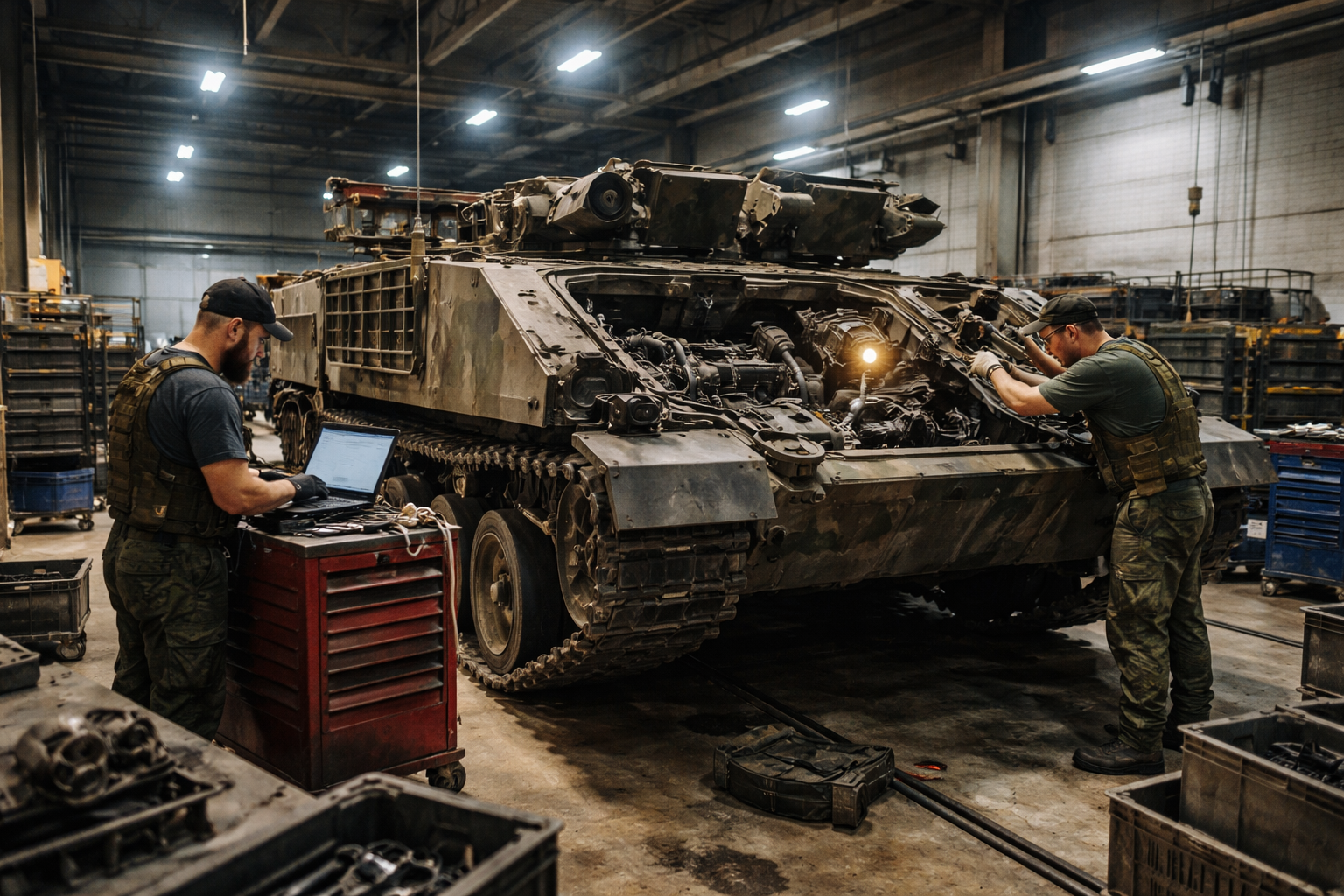
Although recovery vehicles rarely receive the attention given to tanks or infantry fighting vehicles, they are central to armoured readiness. Heavy forces need protected systems able to recover damaged vehicles, tow immobilised armour, support repairs, and keep formations moving under difficult conditions. A tank that cannot be recovered quickly can become a combat loss, a maintenance burden, or an obstacle for the force around it.
The Büffel’s production requirements reflect that practical role. Heavy-duty chassis work, cranes, winches, hydraulics, protected crew compartments, recovery tools, communications, power systems, and maintainable mechanical architecture all have to be engineered for reliability under stress. These are not decorative additions to an armoured fleet; they are the systems that allow expensive combat vehicles to remain usable after damage, breakdown, or terrain failure.
Rheinmetall’s decision to begin production ahead of delivery pressure shows how defence companies are adjusting to Europe’s replenishment cycle. Internal investment can secure supplier capacity, smooth factory loading, and reduce the risk of schedule compression later. As European governments replace equipment transferred to Ukraine, companies with available production planning and mature vehicle families will have an advantage.
The A2 modernisation and obsolescence clearance are especially important. Armoured support vehicles often remain in service for decades, during which components disappear, suppliers change, electronics age, and original manufacturing assumptions no longer hold. Clearing obsolescence can require redesigned parts, new qualification evidence, updated drawings, revised spares packages, and changes to support documentation.
Germany’s order sits within a wider land-systems renewal cycle shaped by Ukraine, NATO readiness, and the return of heavy-force planning. The most visible demand is for tanks, artillery, missiles, and air defence, but the enabling fleet needs the same attention. Recovery vehicles, bridge layers, engineering systems, transporters, maintenance vehicles, and spares stores all determine whether combat platforms can operate at scale.
Recent armoured-vehicle developments already point in that direction. Transmission supply for CV90 MkIV production and hybrid drive work for future armoured mobility show how mobility and supportability are moving closer to the centre of land-system procurement. Heavy fleets are being judged not only by firepower and protection, but by the industrial systems that keep them deployable.
For Rheinmetall, the Büffel contract supports its long-running position in heavy land systems while reinforcing the value of mature platforms. A proven recovery vehicle can be modernised, produced, and supported with less development risk than a clean-sheet design. That matters for customers trying to restore readiness quickly without adding another uncertain programme to an already crowded procurement schedule.
The replacement of vehicles sent to Ukraine also demonstrates how support to allies creates delayed demand at home. European armies have drawn from their own inventories to supply Kyiv, and the industrial backfill is now spreading across vehicle types that were once easy to overlook. Those replacement contracts will shape factory capacity, supplier orders, and workforce demand for years.
Heavy recovery capability is also becoming more relevant as vehicle weights rise. Modern tanks and infantry fighting vehicles carry greater armour, electronics, protection systems, and mission equipment. Recovery platforms must keep pace with those weights and with the conditions in which vehicles may be immobilised. Underpowered or outdated recovery assets can constrain the use of the very combat platforms they are meant to support.
The contract’s delivery profile, running into 2029, underlines the length of even relatively straightforward replenishment. Mature platforms still require production scheduling, component supply, assembly, testing, acceptance, and training. European readiness cannot be rebuilt instantly simply by placing orders.
For the Bundeswehr, the new Büffel A2s restore a capability thinned by support to Ukraine. For industry, the contract reinforces a more grounded view of armoured warfare production. The main battle tank may dominate attention, but the recovery vehicle is often the difference between an armoured fleet that looks capable on paper and one that can sustain operations under pressure.