IN Brief:
- The Royal New Zealand Air Force has fired AGM-84 Harpoon missiles from a P-8A Poseidon for the first time.
- The firing took place during Valiant Shield 2026, with missiles supplied by Australia and support from allied partners.
- The test strengthens New Zealand’s maritime strike posture while increasing demand for weapons integration, logistics, and regional support capacity.
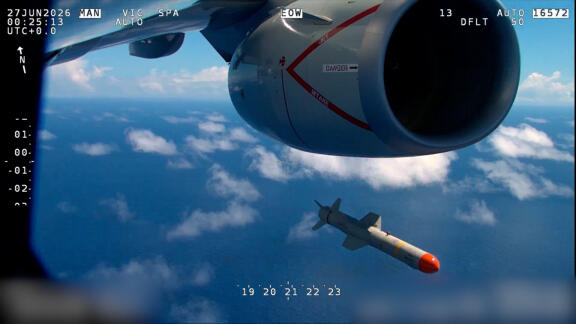
The Royal New Zealand Air Force has completed its first AGM-84 Harpoon missile firing from a Boeing P-8A Poseidon, adding a surface-strike layer to a fleet better known for maritime patrol, surveillance, and anti-submarine warfare.
The firing took place during Valiant Shield 2026 near Guam, where a No. 5 Squadron P-8A launched two Harpoon anti-ship missiles against a decommissioned vessel target. Australia supplied the missiles, while allied partners supported the wider exercise architecture around the test.
For New Zealand, the launch rebuilds an anti-ship missile capability around a modern maritime patrol aircraft. A P-8A can carry Harpoon, but bringing the weapon into practical service requires more than a clean separation from the aircraft. Armament handling, software readiness, aircraft clearance, mission planning, weapons loading, telemetry collection, aircrew training, and post-shot assessment all become part of the operating model.
The P-8A gives the RNZAF a long-range maritime aircraft with reach across surveillance, anti-submarine warfare, intelligence collection, and search and rescue. Validated anti-ship employment changes the aircraft’s role in the Pacific, where long distances, dispersed operating areas, and limited forward infrastructure place a premium on platforms able to detect, track, and engage surface threats inside a coalition force structure.
Behind the firing sits a wider support chain. Maritime strike from a patrol aircraft depends on certified weapons maintenance, stockpile management, test equipment, training rounds, ground handling equipment, software support, and access to ranges. Smaller operators face a sharper version of that challenge, as national inventory depth and domestic weapons support capacity are rarely sufficient to cover every requirement alone. The Australian missile contribution shows how regional partners are likely to share weapons, test facilities, and operational knowledge as Pacific defence planning becomes more practical.
Harpoon is a mature weapon, yet maturity does not remove the production and sustainment burden. Existing inventories still need battery management, guidance checks, warhead safety assurance, captive-carry testing, corrosion control, and life-extension work. As more P-8A operators exercise strike roles, suppliers and maintainers will need to keep weapons compatible with aircraft updates, mission-system changes, and evolving operational requirements.
The test also sits within a broader Indo-Pacific shift toward aircraft that can do more than observe. Maritime patrol aircraft have always had warfighting utility, but the growth of long-range missiles, autonomous systems, and contested logistics is pushing regional operators to make those roles more credible. Surveillance without a strike pathway leaves a gap between detection and deterrence, while strike without surveillance risks depending on a separate and potentially fragile targeting chain.
Valiant Shield has become a useful pressure test for that allied architecture. The same exercise environment has already placed Boeing’s MQ-28 Ghost Bat collaborative combat aircraft into a wider Pacific integration setting, with crewed aircraft, uncrewed platforms, tankers, command nodes, and weapons stockpiles being tested as a connected system rather than as separate national assets.
That has direct manufacturing consequences. The Indo-Pacific is too large for boutique capability. Aircraft, missiles, and support equipment must be maintainable far from home bases, adaptable across allied exercises, and backed by supply chains able to support high-tempo deployments. Even an established weapon such as Harpoon becomes part of a modern industrial debate when it is tied to long-range patrol aircraft and coalition operations.
The RNZAF’s first P-8A Harpoon firing therefore demonstrates more than a weapons release. It shows New Zealand building a practical maritime strike chain around aircraft, missiles, personnel, partners, and logistics. For suppliers, the work sits in the less visible layers: mission planning software, ground support equipment, missile handling, aircraft-weapons certification, maintenance training, and stockpile sustainment. Those elements will determine whether the capability remains an exercise milestone or becomes a repeatable operational tool.