IN Brief:
- Airbus Defence and Space has signed a Memorandum of Understanding with Brave1, Ukraine’s government-led defence technology coordinator.
- The agreement is Brave1’s first industrial strategic partnership with a Western company.
- Airbus technologies will be integrated into Brave1’s Test in Ukraine framework, creating a route for frontline evaluation and operational feedback.
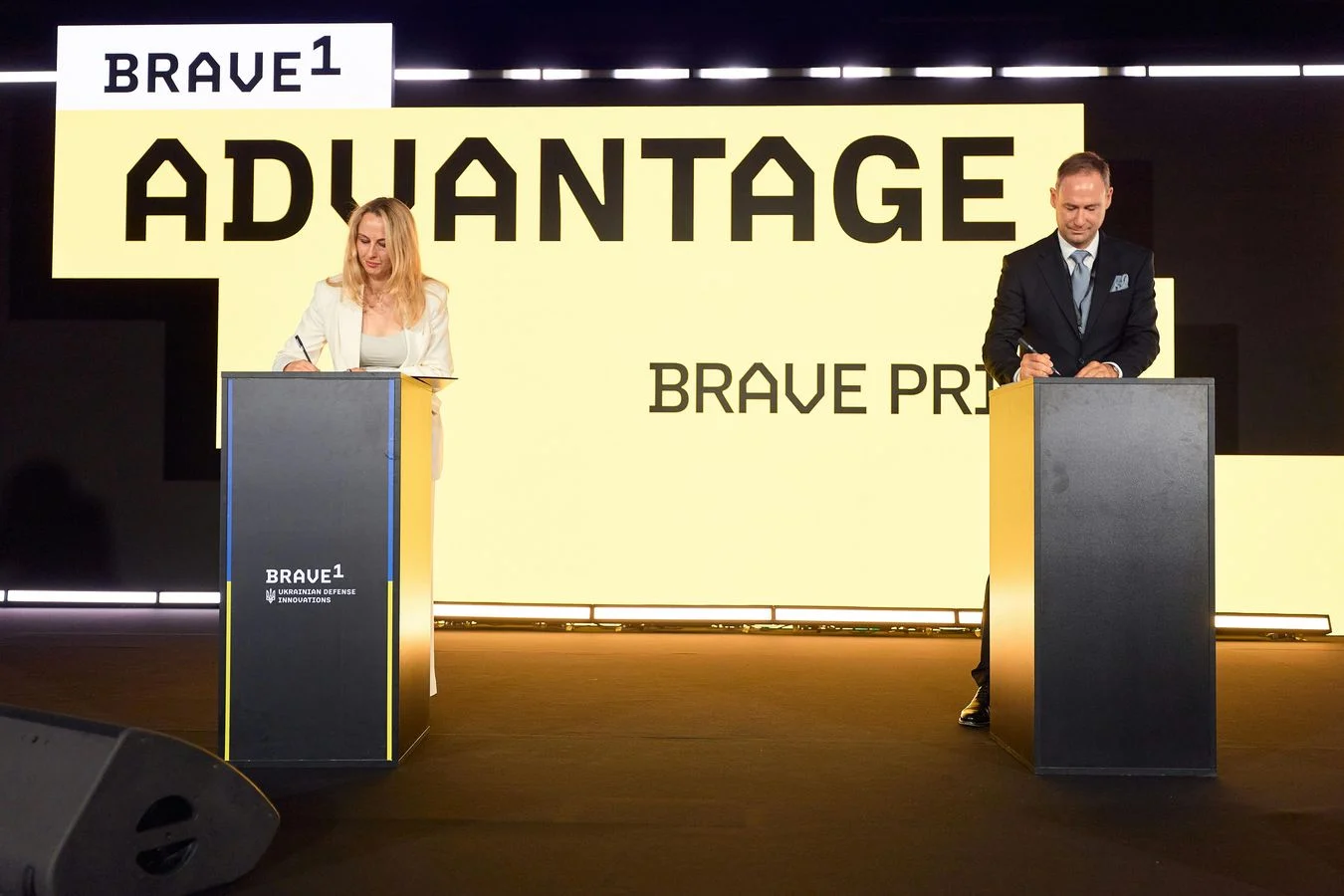
Airbus Defence and Space has signed a Memorandum of Understanding with Brave1, Ukraine’s central government-led defence technology coordinator, creating a direct link between a major European aerospace prime and one of the fastest defence innovation environments in the world.
The agreement is Brave1’s first industrial strategic partnership with a Western company. Brave1 functions as a joint innovation platform for Ukraine’s ministries, military, and private technology sector, accelerating battlefield technologies from concept to deployment. The Airbus partnership establishes joint task forces to drive projects from early scientific research through to the modernisation of active equipment.
Airbus technologies will be integrated into Brave1’s Test in Ukraine framework, giving the company access to live frontline co-testing and joint evaluation. Operational performance data will feed back into development activity, shortening the loop between engineering decisions and battlefield use. Airbus will also act as a key partner of the Defence Tech Valley summit in Lviv, placing the company visibly inside Ukraine’s defence technology ecosystem.
European defence research and development is being reshaped by the war in Ukraine. Traditional aerospace development is built around long qualification cycles, controlled test regimes, certification gates, and platform-level integration discipline. Ukraine’s wartime innovation model is built around short iteration cycles, battlefield feedback, urgent adaptation, and mass use of relatively low-cost technologies. The Airbus-Brave1 partnership brings those models into closer contact.
The work will not be straightforward. Aerospace primes cannot abandon safety, documentation, export controls, configuration management, or certification standards. Ukrainian developers cannot afford slow experimentation when electronic warfare, drone tactics, and battlefield requirements change within days. The value of the partnership will depend on whether Airbus can absorb fast operational feedback while preserving the industrial discipline required to produce reliable defence systems at scale.
Production sits at the centre of that challenge. Battlefield co-testing can reveal whether a system works, but scaling it requires materials, suppliers, manufacturing processes, software control, test equipment, spares, training, and repeatable quality. A drone jammer, sensor, autonomy module, counter-UAS system, or aircraft subsystem may be iterated quickly in Ukraine, but a European industrial partner has to translate that into products that can be manufactured, supported, and exported under controlled conditions.
The agreement also fits a wider Airbus push into Ukrainian and European defence technology partnerships. The company has recently been active across air defence, uncrewed systems, and AI-enabled military decision-making. Ukraine’s use of captured weapons as an engineering database for approved partners shows how battlefield exploitation is being converted into structured technical knowledge. Brave1 adds another route for operational learning to become design input.
Ukraine has become a testing environment for technologies that many European forces are still procuring slowly. Small drones, FPV systems, electronic warfare, counter-drone systems, tactical software, battlefield connectivity, and rapid repair models have all evolved under combat pressure. European manufacturers that ignore that environment risk building systems against outdated assumptions. Manufacturers that engage with it still have to avoid designing only for one battlefield and losing wider applicability.
Airbus brings aerospace engineering depth, systems integration experience, industrial scale, and access to European defence customers. Brave1 brings speed, frontline access, and a network of Ukrainian developers who have learned how quickly systems must adapt under fire. Useful outcomes may sit in areas where those strengths overlap: counter-UAS, secure communications, ISR, autonomy, mission software, electronic protection, and the modernisation of active equipment.
The Test in Ukraine framework is especially valuable because defence companies often struggle to get realistic operational feedback early enough. Range tests and demonstrations rarely reproduce the density of jamming, deception, attrition, mud, weather, improvisation, and user adaptation seen in war. Frontline co-testing gives engineers data that can challenge assumptions before a product reaches formal procurement.
The industrial opportunity is not limited to Airbus. If the partnership works, it could create pathways for Ukrainian companies to enter European supply chains and for European primes to qualify Ukrainian innovations under recognised standards. That will require careful work around intellectual property, security, export controls, production certification, and long-term support. It could also strengthen Europe’s resilience by diversifying the sources of defence technology.
The agreement should be read as part of a broader European move toward faster defence innovation. Governments want production at wartime relevance, but industry still has to build safe, repeatable, and supportable systems. Airbus and Brave1 are now testing whether frontline urgency and aerospace discipline can be combined without diluting either.
For defence manufacturing audiences, the partnership is strongest where feedback becomes part of the production chain. Data from active equipment and frontline trials can influence design, supplier choices, software updates, maintenance procedures, and future product roadmaps. In a market where adaptation speed is becoming a form of capability, that loop may prove as valuable as any single system developed under the MoU.