IN Brief:
- AEVEX has received a $50m US Air Force contract, including $27m in initial funding.
- The award supports production of a long-range precision strike platform for contested and GPS-denied missions.
- Work will be executed across AEVEX’s US engineering, integration, and production facilities.
AEVEX has secured a $50m US Air Force contract to expand unmanned mission-support capabilities, advancing production of a long-range precision strike platform designed for contested and GPS-denied environments.
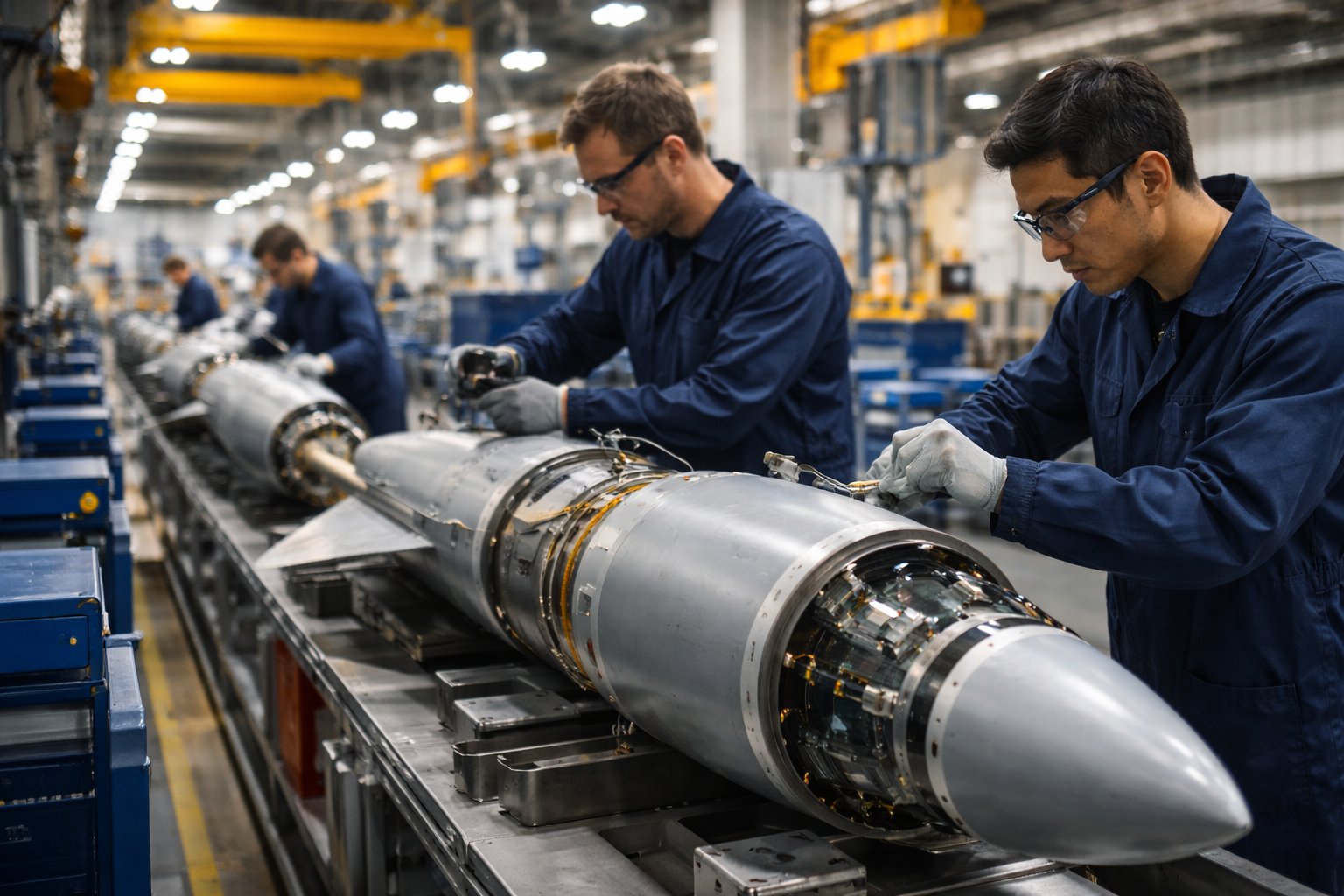
The contract includes $27m in initial funding and supports a modular, expeditionary unmanned capability built for extended-range missions. The platform is designed for high payload capacity, rapid reconfiguration, and payload integration across diverse mission profiles. Work will be executed across AEVEX’s US engineering, integration, and production facilities.
The award lands in a US market increasingly focused on affordable, rapidly deployable uncrewed systems. Long-range strike drones occupy a different industrial category from small tactical quadcopters or large exquisite aircraft. They have to be cheap enough to field in useful numbers, capable enough to affect operations, and simple enough to manufacture, modify, and support under compressed timelines.
GPS-denied operation is one of the defining requirements. A long-range strike drone that depends entirely on satellite navigation becomes fragile in a contested electronic warfare environment. Designing for degraded or denied GPS means integrating alternative navigation, inertial systems, terrain or vision-based aids, resilient communications, autonomy, and mission logic that can continue when links are jammed or unavailable. Those features add capability, but they also increase production and testing complexity.
AEVEX’s vertical integration is central to the industrial picture. The company combines autonomous unmanned systems, AI-enabled mission software, ISR, electronic warfare, rapid prototyping, and high-volume manufacturing across multiple US locations. That breadth allows a tighter loop between design, test, integration, and production, which is increasingly important as drone requirements change quickly.
The US Air Force and wider Department of Defense are trying to rebalance between exquisite platforms and attritable systems. Cheaper uncrewed aircraft do not replace crewed fighters, bombers, or standoff missiles. They add mass, complicate enemy targeting, and provide strike options that can be produced and lost at a different cost point. AEVEX’s contract fits that pattern.
The wider production bottleneck around affordable strike has already exposed the importance of engine factories and propulsion supply. Long-range uncrewed strike systems depend on propulsion, guidance, warheads or payloads, datalinks, composite structures, batteries or fuel systems, and rapid assembly processes. Engines and electronics can become just as limiting as airframes.
The modularity requirement also deserves attention. A rapidly reconfigurable platform can support different missions and payloads, but modularity only works if interfaces are disciplined. Power, data, mechanical attachment, environmental control, software recognition, and safety cases all need to be standardised enough to allow change without creating a fresh certification burden every time a payload is added. Poorly controlled modularity can slow a programme rather than accelerate it.
GPS-denied strike overlaps with electronic warfare and cyber resilience. A platform operating in contested environments must manage emissions, resist jamming, and preserve mission integrity when communications are limited. That creates demand for onboard processing and autonomy, which increases the importance of secure software pipelines and embedded compute supply. Drone manufacturing is now as much about electronics and code as airframes.
The award follows a broader rise in defence customer and investor interest in uncrewed systems companies. AEVEX has expanded its public profile as US and allied customers look for systems that can move from prototype to operational quantities faster than traditional aircraft programmes. The contract will test whether the company can sustain that pace while meeting military expectations for reliability, traceability, and configuration control.
Production at operationally meaningful scale will be the measure. A small batch can demonstrate capability, but deterrence and wartime utility require repeatable output, spares, training systems, repair procedures, launch equipment, and operators who can use the system without bespoke support. The Air Force’s award points toward that next step.
For US industry, AEVEX’s contract is another signal that long-range uncrewed strike is moving from experimentation into structured procurement. The companies that succeed will be those able to join software agility with manufacturing discipline, while building supply chains resilient enough for a market likely to become larger, faster, and more contested.