IN Brief:
- Kongsberg has signed a NOK 4.7bn contract to deliver Joint Strike Missiles to a new customer.
- The buyer is the sixth nation to select JSM for its fighter fleet, following Norway, Japan, Australia, the US, and Germany.
- The order reinforces demand for F-35-compatible strike weapons and the industrial base behind advanced missile production.
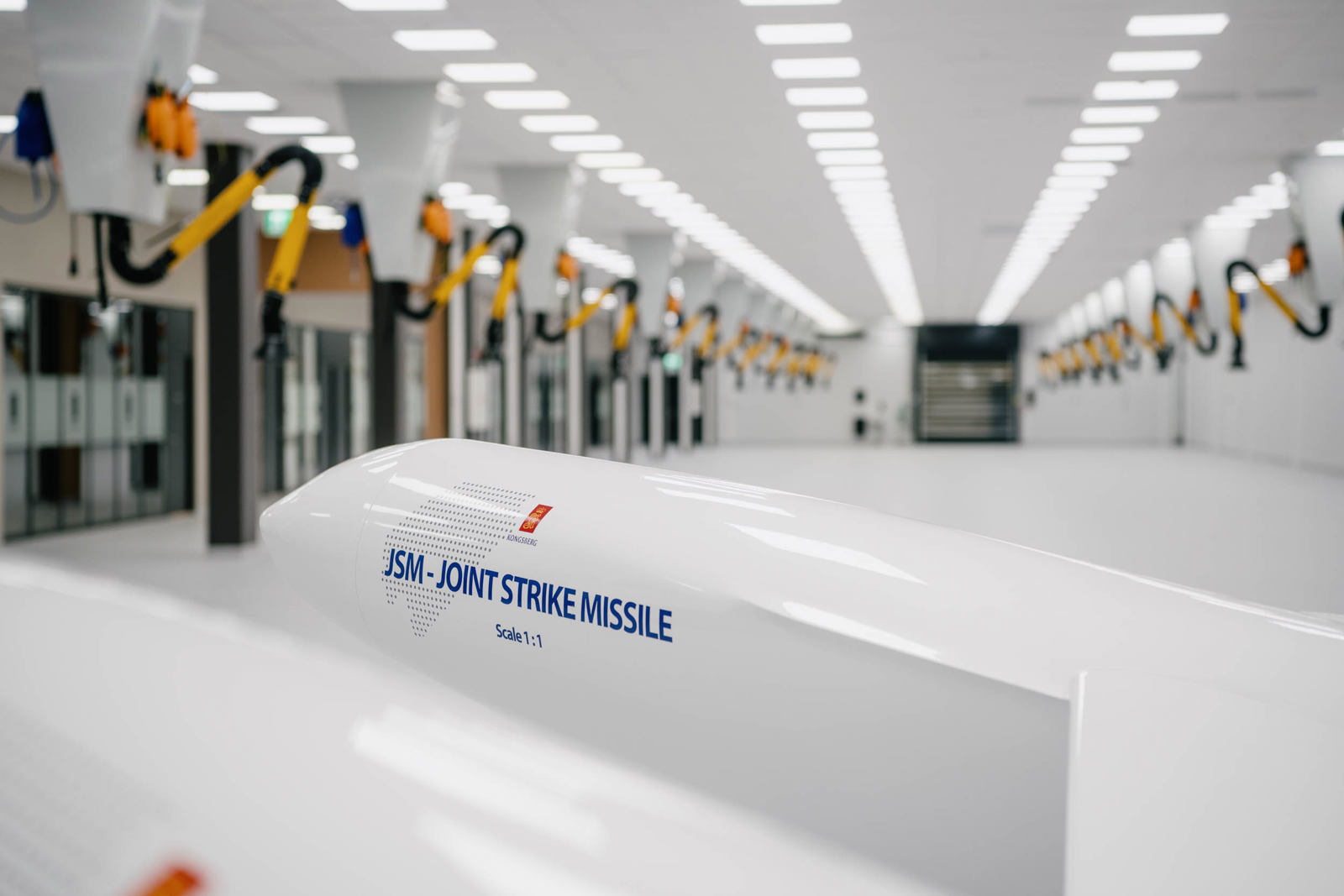
Kongsberg has signed a NOK 4.7bn contract to supply Joint Strike Missiles to a new customer, expanding the user base for one of the F-35 programme’s most strategically important strike weapons.
The buyer has not been named, but it becomes the sixth country to select JSM for its fighter fleet, following Norway, Japan, Australia, the United States, and Germany. For Kongsberg, the order reinforces the missile’s position inside the international F-35 weapons ecosystem. For the wider industrial base, it adds another layer of demand to a guided-weapons market already under pressure from stockpile rebuilding, long-range strike requirements, and maritime deterrence.
JSM is designed as a fifth-generation strike missile able to fit the F-35’s internal weapons bay, preserving the aircraft’s low-observable profile while giving operators a precision option against defended land and maritime targets. That internal-carriage requirement is a major engineering driver. A missile designed for the F-35 must fit within tight dimensional limits while retaining range, survivability, guidance performance, warhead effect, and safe release characteristics.
The order is therefore more than another export munition sale. It is part of the wider F-35 industrial architecture. Every new customer brings integration, logistics, training, software, mission planning, test equipment, storage, and sustainment requirements. The missile must also sit inside national stockpile plans and allied operational concepts, particularly in regions where maritime strike and anti-access threats are central to air-power planning.
Europe’s missile sector is already under strain. Guided weapons combine propulsion, seekers, warheads, datalinks, navigation systems, control surfaces, composite and metallic structures, energetics, and electronics that must survive extreme environments. Scaling output is difficult because many subcomponents rely on specialist suppliers, controlled materials, long qualification cycles, and limited test infrastructure.
The wider market is moving in the same direction. Development of new AMRAAM variants has already drawn allied customers deeper into missile development and stockpile planning, while demand for affordable strike systems has placed propulsion capacity under renewed pressure. JSM sits in that industrial moment. Western air forces are relearning that aircraft capability is constrained by the depth, compatibility, and availability of the weapons carried under or inside them.
For F-35 operators, the attraction is clear. The aircraft’s sensors and survivability are most valuable when paired with weapons that can be carried without compromising signature. External stores increase payload but reduce stealth. Internal carriage preserves penetration options, but demands a missile that can deliver useful range and effect inside a confined bay. JSM’s export growth shows that more operators want that option in their inventory rather than relying only on legacy air-launched weapons.
The maritime role is particularly strong. F-35 users in the Indo-Pacific and northern Europe face large maritime operating areas, long coastlines, and increasingly capable naval air-defence systems. A missile able to support land and maritime strike from a fifth-generation aircraft gives planners more flexibility, while increasing pressure on stockpile depth. A small number of highly capable missiles may support deterrence signalling, but sustained operations require production volume, storage life, and replenishment capacity.
Kongsberg’s challenge now is industrial execution. A NOK 4.7bn order is significant, but it lands in a market where governments are asking suppliers to shorten delivery timelines, increase capacity, and support more customers at once. That means investment in manufacturing flow, supplier qualification, test capacity, and workforce resilience. It also requires disciplined export configuration management so that national variants do not fragment the production base unnecessarily.
The order strengthens Norway’s position in the advanced weapons supply chain and gives European industry another export success in an area where demand is unlikely to soften. It also shows how platform decisions continue to create downstream manufacturing work. Buying the F-35 creates a long tail of weapons, support systems, software, and sustainment needs, with JSM now becoming one of the more visible European examples.
A sixth customer gives the missile programme momentum. The harder measure will be whether the production system behind JSM can keep pace with the requirement for deeper, more resilient, and more distributed missile inventories.