IN Brief:
- RENK will continue supplying propulsion systems for Rheinmetall’s KF41 Lynx infantry fighting vehicle.
- The agreement covers HSWL 256C transmissions and final drives, with value above €270 million including options.
- European armoured vehicle production is increasingly constrained by high-value subsystems, not only hull assembly.
RENK and Rheinmetall have extended their framework agreement for propulsion systems on the KF41 Lynx infantry fighting vehicle, putting transmissions and final drives at the centre of Europe’s armoured vehicle production challenge.
The agreement is valued above €270 million including options and covers HSWL 256C transmissions and final drives for the Lynx platform. The vehicle is already being introduced into Hungarian service and is positioned for further European demand as armies rebuild tracked combat fleets and replace ageing infantry fighting vehicles.
Armoured vehicle production is often discussed through hulls, turrets, and final assembly, yet the components that determine mobility, reliability, and maintainability are harder to scale quickly. Transmissions, final drives, power-packs, suspension, bearings, cooling, test systems, and electronic controls all require specialised manufacturing capability, qualified suppliers, and long validation cycles.
RENK has moved early to expand capacity, anticipating demand for propulsion systems across multiple vehicle programmes. That capacity planning carries weight because driveline components are not easily substituted once a vehicle is designed around a specific architecture. A tracked infantry fighting vehicle places extreme loads on its propulsion system, especially when armour packages, active protection, electronics, and larger turrets keep pushing weight upward.
The KF41 Lynx sits in a market shaped by Ukraine, NATO force regeneration, and the return of heavy land warfare planning. European armies are looking again at protected mobility, mechanised infantry, direct firepower, and survivability against drones, artillery, mines, and anti-armour weapons. Those requirements add weight and complexity, increasing stress on mobility systems across the vehicle’s life.
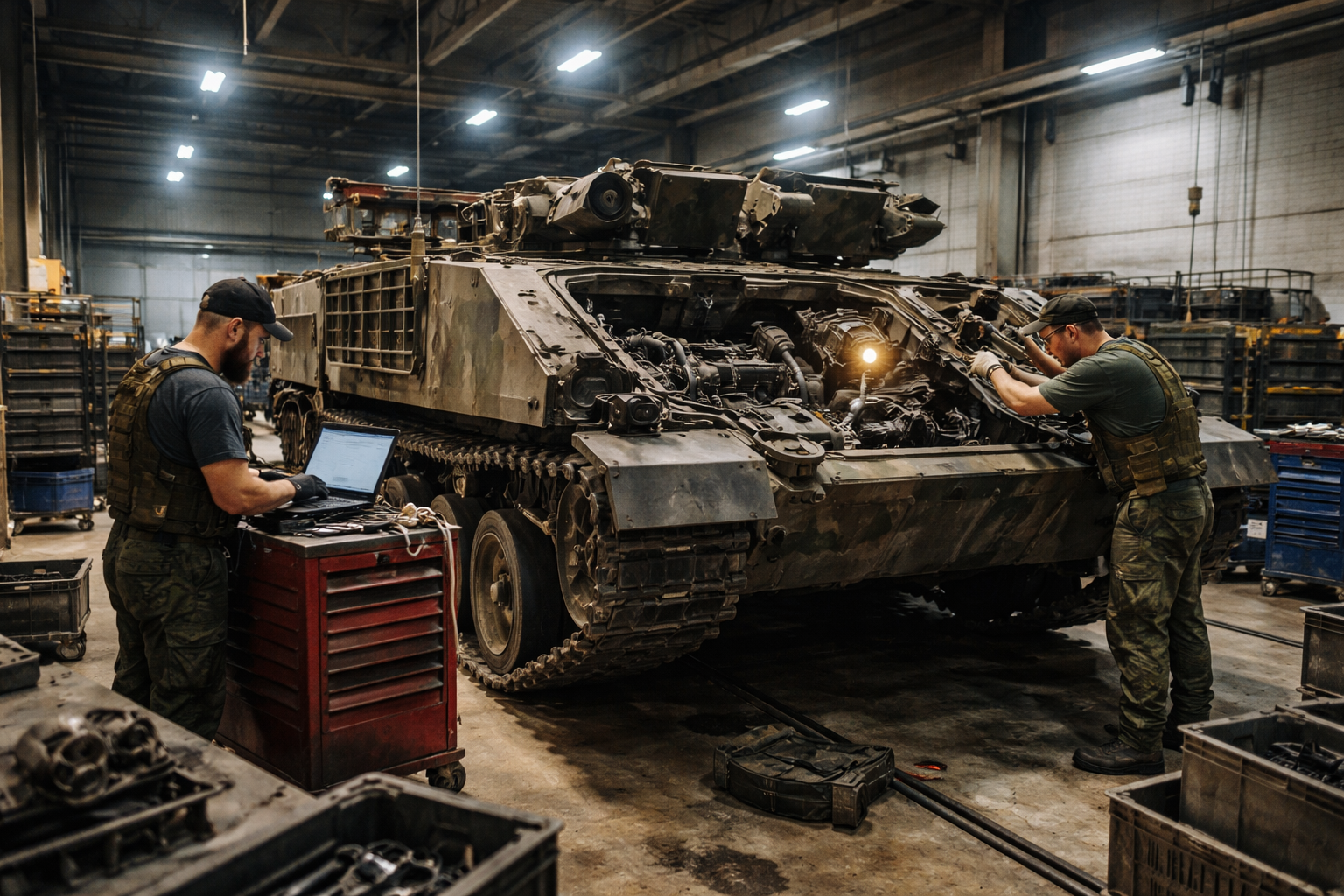
For manufacturers, higher vehicle output is only one part of the challenge. Armies need vehicles that can be sustained in high-use conditions. Tracks, running gear, transmissions, engines, final drives, and cooling systems become decisive when vehicles operate across rough terrain, carry additional protection, and require rapid repair close to operational areas. A vehicle that cannot be recovered, maintained, and returned to service efficiently becomes a production liability as well as an operational problem.
Europe’s armoured vehicle sector also faces a sequencing problem. Governments want faster delivery, but supply chains for heavy vehicle components were sized for smaller peacetime batches. Expanding hull fabrication is difficult; expanding highly engineered driveline production can be slower still. Skilled labour, machining capacity, heat treatment, inspection, software-controlled test rigs, and supplier qualification all limit how quickly output can grow.
The RENK–Rheinmetall extension shows why prime contractors are moving to secure critical suppliers earlier. Long framework agreements give subsystem manufacturers a stronger basis for investment and reduce the risk of production schedules being built around components that are not available in sufficient numbers.
The Lynx is also competing in a market where customers want industrial participation as well as modern protection, digital architecture, lethality, and growth space. Local assembly and national workshare can help secure orders, but they do not remove the need for qualified propulsion suppliers. If final assembly is localised while the driveline remains dependent on a narrow supplier base, the programme still inherits a central bottleneck.
The same pressure is visible across European land systems, where KNDS’s conversion of the Görlitz rail plant into an armoured vehicle hub shows how the continent is looking for capacity beyond traditional defence sites. Heavy vehicle production is now a wider industrial mobilisation effort rather than a closed set of established military factories.
Propulsion deserves more attention because it sets the practical ceiling for many armoured vehicle programmes. A factory can weld hulls, install mission systems, and paint vehicles, but without reliable transmissions and final drives the line stalls. Heavy vehicle manufacturing is a chain, and the slowest specialised link dictates output.
Once vehicles are fielded, propulsion systems generate recurring support demand. Spare transmissions, overhaul capacity, field repair kits, diagnostic tools, and trained maintainers become part of the programme’s industrial footprint. The more Lynx fleets grow across Europe, the more regional support capacity will be needed to avoid sending major components back through congested supply routes.
The RENK agreement gives Rheinmetall a stronger foundation for future Lynx production, while highlighting how European rearmament is changing supplier relationships. Subsystem companies are no longer quiet second-tier actors feeding occasional batches into peacetime lines. They are capacity gatekeepers.
For NATO armies seeking heavier and more survivable vehicle fleets, Lynx production will be judged in vehicles delivered. For industry, the deeper measure will be whether Europe can scale the parts that keep those vehicles moving.