IN Brief:
- Trinity Robotics has secured investment from Defence Builder Fund I, Front Ventures, and Hede Capital.
- The company plans to scale Konyk ONE production from up to 70 systems a month toward more than 150.
- Ukraine’s UGV sector is turning battlefield feedback into a faster manufacturing and iteration loop.
Ukrainian unmanned ground vehicle developer Trinity Robotics has raised more than €500,000 to expand production of its Konyk ONE platform, as frontline demand turns ground autonomy into a manufacturing problem.
The investment comes from Defence Builder Fund I alongside Swedish investors Front Ventures and Hede Capital. Konyk ONE is already in service with more than 20 military units across multiple frontline sectors, and Trinity is moving from production of up to 70 systems per month toward more than 150.
The platform is designed for logistics, casualty evacuation, mining, and demining tasks. It can carry up to 300 kg, travel 45 km under full load on a single charge, and be controlled at ranges up to 12 km. The vehicle is rated IP54 and is sized to fit in the bed of a standard pickup, reducing transport complexity for units operating under constant pressure.
Ground robots have an obvious role in Ukraine. They can move supplies, evacuate casualties, and perform dangerous engineering tasks without putting soldiers into exposed routes. In an environment shaped by drones, artillery, mines, and electronic warfare, logistics and evacuation UGVs offer a practical way to reduce exposure on repetitive high-risk missions.
For manufacturers, the production tempo is the sharper development. Ukraine’s unmanned ground vehicle market remains small in value compared with aircraft, missiles, or armoured vehicles, but it is growing quickly. Logistics and evacuation platforms are driving much of that growth because they address daily operational needs rather than occasional specialist tasks.
Konyk ONE appears shaped by use rather than showroom design. Payload capacity, range, weather resistance, pickup transportability, modular communications, and autonomy options point to a system built for quick deployment and iterative improvement. That creates a different industrial rhythm from traditional defence vehicle programmes.
A conventional military vehicle can spend years in requirement definition, trials, redesign, and procurement. Ukrainian ground robotics has often moved through a compressed loop: unit demand, prototype, field use, feedback, modification, and small-batch production. The challenge now is to preserve that speed while improving repeatability, quality assurance, documentation, and supply security.
The same Ukrainian compression is visible in interceptor and uncrewed aircraft production, where companies are being forced to narrow the gap between engineering and operational validation. War has turned the battlefield into a constant test environment, but scaling from urgent adaptation to stable manufacture requires a different set of disciplines.
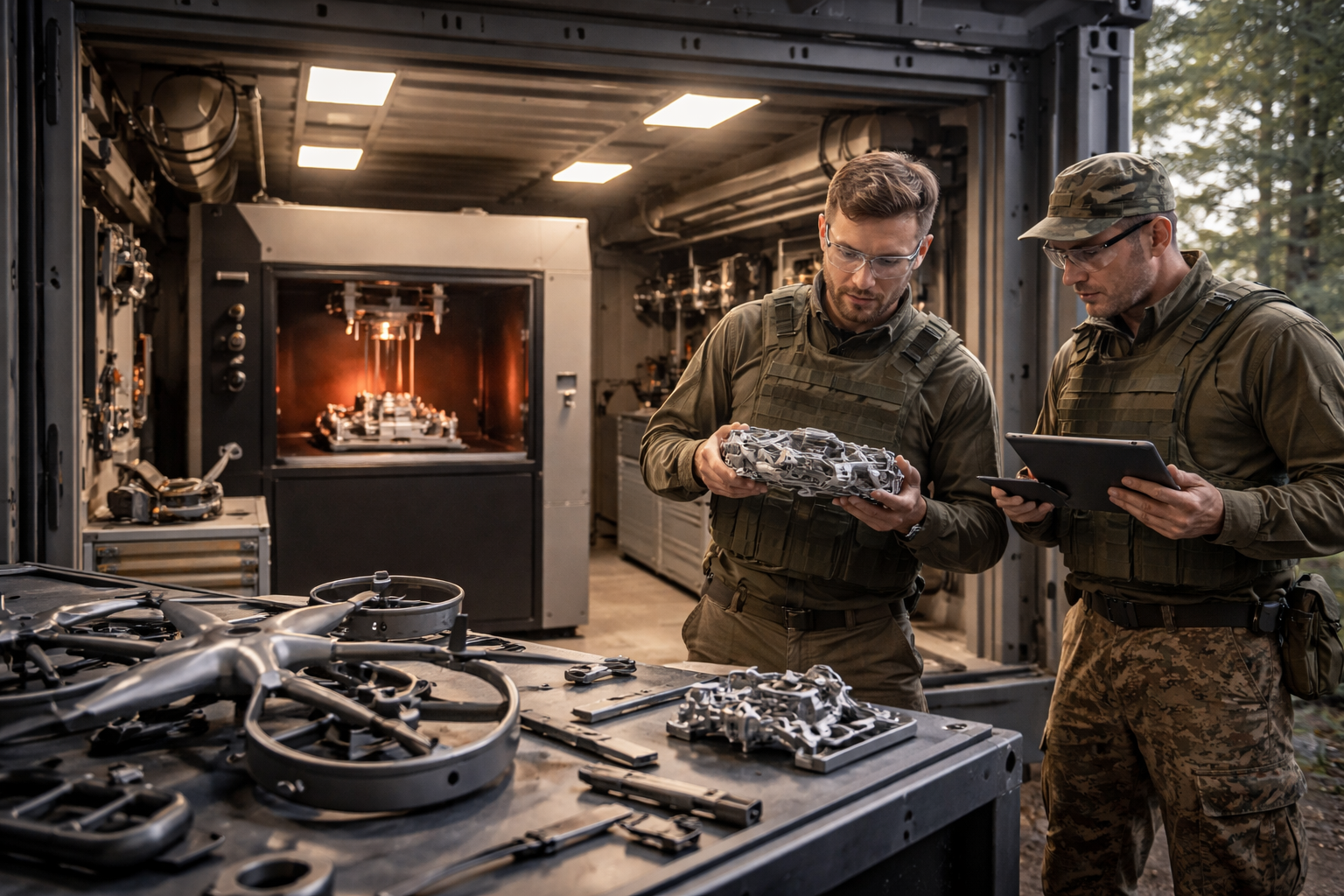
For Trinity, moving from tens of systems per month to more than 150 changes the company. Suppliers must deliver motors, controllers, batteries, structures, wheels or tracks, wiring, radios, sensors, and machining capacity on schedule. Quality problems that are manageable in small batches become expensive and operationally dangerous once vehicles are deployed across many units.
Ground robots also face a hard reliability test. A logistics UGV that fails on a contested route can block movement, lose cargo, expose recovery teams, or leave a casualty in danger. Manufacturing consistency, environmental sealing, battery safety, drivetrain robustness, and serviceability are therefore as central as autonomy features. The platform must be repairable under field conditions by personnel who cannot wait for factory technicians.
The investment also signals widening European interest in Ukraine’s defence technology base. Nordic investors are not simply funding a Ukrainian company; they are connecting frontline-validated engineering with European capital and, potentially, manufacturing depth. If that pattern continues, Ukraine may become an experimental and production partner for European land autonomy rather than only a recipient of equipment.
European armies are beginning to absorb Ukraine’s lessons around contested logistics, casualty evacuation, mine clearance, and the limits of crewed exposure. UGVs that can carry meaningful loads, operate with limited infrastructure, and be manufactured affordably will have a clearer procurement case than more elaborate robots built for narrow demonstrations.
There is still a gap between wartime scaling and NATO qualification. Export customers will want documentation, safety certification, electromagnetic compatibility testing, secure communications, spares packages, training material, and long-term support. Trinity’s next phase will be judged by whether it can build that industrial wrapper without losing the field-driven pace that made the product relevant.
Konyk ONE is not a heavy armoured vehicle, and it does not need to be. Its value lies in replacing human exposure on repetitive, dangerous tasks. That requirement can grow quickly once armies accept the concept.
Ukraine’s ground robotics sector is moving from improvisation toward manufacture. Trinity’s funding round adds another sign that the next bottleneck will not be ideas, but production discipline.