IN Brief:
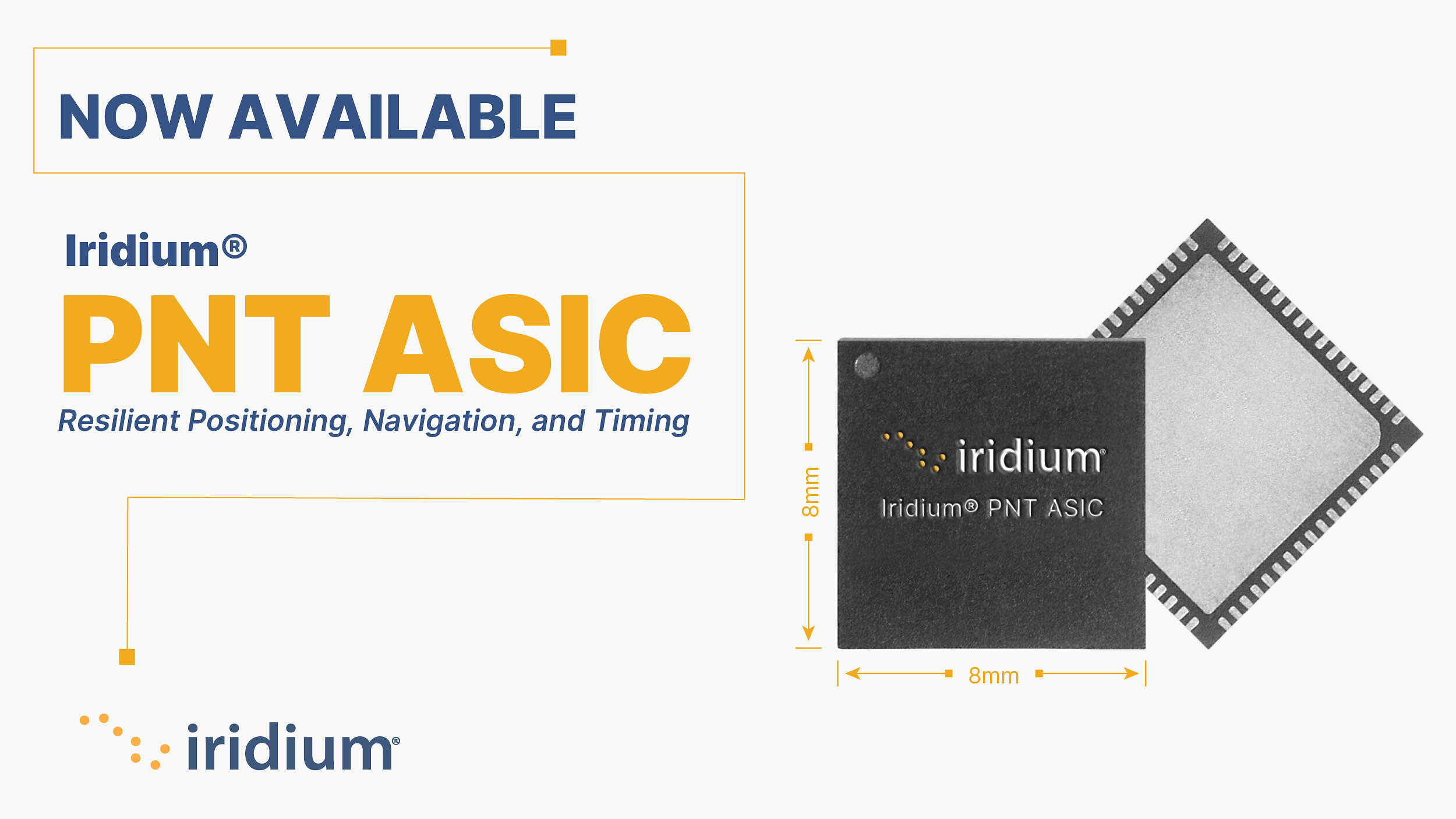
- The Iridium PNT ASIC measures 8mm by 8mm and weighs less than 0.2 grams.
- More than 150 organisations have expressed interest since its October 2025 unveiling.
- Integration is underway across aviation, autonomous systems, communications, maritime equipment, and critical infrastructure.
Iridium Communications has made its positioning, navigation, and timing application-specific integrated circuit commercially available, bringing an alternative source of trusted location and timing data into an 8mm by 8mm package.
Weighing less than 0.2 grams, the Iridium PNT ASIC receives cryptographically protected signals from the company’s low-Earth-orbit satellite network. Its one-way bursts are designed to remain usable where conventional global navigation satellite system signals are weak, jammed, spoofed, or unavailable.
More than 150 organisations have engaged with the technology since its unveiling in October 2025. Interest covers aviation, maritime equipment, telecommunications, uncrewed vehicles, autonomous systems, government applications, and critical infrastructure.
Rather than replacing GPS or another GNSS constellation, the ASIC adds an independent source against which position and time can be compared. Equipment can use disagreement between signals to detect when conventional navigation data has become unreliable.
Spoofing is particularly difficult because a receiver may continue displaying a plausible location while being led away from its true position. Complete signal loss is generally easier to identify than false data that remains internally consistent.
Resilient systems therefore compare several inputs, monitor their confidence, and determine when one source should be rejected. Iridium’s signal can sit alongside GNSS, inertial sensors, clocks, maps, terrain information, and other navigation aids.
The package size alters the range of equipment able to carry assured PNT. Earlier solutions often required a separate line-replaceable unit, antenna, power supply, cabling, and integration space.
An ASIC can be incorporated directly into communications equipment, flight computers, vehicle electronics, timing devices, and compact navigation modules, allowing resilience to enter the original design rather than being added later.
Physical size does not remove systems-engineering work. Manufacturers must design circuit boards, antennas, power conditioning, secure interfaces, software drivers, and algorithms that decide how the additional information is used.
Solace Communications is integrating the component into its Vector assured-PNT family, combining Iridium data with multi-band GNSS and inertial sensing. The system assigns confidence scores while LTE and Iridium Short Burst Data support telemetry and messaging.
Skyband Systems plans to use the ASIC within its M100 aviation line-replaceable unit. Iridium PNT and onboard inertial sensors will be combined to alert crews to interference and maintain aircraft-location awareness.
Both integrations illustrate that the chip is an enabling component rather than a complete navigation system. Its operational value depends on sensor fusion, fault detection, software assurance, user presentation, and the quality of the surrounding hardware.
Semiconductor manufacture introduces its own supply-chain demands. Application-specific chips require design, wafer fabrication, packaging, and electrical testing, often through several specialist companies located in different countries.
Defence and aerospace customers expect long-term availability, traceability, controlled design changes, and secure handling. Commercial semiconductor processes can become obsolete far sooner than the platforms using them.
Lifecycle planning may require long-term foundry agreements, redesign provisions, or lifetime purchasing. Stockpiling protects against obsolescence but ties up capital and can create storage or authenticity risks.
Environmental qualification will differ between applications. Aircraft, missiles, ships, ground vehicles, and fixed infrastructure expose electronics to vibration, temperature, humidity, electromagnetic interference, and irregular power.
Integrators must qualify the complete product rather than rely on the chip specification alone. Circuit-board design, soldering, connectors, antennas, enclosures, and software all influence performance under operating conditions.
Aviation certification adds further scrutiny. Alerting a crew to possible spoofing requires low false-alarm rates and an interface that remains understandable during high workload.
Using the signal directly within safety-critical navigation would demand more extensive assurance than presenting it as a secondary indication. Manufacturers need to define clearly how their equipment behaves when inputs disagree.
Precise timing creates a market beyond moving platforms. Telecommunications networks, power grids, financial systems, data centres, and military communications depend on synchronised clocks even when no vehicle is determining position.
GNSS interference can therefore disrupt network coordination, electrical protection, data ordering, and secure communications. A compact alternative distributed through embedded equipment could reduce reliance on a single timing source.
Several other approaches are being developed for denied environments, including compact APNT cards for military platforms, new production of military navigation receivers, and Britain’s investment in terrestrial eLoran infrastructure.
The Iridium ASIC works at component level, allowing original equipment manufacturers to add another PNT source without installing a large separate system. Wider adoption will depend on unit cost, antenna requirements, service arrangements, and the engineering effort needed for integration.
Security remains dependent on implementation. Protected satellite signals reduce the risk of fabricated data, but firmware, keys, interfaces, and update routes within the host product must also remain secure.
Commercial availability moves the component into design and qualification programmes. Production orders, completed integrations, and performance during genuine interference will show how far its compact form can extend assured PNT across defence and critical infrastructure.