IN Brief:
- The US Navy has awarded contracts covering nine Block VI Virginia and five Build II Columbia submarines.
- General Dynamics Electric Boat and HII Newport News Shipbuilding will divide construction and module work across both classes.
- Delivery depends upon labour, nuclear qualified suppliers, infrastructure, design maturity, and coordinated production sequencing.
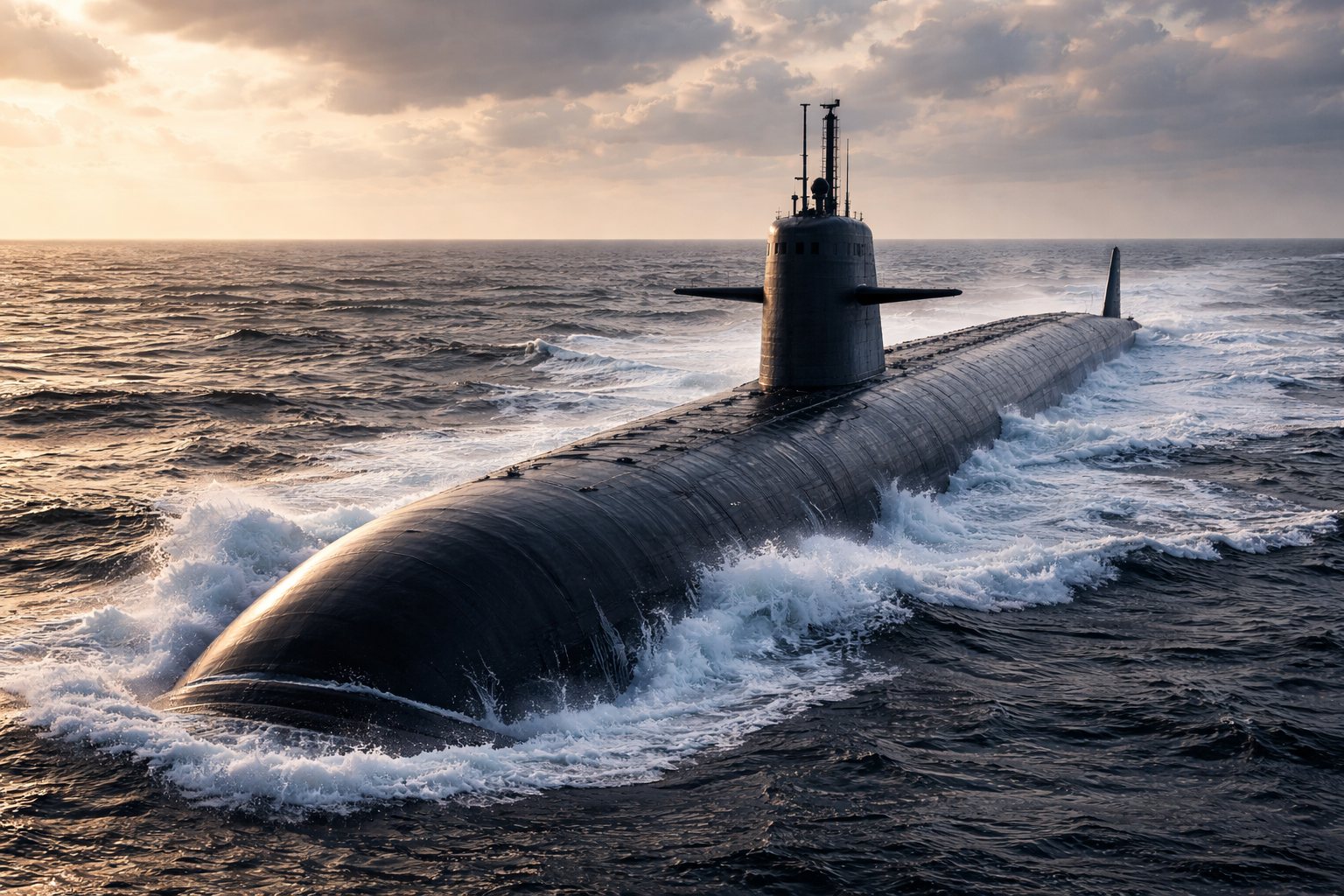
The US Navy has awarded contract modifications valued at a combined $76.6 billion for nine Block VI Virginia class attack submarines and five Build II Columbia class ballistic missile submarines.
General Dynamics Electric Boat and HII’s Newport News Shipbuilding will continue their established construction partnership across both programmes. The package also provides material and infrastructure funding intended to support a production plan extending well into the 2030s.
Newport News is expected to act as delivery yard for six of the Virginia boats while continuing to manufacture major Columbia modules. Electric Boat remains the Columbia prime contractor and delivery yard, while sharing Virginia construction with Newport News.
The award provides a substantial order horizon, but both programmes depend upon an industrial base already carrying heavy schedule pressure. Nuclear submarine manufacture requires qualified welders, pipefitters, electricians, machinists, planners, inspectors, engineers, and suppliers capable of producing specialised equipment at comparatively low volumes.
Virginia and Columbia draw upon many of the same yards, module facilities, design teams, nuclear qualified vendors, heavy component manufacturers, and specialist workers. Although the classes differ in role, size, equipment, and construction sequence, pressure on a common supplier or trade can affect both.
Columbia carries the highest national priority because it must replace the Ohio class deterrent fleet within a schedule that has limited margin. When industrial capacity is insufficient, labour and components may be redirected to protect Columbia milestones, leaving Virginia output exposed to further delay.
The latest package follows earlier Block VI design and preconstruction work, moving the class towards a much larger construction commitment. Design maturity will now influence whether modules flow through the yards or accumulate rework.
Submarine output is governed by physical processes that cannot be accelerated solely through larger orders. Pressure hull fabrication, nuclear component manufacture, non destructive examination, module outfitting, pipework, cabling, and testing require qualified facilities and experienced personnel.
New employees may need several years of training before performing the most specialised work independently. Experienced workers are simultaneously required on current boats, supplier support, quality investigations, rework, and instructor duties, creating a delay between recruitment and additional productive capacity.
Supplier constraints can be less visible than shipyard shortages. A late valve, pump, casting, switchboard, acoustic component, or test unit can interrupt work across a much larger module, while replacement may be difficult if only one company holds the necessary process approval.
Some vendors rely upon a single machine, heat treatment facility, material source, or employee authorised to approve controlled documentation. Capital support and long term orders can reduce that exposure, but new capacity must still be built, qualified, staffed, and connected with the shipyard schedule.
Multiyear contracting gives suppliers a stronger basis for investment than a sequence of annual awards. Tooling, buildings, workforce programmes, and material orders can be planned against a clearer demand signal, provided technical requirements and delivery schedules remain stable.
Late design changes can undermine that stability. Digital models and modular construction improve coordination, but they cannot remove the cost of moving machinery, rerouting services, reopening finished spaces, or changing parts already distributed across several suppliers.
Infrastructure spending must also produce usable throughput rather than additional floor area alone. New buildings, cranes, docks, machines, and assembly stations require trained operators, qualified processes, maintenance support, and a production sequence that prevents the bottleneck moving elsewhere.
The award carries consequences beyond the US fleet because AUKUS depends upon increased American submarine output and the availability of Virginia boats for Australia. The emergence of Australian steel within Virginia class production shows how allied suppliers are beginning to enter the programme.
Adding overseas capacity can widen the supplier base and prepare Australia for future submarine work, although nuclear standards demand extensive qualification, security, documentation, traceability, and manufacturing evidence. Initial components are likely to remain comparatively limited while suppliers demonstrate repeatable performance.
The industrial system must consequently satisfy three overlapping demands: deliver Columbia on time, restore Virginia output, and create enough additional capacity to support AUKUS without weakening either domestic programme.
Financial scale gives the yards and their suppliers the ability to pursue expansion, but accepted submarines will depend upon first time quality, component availability, module flow, infrastructure readiness, and fewer hours devoted to post delivery correction.
The $76.6 billion package secures a formidable quantity of work. Its success will be measured by whether two submarine classes can move through the same constrained industrial network without competing indefinitely for the labour, suppliers, facilities, and engineering decisions each requires.