IN Brief:
- American Rheinmetall leads an 18-month US Army contract for hybrid autonomous ground vehicles.
- Harbinger supplies commercial vehicle technology, Forterra provides autonomy, and Primordial Labs adds voice control.
- Testing will examine how the integrated system supports company-sized logistics movements and potential follow-on production.
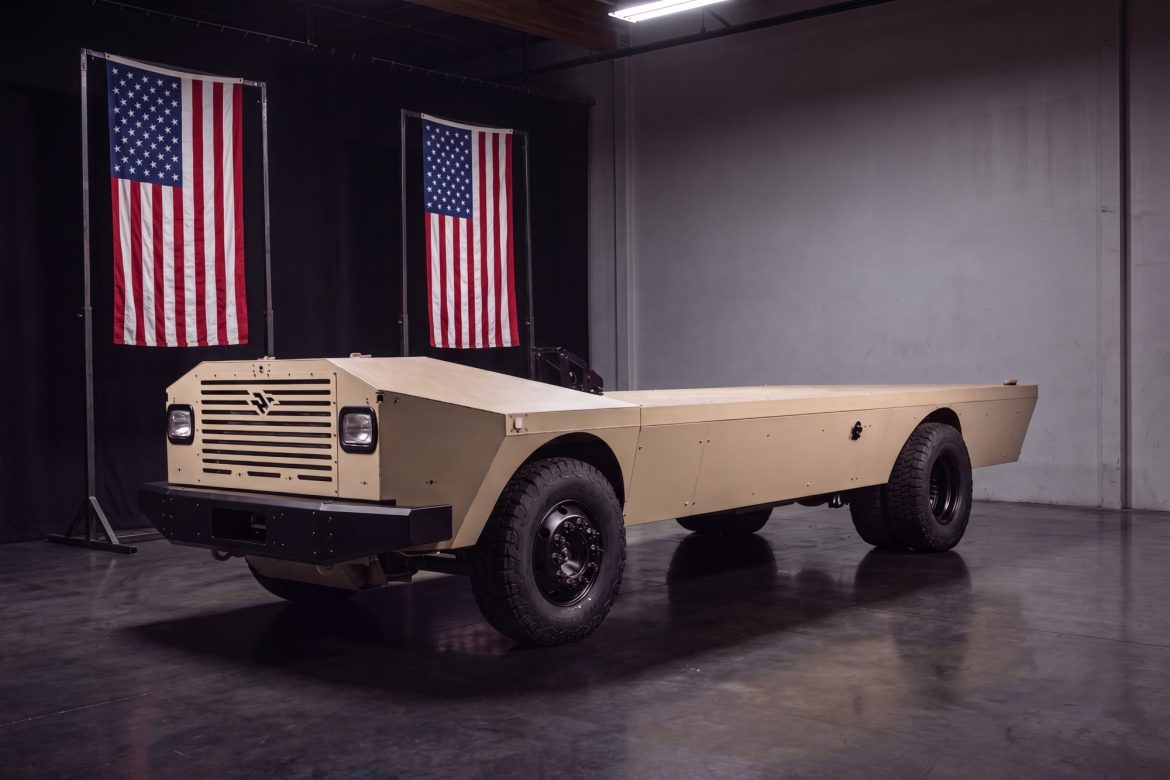
American Rheinmetall has received an 18-month US Army Project Sustainment contract to develop and demonstrate hybrid-powered autonomous ground vehicles for company-level logistics. The team combines commercial vehicle technology from Harbinger, autonomous-driving software from Forterra, and the Anura natural-language interface developed by Primordial Labs.
The award was made through the National Advanced Mobility Consortium, with American Rheinmetall acting as prime contractor and system integrator. Work will take place across US facilities and test ranges. The announcement does not disclose the contract value, number of vehicles, delivery timetable within the 18-month period, or the exact vehicle configuration selected for testing.
Project Sustainment is examining how uncrewed ground vehicles can move supplies to and from forward locations while reducing the number of personnel required to drive repetitive logistics routes. The requirement is aimed at supporting a company-sized element rather than replacing an entire military transport fleet. That keeps the immediate engineering task within a bounded demonstration while leaving room for follow-on orders if the system meets Army objectives.
Harbinger brings commercial vehicle technology and production expertise to the team. The military configuration must still accommodate payload, mobility, communications, environmental, and support requirements that differ from civilian delivery work. The hybrid architecture is intended to combine electric-drive characteristics with extended operating flexibility.
Forterra supplies the autonomous-driving system. A military logistics autonomy package has to perceive terrain and obstacles, plan routes, control the vehicle, and respond safely when conditions fall outside its expected model. Steering, braking, power management, sensors, and communications must remain coordinated across a vehicle assembled from several suppliers’ subsystems.
Primordial Labs adds Anura, a natural-language human-machine interface intended to let operators direct the vehicle by voice. Voice control is intended to reduce the need for code or complex control-station inputs when assigning ordinary movement tasks. Spoken instructions must still be interpreted within authorised limits, confirmed where necessary, and translated into actions that the autonomy stack can execute safely.
Hybrid power, autonomous driving, and voice control create a tightly coupled system. A route decision affects energy use; payload and terrain affect range; communications availability can change the level of supervision; and a natural-language command must remain consistent with vehicle status and mission constraints. Testing therefore has to examine the complete vehicle rather than validate each technology in isolation.
The team also brings together different production cultures. Harbinger is focused on commercial vehicle scale, Forterra on autonomous systems, Primordial Labs on software interaction, and Rheinmetall on military integration and customer delivery. Project management will have to control interfaces, software versions, test evidence, and responsibility for faults that appear only when the subsystems operate together.
American Rheinmetall has said the contract may lead to follow-on production, but no quantity or acquisition decision has been committed. Demonstration contracts often produce useful technical evidence without automatically becoming programmes of record. The Army will have to assess reliability, maintainability, logistics benefit, operator workload, cyber protection, and the cost of fielding and sustaining the complete system before moving beyond the current phase.
The 18-month schedule provides a short window for integration and representative testing. Commercial components can shorten development, but they do not remove qualification, safety, or military support requirements. By contract end, the team must show that its vehicle, autonomy, and control architecture can perform repeatable logistics work rather than produce another polished demonstration without a procurement route.
Cyber and safety assurance will cut across the demonstration. An autonomous logistics vehicle receives commands, processes sensor data, and may exchange information with remote supervisors, creating interfaces that need authentication and controlled software updates. Voice input adds another route for instructions. The release does not describe the communications architecture or security controls, so the test programme must establish that convenience does not weaken command authority or fail-safe behaviour.
Maintenance will be another test of commerciality. The Army will need to understand which parts can be supported through ordinary commercial channels and which require military spares, specialist tools, or controlled software. A platform that drives itself but waits for a unique component during repair has solved only half of the logistics problem.
The 18-month period will also test whether the commercial and military supply chains can be joined without creating a support gap. Vehicle hardware may follow commercial production cycles, while autonomy software, secure communications, and military-specific components require controlled baselines and qualified updates. The team must align those different release rhythms so that a vehicle entering a test event has a traceable hardware and software configuration.