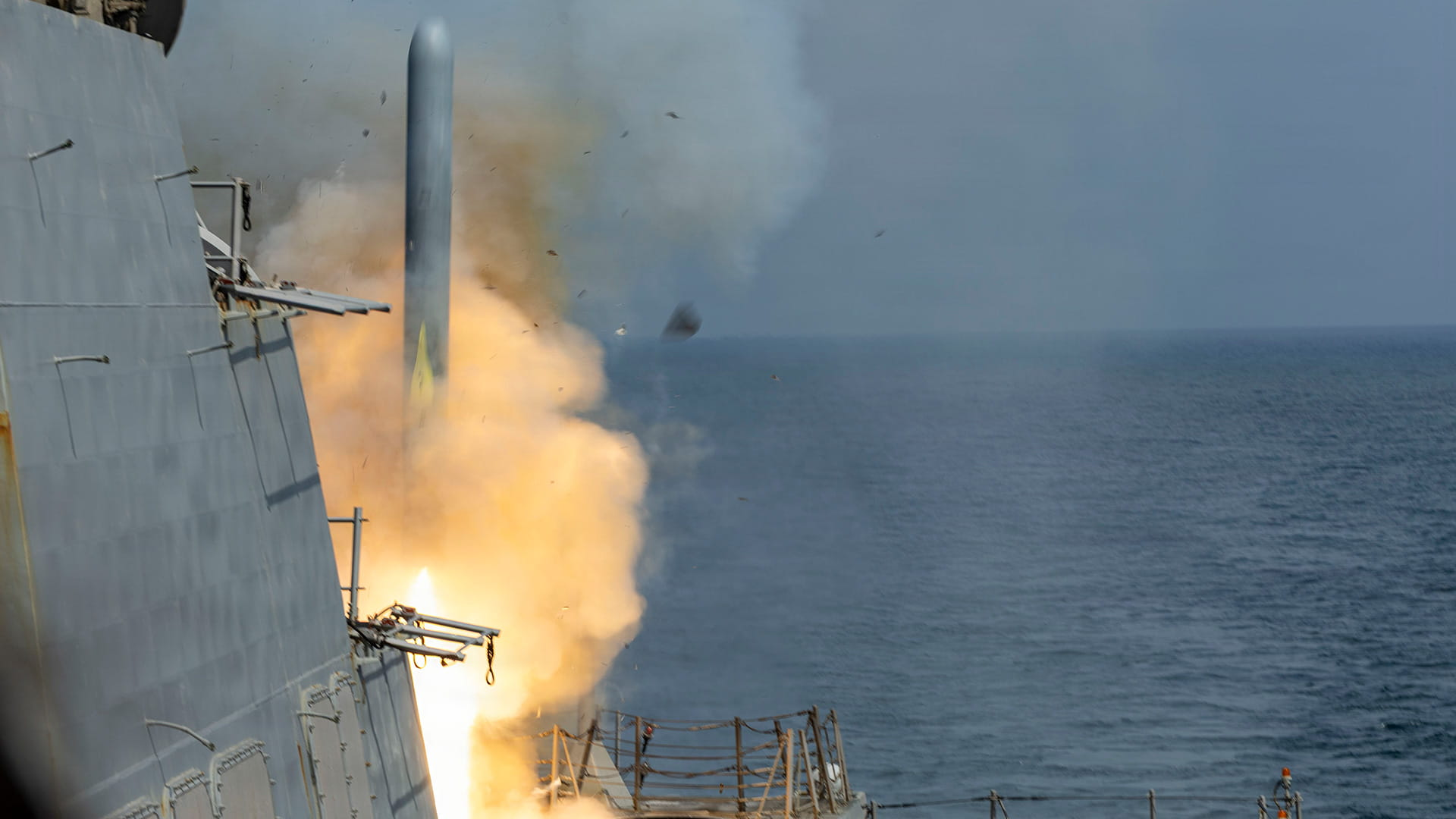
IN Brief:
- Raytheon has received a $22.9 billion multi-year Tomahawk production contract from the US Navy.
- The award supports the previously agreed production ramp to more than 1,000 missiles annually.
- RTX says Tomahawk deliveries in the first half of 2026 were three times the level achieved a year earlier.
Raytheon has received a $22.9 billion multi-year contract to accelerate Tomahawk cruise-missile production for the US Navy, turning an earlier manufacturing agreement into a funded programme supporting annual output above 1,000 missiles.
The contract runs for seven years and was awarded under the US Department of War’s wider effort to increase munitions capacity. It follows agreements reached with Raytheon earlier in 2026 covering production expansion across Tomahawk and several other missile families.
The distinction matters because the target of more than 1,000 Tomahawks per year is not new to the 17 August award. Raytheon had already disclosed the intended production ramp in February; the latest contract provides the long-term procurement framework and associated support needed to move that capacity plan into sustained production.
RTX says it delivered three times as many Tomahawks in the first half of 2026 as it did during the equivalent period in 2025, indicating that output has already begun to increase before the full seven-year programme reaches maturity. The company is continuing to invest in workforce, facilities, technology, and suppliers to support the higher rate.
Tomahawk is a long-range cruise missile deployed from naval launch platforms, with current production supporting both land-attack and maritime-strike configurations. Its maturity can obscure the industrial challenge involved in increasing output: a missile that has been manufactured for decades still depends on a network of propulsion, guidance, navigation, control, electronics, structural, energetic, warhead, and test suppliers whose capacity reflects historic order volumes.
Raising final assembly without expanding those upstream suppliers simply moves the bottleneck. Every missile requires a matched set of qualified components, and many specialist suppliers support more than one weapons programme. A production increase therefore has to propagate through the supply chain rather than stop at Raytheon’s own assembly operation.
The seven-year structure gives those suppliers a clearer demand horizon against which to invest. Specialised defence manufacturing equipment can be expensive and programme-specific, while staff require training and, in some cases, security clearances or process qualifications. Suppliers are more likely to add machinery, floor space, shifts, and skilled workers when the customer requirement extends across several years rather than a succession of small annual orders.
RTX’s February manufacturing plan identified Tomahawk alongside AMRAAM, SM-3, and SM-6 as programmes requiring substantial output growth. The company has said its overall munitions deliveries were already more than 40% higher year on year when those agreements were announced.
For Tomahawk specifically, RTX has been investing in production facilities in Tucson, Arizona. That work forms part of a wider capital programme covering missile manufacturing and is intended to provide the physical capacity required to move production towards the four-figure annual target.
The production problem extends beyond buildings. Missile manufacture is controlled by qualification, traceability, inspection, explosive-safety procedures, environmental testing, software configuration, and acceptance testing. Increasing throughput has to preserve those controls because a weapon may remain stored for long periods before being expected to function immediately under operational conditions.
Tomahawk also continues to evolve while production expands. Current versions incorporate changes to navigation, communications, targeting, and mission capability, including the Maritime Strike Tomahawk configuration. Higher manufacturing rates therefore have to coexist with engineering change and configuration control rather than reproducing a static design indefinitely.
That creates a more difficult industrial problem than simply duplicating an existing production line. New equipment and suppliers have to be qualified against the approved missile configuration, while changes to hardware or software must be introduced without creating incompatible batches or disrupting output.
Associated support is therefore explicitly included in the latest award. For the Navy, predictable supply depends on maintaining the tooling, engineering, test capability, supplier network, and specialist workforce behind the missile rather than merely buying a fixed number of completed rounds.
The contract also shows how the Pentagon is using longer procurement horizons to shape industrial behaviour. Traditional annual contracting can leave manufacturers reluctant to invest heavily in capacity that may no longer be required after a short production surge. A seven-year commitment provides greater certainty, although it also places more pressure on the contractor to demonstrate that investment translates into measurable deliveries.
Raytheon’s first-half delivery increase provides an early indication of movement, but producing more than 1,000 Tomahawks annually will require output to stabilise at a substantially higher level across hundreds of suppliers. Capacity added at the prime contractor will only be useful if propulsion, electronics, structures, energetic materials, and test operations rise with it.
The 17 August award therefore settles an important part of the demand question. The industrial task now is to convert the $22.9 billion commitment and earlier production framework into a repeatable manufacturing rate, with the supply chain capable of maintaining volume without trading away quality, configuration control, or delivery reliability.