IN Brief:
- TurbineOne has opened T1 MachineWorks in Old Town, Maine, with an initial investment of $275,000.
- The facility supports edge AI, autonomous systems, 3D manufacturing, and rapid prototyping for defence applications.
- The site adds engineering and test capacity while TurbineOne executes a US Army contract valued at nearly $99m.
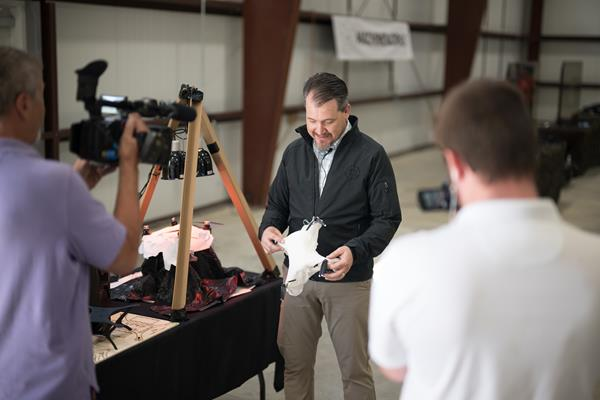
TurbineOne has opened T1 MachineWorks in Old Town, Maine, creating a development and test facility for edge artificial intelligence, autonomous systems, rapid prototyping, and three-dimensional manufacturing for defence applications.
The operation has opened following an initial $275,000 investment and expands TurbineOne’s US engineering footprint while the company executes a US Army contract valued at nearly $99 million.
TurbineOne develops artificial-intelligence software intended to run directly on tactical hardware rather than depending continuously on cloud infrastructure. The company says its technology is already deployed across the US military and is designed to operate in both connected and disconnected environments.
T1 MachineWorks adds physical engineering capability around that software. Planned work includes experimentation with autonomous systems, cross-platform autonomy software, 3D manufacturing, rapid prototyping for aerial platforms, and other defence technology projects.
Bringing those functions together addresses one of the less glamorous constraints in military AI development: software cannot be separated indefinitely from the hardware expected to carry it. Algorithms developed on high-performance engineering computers eventually have to operate on processors with limited power, cooling, mass, and communications capacity.
Edge processing shifts more computation onto deployed equipment so sensing or decision-support functions can continue when data links are weak or unavailable. That reduces dependence on remote computing infrastructure but places tighter limits on model size, processor utilisation, thermal output, storage, and electrical demand.
Those restrictions become more visible when software is installed on an aerial or autonomous platform. Computing hardware competes with sensors, radios, payloads, batteries, motors, and other equipment for weight and power, leaving software developers dependent on engineering trade-offs that cannot be reproduced fully on a desktop system.
The Old Town facility gives TurbineOne a location for testing more of those interactions directly. Hardware can be modified, printed, assembled, and taken into trials without every iteration passing immediately through a conventional production supplier.
Rapid prototyping can shorten that cycle considerably. Mounts, housings, sensor brackets, payload interfaces, and other low-volume parts can be revised through additive or conventional manufacturing as engineers discover problems in flight, vehicle integration, thermal management, or physical access.
The disclosed investment remains modest by defence-factory standards, and T1 MachineWorks should not be confused with a high-volume production plant. Its industrial role is at the engineering end of the chain, where configurations are changed repeatedly before they are stable enough to justify tooling and repeatable serial manufacture.
TurbineOne says it will work with manufacturing partners in Maine rather than reproducing every process internally. That gives the company a route from rapid in-house iteration to external fabrication and production once a design becomes sufficiently mature.
Old Town was also selected for its proximity to the University of Maine and access to aerial and maritime environments suitable for testing. The combination gives engineers a practical route from software and workshop work into operating conditions that expose sensors and autonomy software to variable weather, terrain, lighting, vibration, and communications.
Those conditions are particularly important for autonomous systems. Recorded datasets and controlled demonstrations can establish that an algorithm works under known circumstances, but field trials expose the less predictable combination of sensor noise, changing backgrounds, moving objects, degraded navigation, poor links, and the behaviour of the physical platform itself.
The new facility also creates an environment for hardware-in-the-loop testing, where software can be exercised against real sensors, processors, communications equipment, or vehicle controllers before a complete system is deployed. That can reveal integration faults earlier than purely simulated development.
TurbineOne’s Army work adds pressure to formalise those processes. A nearly $99 million programme requires more than fast engineering iterations: fielded software and hardware need known configurations, cybersecurity controls, documentation, acceptance evidence, support arrangements, and a disciplined route for issuing later updates.
That can sit awkwardly beside the pace expected of AI development. Machine-learning software benefits from frequent model and code changes, while military sustainment depends on establishing exactly which version is installed on each system and proving that updates do not introduce unacceptable behaviour.
T1 MachineWorks gives TurbineOne a physical environment in which both approaches can meet. Experimental configurations can be changed quickly at the development stage, while more mature designs can be transferred to manufacturing partners once their hardware, software, and interfaces have stabilised.
The opening therefore increases development capacity rather than merely adding another company office. Its performance will be reflected in the rate at which edge-AI and autonomy concepts can be converted into hardware-integrated systems, tested outside the laboratory, and handed into production without losing control of the configuration along the way.