IN Brief:
- Croatia has authorised 18 K239 Chunmoo launchers in a package valued at €544.05 million including VAT.
- Hanwha Aerospace will supply the launchers and rocket ammunition, while WB Electronics provides command-and-control integration.
- The procurement runs from 2026 to 2029, with the Croatian Government citing delivery times, availability, price, and industrial cooperation.
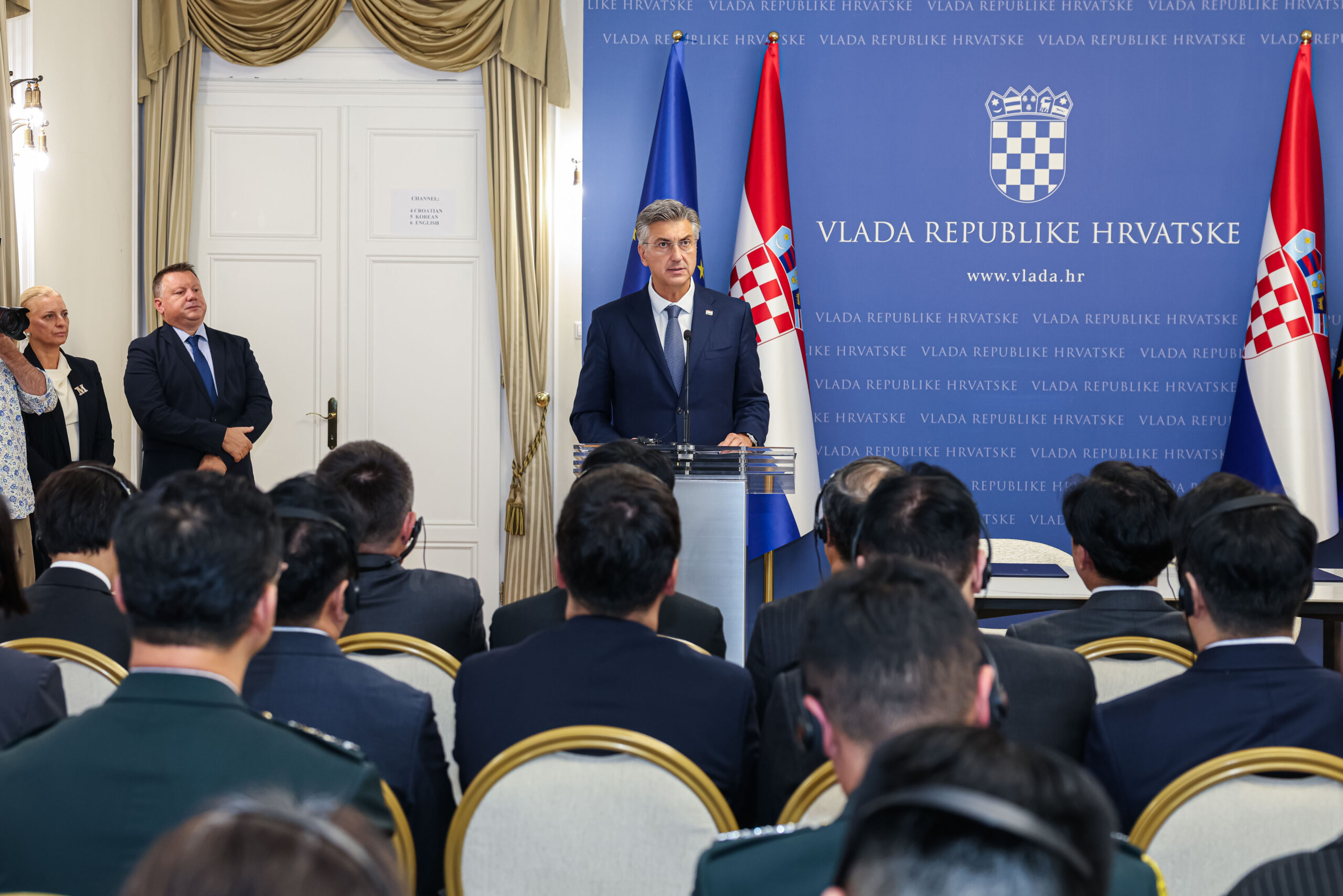
Croatia has authorised the acquisition of 18 K239 Chunmoo multiple-launch rocket systems from South Korea, approving a €544.05 million package that combines Hanwha launchers and ammunition with a Polish command-and-control system.
Hanwha Aerospace will supply the 18 self-propelled launchers and rocket ammunition, while WB Electronics will deliver, install, and integrate the command-and-control system. The Croatian procurement is scheduled to run between 2026 and 2029.
The Croatian Ministry of Defence puts the acquisition at €435.2 million excluding VAT and €544,050,898.75 including VAT. Of that total, approximately €108.8 million is allocated for payment in 2026, with further commitments extending through 2029.
The government decision was taken on 4 September and forms part of a broader package of Croatian military modernisation measures. Chunmoo will replace ageing M-92 Vulkan and BM-21 Grad multiple-launch rocket systems, shifting the land force from legacy rocket artillery towards a modular launcher designed to use several classes of guided and unguided ammunition.
The K239 carries two interchangeable rocket pods, allowing different ammunition types to be loaded on the same vehicle. That architecture provides greater flexibility than Croatia’s existing systems, which are based around older Soviet and Yugoslav-era launcher concepts and substantially shorter engagement ranges.
Croatian officials have cited delivery speed, availability, price, and openness to industrial cooperation among the reasons for selecting the South Korean system. The Ministry of Defence gives an expected delivery period of 24 to 36 months, a relatively short timescale for establishing a new long-range rocket-artillery fleet.
Delivery speed has become an increasingly important factor in European defence procurement because demand for artillery, missile systems, and ammunition has risen faster than established production capacity. Selecting an available system is therefore only useful if launchers can be accompanied by sufficient ammunition, training, maintenance, and integration work on the same schedule.
The WB Electronics contract addresses part of that integration problem. A modern multiple-launch rocket system depends on the digital command chain connecting sensors, target information, firing units, and higher headquarters. Providing a defined command-and-control layer as part of the acquisition should allow Croatia to introduce the launchers as an operational system rather than as isolated firing vehicles.
The multinational architecture also creates a more complex industrial chain. The launcher and ammunition come from South Korea, command-and-control equipment from Poland, and the complete system will have to be integrated into Croatian communications, logistics, training, and maintenance structures.
That arrangement reflects Chunmoo’s expanding European footprint. Poland already operates the system at significantly greater scale, while Estonia and Norway have also moved towards Chunmoo. A larger group of European operators gives Hanwha an incentive to build regional maintenance, training, and ammunition arrangements rather than supporting each national fleet entirely from South Korea.
Croatia will also operate HIMARS, creating two different but complementary rocket-artillery families. Zagreb has presented the systems as filling related long-range fires requirements rather than one replacing the other, which will put additional emphasis on command-system interoperability and ammunition management.
A mixed fleet can give commanders access to different ammunition and supplier bases, but it can also increase the number of spares, training courses, maintenance tools, and technical configurations that the armed forces must support. The practical value will depend on how much commonality Croatia can create at command-and-control level and how its ammunition stocks are managed across the two systems.
The Croatian Government has not published detailed ammunition quantities within the Chunmoo package. That prevents assessment of the initial stock depth, which is a crucial figure for any rocket-artillery system because guided long-range munitions are costly and production lead times can be lengthy.
Through-life industrial cooperation will be another measure of the programme. The government has identified Hanwha’s openness to industrial cooperation as a factor in the procurement decision, but specific Croatian workshare, maintenance responsibilities, or local production arrangements have not yet been publicly detailed.
The 2026–2029 spending profile gives Croatia several years to establish the supporting infrastructure while the launchers and ammunition are delivered. Training, storage, workshop capability, digital integration, and ammunition handling all have to be ready if the fleet is to become operational without an extended period of dependence on foreign support teams.
For Hanwha, Croatia adds another NATO customer to an increasingly important European business. For Zagreb, the programme is a substantial change in artillery capability, but the 18 launchers will only be as useful as the stocks, networks, and maintenance structure assembled around them.