IN Brief:
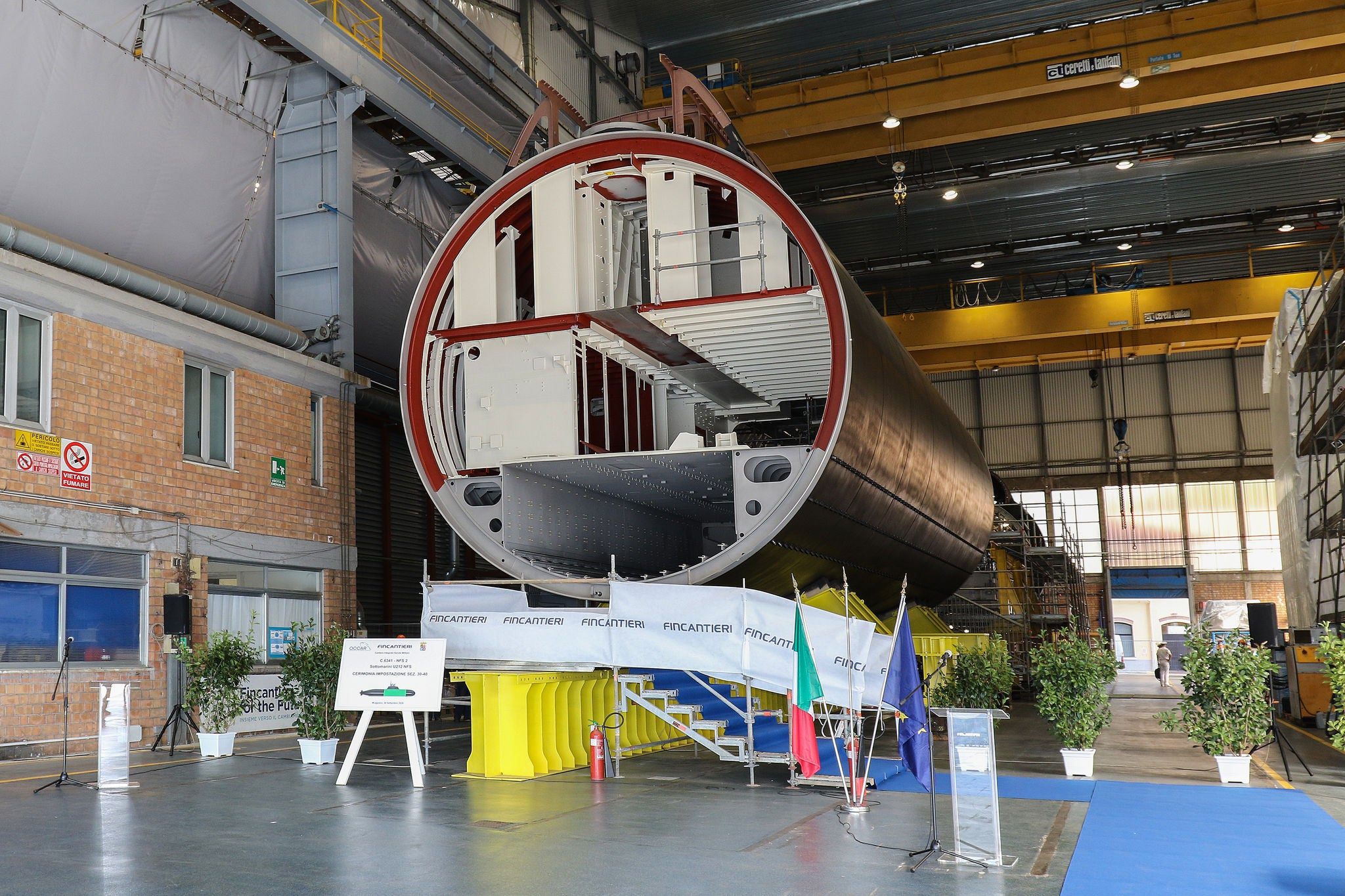
- Fincantieri has laid the keel of the second U212NFS submarine at its Muggiano shipyard.
- The boat is due in 2030, with construction of all four submarines already under way.
- The programme introduces Italian-developed lithium-ion propulsion batteries, a new combat system and expanded lifecycle support.
Fincantieri has laid the keel for the second U212NFS submarine for the Italian Navy at its Muggiano shipyard, moving another boat in the four-submarine programme into a more advanced stage of construction.
The second submarine is scheduled for delivery in 2030. Its keel laying follows the equivalent milestone for the first U212NFS in February 2026, while construction activity is now under way across all four boats in the programme managed by OCCAR on behalf of Italy.
U212NFS, or Near Future Submarine, develops the U212A lineage with a larger proportion of Italian technology and increased integration of onboard systems. Fincantieri remains design authority and prime contractor, retaining responsibility for the overall submarine architecture and construction programme.
Among the principal changes are an Italian-developed lithium-ion propulsion battery and a new combat system. The programme also introduces additional national technology and expanded lifecycle support, increasing the engineering work associated with integration, qualification and later sustainment.
Lithium-ion energy storage changes several aspects of conventional submarine design. Battery management, charging, cooling, electrical protection and safety arrangements have to operate within a tightly controlled underwater platform where heat, space and electrical distribution are already constrained.
The combat system presents a separate integration task, bringing sensors, communications, weapons and command functions together through a software intensive architecture. Changes in one subsystem have to be managed against interfaces elsewhere in the boat, making configuration control increasingly important as several submarines move through production at the same time.
Concurrent construction can preserve workforce continuity and allow production learning to transfer between successive hulls, but it also reduces the time available to absorb design changes before the same equipment or process reaches later boats. Engineering changes have to be introduced without destabilising material already ordered, installed or undergoing qualification.
The second keel laying therefore marks more than ceremonial progress. It confirms continued movement through the production schedule at Muggiano while the first submarine is already further advanced and the remaining boats progress through earlier manufacturing stages.
Fincantieri says the shipyard has more than a century of submarine construction experience and has produced more than 100 submarines. The associated capability includes pressure hull work, specialist welding, outfitting, systems installation and testing supported by a supply chain able to meet naval qualification requirements.
Such infrastructure is difficult to recreate quickly. Submarine programmes rely on specialist facilities and skilled trades that need continuity between orders, particularly where pressure hull manufacture, acoustic performance and tightly packed mechanical and electrical systems impose standards well beyond conventional shipbuilding.
The U212NFS programme has also expanded beyond its original construction scope. A contract amendment agreed in July added new technological capabilities and strengthened integrated logistics support, extending Fincantieri’s work across a larger part of the submarines’ lifecycle.
That amendment included additional underwater countermeasure capability through WASS Submarine Systems and accelerated delivery planning for the wider four-boat programme. Fincantieri has said deliveries across the class are scheduled between 2029 and 2032.
The programme also sits within an established European industrial relationship. In September, Fincantieri and TKMS widened their underwater cooperation framework, building on the U212 family while retaining separate national programmes, design responsibilities and customer requirements.
Italy’s U212NFS programme illustrates how that shared heritage can coexist with greater national system content. Fincantieri is using the basic lineage as the foundation for Italian propulsion, combat-system and support developments while keeping overall configuration authority inside the domestic programme.
The arrangement also sustains a wider industrial chain around Muggiano. Modern submarine construction draws on specialist steel, energy storage, electrical equipment, sonar, optronics, communications, weapons integration and software, with many of those suppliers required to maintain support long after the boats leave the yard.
The second boat is now due to progress through hull assembly, outfitting and systems integration ahead of its planned 2030 delivery. With all four submarines under construction, programme performance will increasingly be measured by how consistently the shipyard can integrate new systems across successive boats while maintaining the delivery sequence through 2032.