IN Brief:
- Sentinel is the first of four new offshore patrol vessels being built by Fassmer for the Republic of Singapore Navy.
- The 2,700-tonne design combines CODLOD propulsion, modular mission capacity, stern launch and recovery and an integrated sensor suite.
- Platform acceptance and sea trials now precede delivery while the remaining three vessels continue through construction.
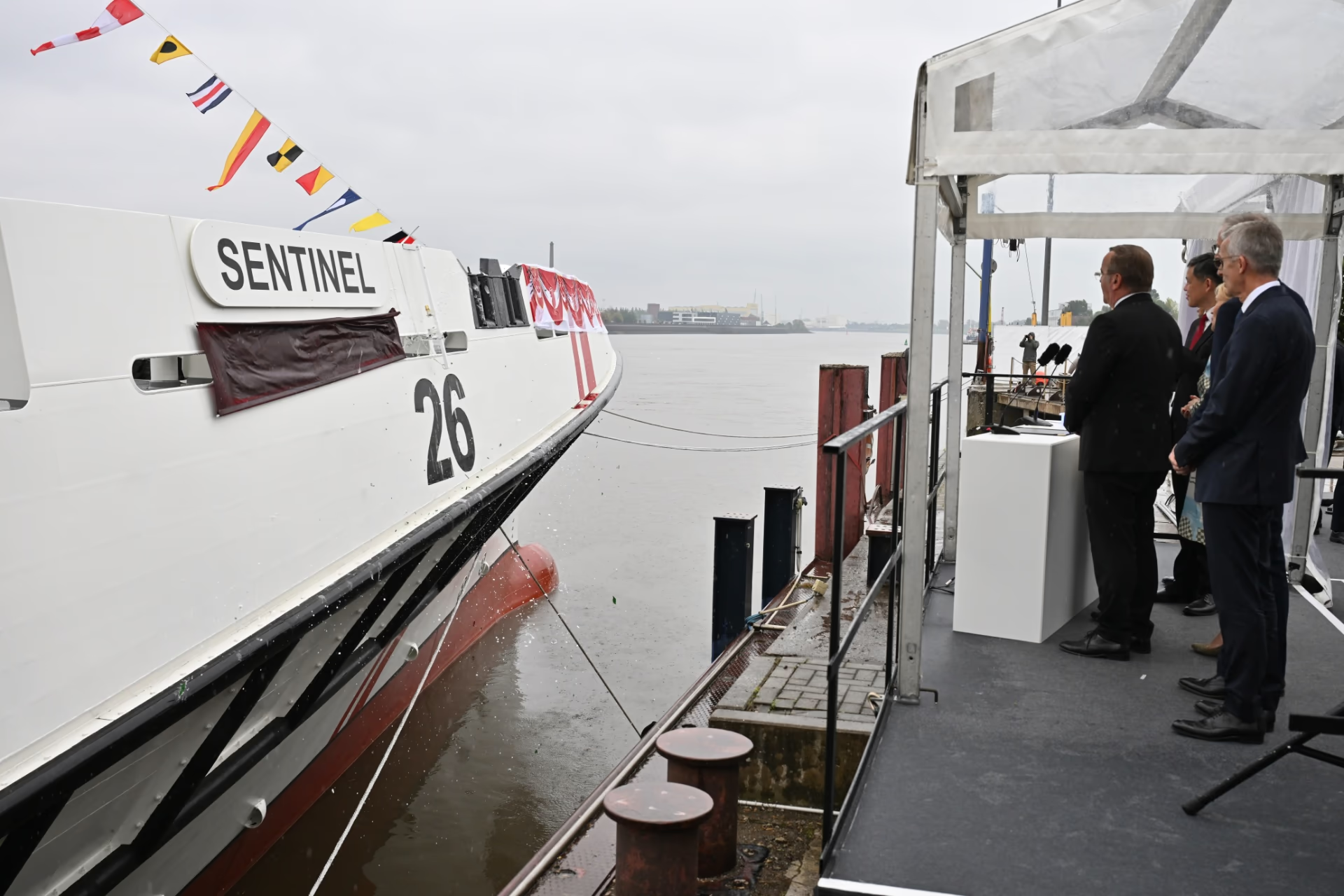
The Republic of Singapore Navy has launched the first of four Sentinel-class offshore patrol vessels at Fassmer in Berne, Germany, moving the programme from hull construction into acceptance and sea trials.
Sentinel was launched on 1 October, with the remaining three vessels continuing through construction at the German yard. Progressive deliveries are due from 2028, allowing the navy to introduce the new class while its existing Maritime Security and Response Vessels remain available.
The new ships are substantially larger than the vessels they will replace. Each measures 94.85 metres in length with a 15.2-metre beam and displacement of around 2,700 tonnes, while maximum speed exceeds 23 knots and endurance is more than 4,000 nautical miles.
A baseline crew of approximately 40 reflects the extensive use of automation and manpower-efficient systems. The ships are intended for persistent maritime security duties, so machinery, surveillance and mission equipment must support long operating periods without requiring a crew size more typical of a conventional frigate.
Propulsion uses a combined diesel-electric or diesel arrangement. Lower-speed electric operation can support efficient patrol activity, while mechanical diesel propulsion provides the power required for higher speeds. Integrating the two operating modes requires coordinated machinery control, electrical generation, propulsion equipment and automation within the same platform.
The class has also been designed to accept changing mission equipment. Containerised systems can be carried for different tasks, while the vessels can deploy manned and unmanned craft. A stern launch and recovery system is intended to reduce the time and crew exposure involved in putting boats or other mission craft into the water.
That flexibility adds work during construction because the ship must provide the structural, electrical and data interfaces required for mission equipment that may not remain permanently fitted. Designing those interfaces during initial manufacture is considerably simpler than adding them later through major modification.
The weapons fit includes a STRALES 76mm guided gun and a Rafael 30mm remotely controlled weapon station. Other equipment includes a laser dazzler, acoustic hailing system, less-lethal grenade launcher and water cannon, reflecting the range of escalation levels encountered during maritime security operations.
The sensor suite brings equipment from several specialist suppliers onto one platform. Systems include Terma navigation radar, Saab radar equipment, Thales fire control radar, Safran electro-optical sensors and 360-degree navigation cameras from Seadronix.
Shipbuilding therefore continues well beyond fabrication of the hull. Each sensor and weapon needs power, cooling, cabling, physical mounting and data connections, while the complete installation has to be checked for electromagnetic compatibility and integrated into the vessel’s command and control architecture.
Key spaces also receive ballistic protection, while heavy bow fendering supports close approaches and alongside operations. Those features are directly connected to the class’s maritime security role, where crews may need to intercept, shadow or board vessels rather than remain at stand-off distance.
Launch represents a clear production milestone but leaves a substantial volume of work ahead. Machinery, electrical systems, navigation equipment, communications, weapons, sensors and automation now have to be commissioned and tested before the ship can complete harbour acceptance and sea trials.
Those trials will assess more than basic propulsion and handling. They provide the opportunity to prove that systems installed by different manufacturers work together under realistic operating conditions and that the ship performs within its contractual requirements before delivery.
The programme also benefits from repeat construction. Lessons identified while commissioning Sentinel can be incorporated into the three sister ships while they remain at earlier production stages, reducing the risk of repeating installation or integration problems across the full class.
Series construction allows the yard to stabilise work instructions, supplier deliveries and test procedures as production continues. Specialist teams also gain familiarity with the class, reducing the amount of one-off engineering intervention required as later vessels move through equivalent stages.
Fassmer’s Berne operation combines design, engineering and shipbuilding capacity for specialist vessels. The Singapore programme consequently sits within an established production environment rather than a temporary facility created for four ships.
Through-life support will become the next industrial requirement once the vessels enter service. Spare parts, technical documentation, software configuration and upgrade work will remain necessary long after physical construction has finished, particularly for a class designed to accept evolving mission equipment.
Sentinel will now progress through acceptance and sea trials while work continues on the remaining three hulls. The first delivery milestone from 2028 will show how effectively the programme has converted the common design into repeatable production across the four-ship series.