IN Brief:
- YFQ-48A Talon Blue has completed its first fully autonomous flight from Mojave Air and Space Port.
- The sortie included autonomous taxi, take-off, airborne manoeuvres and landing.
- Northrop is funding the aircraft itself while using reduced part count and modular manufacturing to target faster, lower cost production.
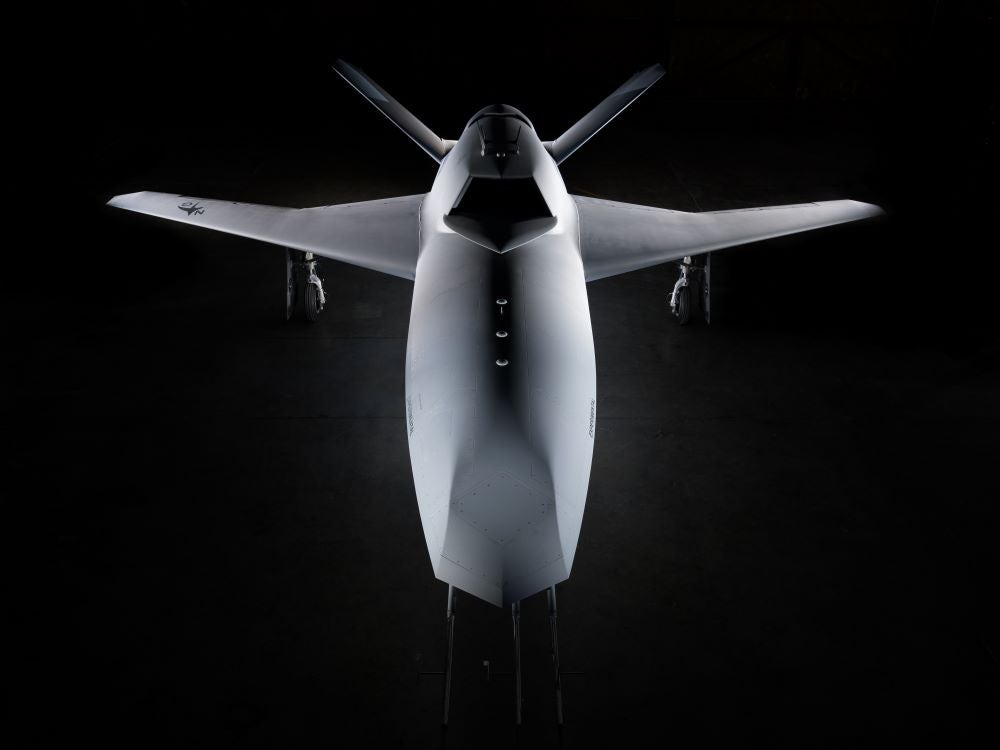
Northrop Grumman has completed the first flight of its YFQ-48A Talon Blue autonomous aircraft, with the company funded demonstrator carrying out taxi, take-off, airborne manoeuvres and landing autonomously during a sortie from Mojave Air and Space Port in California.
The flight moves Talon Blue from ground testing into an active flight test phase and gives Northrop a flying aircraft as the US Air Force develops later increments of its Collaborative Combat Aircraft programme. Talon Blue remains funded by Northrop rather than being a production aircraft selected under the first CCA increment, although the Air Force has assigned it the YFQ-48A designation.
Northrop has not published the sortie duration, detailed test card or full performance envelope. Aviation Week reported that external flight tracking showed the aircraft operating largely in a racetrack pattern over Mojave, but those measurements sit outside the manufacturer’s test record. The confirmed milestone is that the aircraft completed the complete ground and airborne sequence autonomously rather than relying on a pilot for take-off or recovery.
Autonomous taxi, take-off and landing exercise different parts of the control problem from maintaining a prescribed path once the aircraft is airborne. The vehicle management system has to control steering and braking on the ground, align with the runway, manage acceleration and rotation, then control energy, attitude and flight path through approach and touchdown. Each phase has comparatively narrow operating margins and different sensor inputs.
Northrop has been developing the supporting autonomy architecture through its wider Project Talon portfolio. Talon IQ provides an autonomous test environment based on the Scaled Composites Model 437 aircraft, allowing Northrop, government teams and outside partners to develop and test software on a reusable platform before moving capabilities into another aircraft.
Talon Blue supplies the purpose built airframe within that portfolio and is intended to operate as an autonomous wingman alongside crewed fighters. Northrop describes the aircraft as modular and says customer feedback led to reductions in part count and weight, combined with manufacturing techniques intended to shorten build timelines and support more affordable production.
Reducing part count can remove assembly operations, tooling, fasteners, interfaces and inspection points if the simplified structure still carries the necessary loads and accommodates propulsion, fuel, communications, sensors and weapons. Northrop has not published enough manufacturing detail to quantify the production saving, so the benefit remains an engineering objective until a repeatable build process establishes actual time and cost.
The company’s wider unmanned portfolio has accumulated more than 500,000 autonomous flight hours, providing experience in vehicle management and mission systems across several aircraft types. Collaborative combat aircraft introduce a different operating requirement because they are expected to work dynamically around crewed aircraft and other assets rather than follow the more predictable mission patterns associated with long endurance surveillance platforms.
An autonomous wingman also has to do considerably more than fly without continuous stick and throttle commands. It must follow mission constraints, manage its own aircraft state, respond predictably to changing conditions and retain safe behaviour when communications with the controlling force are degraded. Higher level mission autonomy may eventually coordinate sensors or weapons while allowing a human operator to supervise several aircraft rather than manually flying each one.
Project Talon separates some of that software maturation from the final aircraft. Talon IQ provides an open test environment for developing and iterating autonomy, while Talon Blue provides the aircraft on which the integrated vehicle and autonomy system can be demonstrated. The approach can move experimental software work through a reusable testbed before it reaches the dedicated combat aircraft demonstrator, although Talon Blue still has to prove the final integration under its own aerodynamic and propulsion conditions.
The YFQ-48A designation gives the aircraft formal US Air Force recognition without constituting a production selection. Northrop continues to position Talon Blue for future CCA opportunities as later Air Force increments develop, alongside other autonomous aircraft emerging from competing manufacturers.
Repeated flight testing will expand the operating envelope and expose control behaviour, maintenance requirements and integration faults that are difficult to establish during ground trials. Mission system testing will then have to demonstrate that the aircraft can perform useful collaborative tasks rather than simply complete an autonomous flight profile.
The first sortie closes the gap between a displayed prototype and a functioning autonomous aircraft, but the production and operational case remains open. Subsequent flight hours, more complex mission behaviour and evidence that the simplified modular design can be manufactured repeatedly will determine whether Talon Blue can combine autonomy with the cost and production scale expected of a collaborative combat aircraft.