IN Brief:
- The first Gripen E produced in Brazil completed its maiden flight from Gavião Peixoto on 6 October.
- The aircraft is the first of 15 due to be produced on Embraer’s Brazilian final assembly line.
- The production acceptance flight begins the final manufacturing phase before certification and delivery to the Brazilian Air Force.
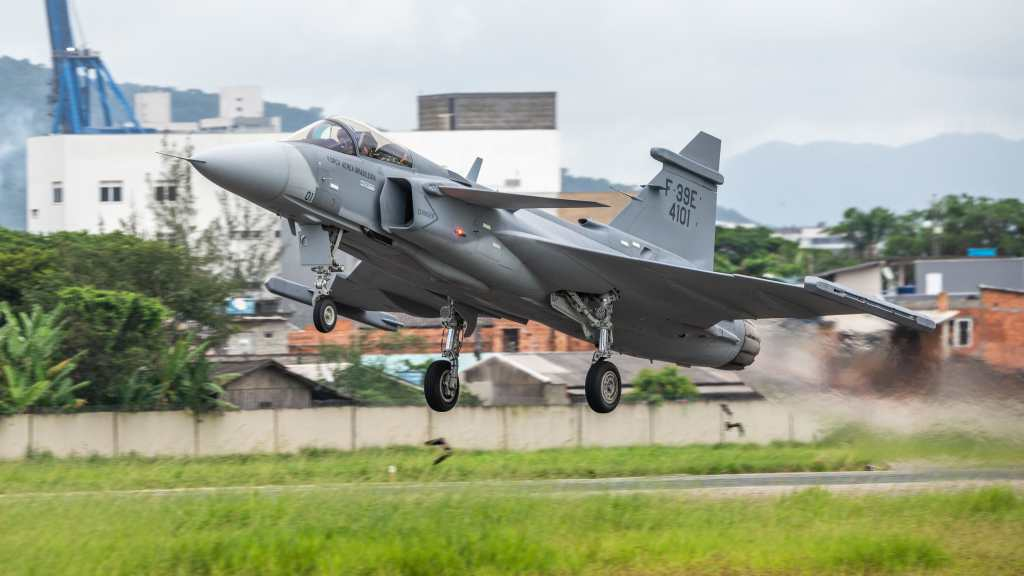
The first Gripen E produced in Brazil has completed its maiden flight, moving Saab and Embraer’s technology transfer programme into the final production acceptance phase before delivery to the Brazilian Air Force. The aircraft departed Embraer’s Gavião Peixoto aerodrome in São Paulo state at 10:21 local time on 6 October with Saab chief test pilot Jakob Högberg at the controls.
Saab worked with Embraer flight engineers on planning and execution of the sortie, which was an acceptance test for a production aircraft rather than the start of a new design flight campaign. Basic systems and initial performance had to be checked after assembly before the fighter could proceed through the remaining manufacturing and certification work.
Once that process is complete, the aircraft will be prepared for delivery to the Brazilian Air Force and move to Anápolis Air Force Base, joining a fleet that already includes ten Gripen fighters operated by the First Air Defence Group. Its arrival will therefore add another operational aircraft while also demonstrating that the Brazilian production line can take a fighter from structural build through systems installation and into airborne acceptance.
As the first of 15 Gripen E fighters scheduled to be produced in Brazil under the current programme, the aircraft gives Embraer’s Gavião Peixoto line a series production task rather than a single demonstration build. The line began operating in 2023 as a second production location alongside Saab’s principal fighter manufacturing operation in Sweden.
Final assembly involves bringing together major structures before technicians install wiring, landing gear, avionics, canopy, ejection seat, radar, engine and other systems. Brazil also contributes aerostructures from Saab’s São Bernardo do Campo facility, where tail cones, air brakes and fuselage sections are produced for the wider Gripen supply chain.
Combining those structural and assembly activities broadens the Brazilian role beyond joining complete imported sections. Engineers and technicians have trained within Saab operations, while design, development and flight test cooperation has built local expertise around both the aircraft and the processes needed to produce it repeatedly.
That transfer of knowledge has to be converted into controlled production documentation because a fighter line depends on repeatable work instructions, approved tooling, inspection records and configuration management rather than individual familiarity alone. Each aircraft has to be built to the required standard even as different technicians, suppliers and production stages contribute to the finished airframe.
The maiden flight connects those industrial processes because ground completion alone is not sufficient to release a fighter. Electrical systems, software loads and hydraulic functions can be checked in the plant, but airborne operation exposes the finished aircraft to aerodynamic loads, vibration and thermal conditions that cannot be reproduced completely on the ground.
Any discrepancy identified during the acceptance sortie or subsequent flights can therefore be returned to engineering or production teams before delivery. The aircraft is being tested as a complete manufactured product, making the flight part of quality control rather than a ceremonial event after the build has already been accepted.
That process now has to become repeatable as the Brazilian line progresses through the remaining 14 aircraft. Tooling, work instructions, inspection records and configuration control must produce the same standard consistently, otherwise the industrial value of transferring production to Brazil would be limited by the amount of additional engineering attention required around each airframe.
Supplier performance becomes part of the same test because locally produced structures and installed systems have to arrive in the correct configuration and at the rate required by final assembly. Delays or quality problems in one component family can interrupt work further down the line even when the assembly plant itself has available capacity.
Repeatability will also determine how useful Gavião Peixoto becomes if Saab and Embraer later use the facility for demand beyond Brazil’s current programme. Aircraft built in Brazil have to meet the same configuration and acceptance standards as those produced in Sweden, which requires engineering authority, supplier control and quality records to remain aligned between the two locations.
The 6 October flight shifts the programme from establishing Brazilian production capability towards proving that capability across a series of aircraft. Completing the first locally produced fighter demonstrates that the line can reach airborne acceptance; the next industrial measure is whether it can repeat the sequence at a stable rate while preserving the same standard across the rest of the planned build.