IN Brief:
- Hanwha has acquired two THeMIS unmanned ground vehicles for separate South Korean and Australian initiatives.
- The companies have created a framework for Australian and New Zealand marketing, production, sales and sustainment.
- Planned industrial work includes local supply chains, maintenance, upgrades and integration of regional payloads.
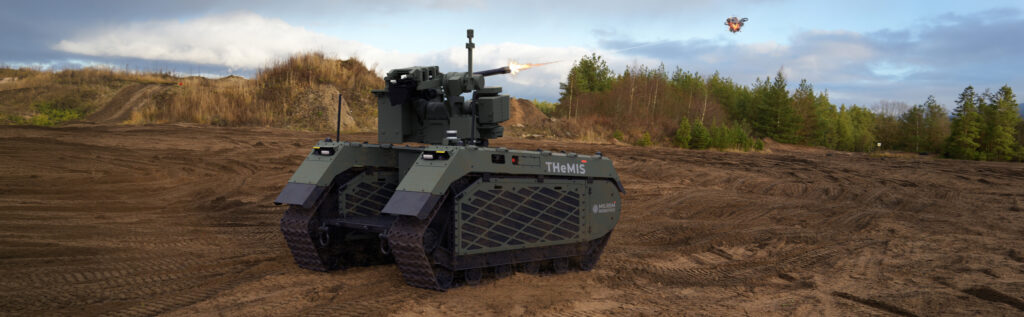
Hanwha and Milrem Robotics are expanding cooperation around the THeMIS unmanned ground vehicle in Australia, New Zealand and South Korea, creating a framework that could extend from platform sales into local production, sustainment and subsystem integration. Hanwha has acquired two THeMIS vehicles for separate South Korean and Australian initiatives, giving the partnership physical platforms for engineering, demonstration and market development rather than leaving the relationship at agreement level.
Milrem Robotics already works with Hanwha on ground robotics outside Australasia, including South Korean requirements and Romania’s unmanned ground vehicle programme. The new framework gives that cooperation a defined route into Australia and New Zealand by adding regional marketing, possible local manufacture, sales and sustainment to the technical work already under way.
The two acquired vehicles will support different strands of that expansion. Hanwha will use one in South Korea for research and development, allowing sensors, autonomy functions, control systems and payloads to be tested on a representative platform, while the Australian vehicle sits within a broader plan covering maintenance, upgrades, payload integration and development of a regional supply chain if customer programmes emerge.
Because THeMIS is built around a modular tracked chassis rather than one fixed mission configuration, the industrial opportunity extends beyond the base vehicle itself. Existing variants cover logistics, reconnaissance, engineering support, casualty evacuation and armed roles, allowing propulsion, mobility and core control systems to remain common while the mission equipment changes.
Changing that equipment shifts a substantial amount of engineering work into the interface between chassis and payload. A new sensor, weapon station or communications package alters electrical load, data traffic, mass distribution and sometimes cooling requirements, while the vehicle software has to recognise and exchange information with the added equipment reliably. Local payload integration can therefore become as technically important as assembly of the vehicle underneath it.
Australian suppliers already working on sensors, remote weapon stations, communications equipment, autonomy software and counter-UAS technologies could fit into that part of the programme if regional customers select THeMIS. A local engineering capability would give those companies a physical platform on which equipment can be integrated and tested against Australian requirements rather than supplied as isolated components with the integration work performed overseas.
Hanwha also brings an established Australian industrial base through the Redback infantry fighting vehicle programme, including facilities, engineering staff and suppliers already involved in armoured vehicle work. If customer demand later supports local THeMIS assembly or deeper sustainment, that infrastructure could provide part of the industrial foundation rather than requiring an entirely separate support system.
No Australian or New Zealand customer order has yet been disclosed, so the reference to possible production remains an industrial option rather than evidence of a committed manufacturing line. Demonstration vehicles, maintenance capability and serial production require very different levels of tooling, workforce and order volume, which means the current framework allows the relationship to deepen in stages rather than assuming all of those activities will begin together.
The same graduated approach applies to sovereign sustainment. Mechanical work on tracks, suspension and power systems can be established with comparatively modest fleet numbers, whereas deeper support also requires technical data, diagnostic tools, software access and an approved route for configuration changes. Once several payload combinations exist, software baselines, spares requirements and training needs can diverge quickly unless those changes are controlled across the fleet.
Hanwha also operates Arion-SMET and other unmanned ground vehicle programmes, while previous work with Milrem has included discussion of integrating sensors and effectors across autonomous platforms. Keeping interfaces sufficiently common can allow selected technologies developed on one vehicle to be tested or transferred to another where power, data and control requirements are compatible.
That progression favours sustainment and payload integration as earlier industrial steps because both can be supported with smaller fleets than a full manufacturing line. Serial production would require a more predictable order base capable of supporting tooling, supplier qualification and quality assurance over a longer period.
With physical vehicles already assigned to South Korean and Australian initiatives, Hanwha and Milrem can now test those industrial choices against actual engineering work and customer demand. The framework creates a route from demonstration through support and potentially into production, but the depth of local activity will ultimately be determined by contracts and fleet scale rather than by the breadth of the agreement alone.