IN Brief:
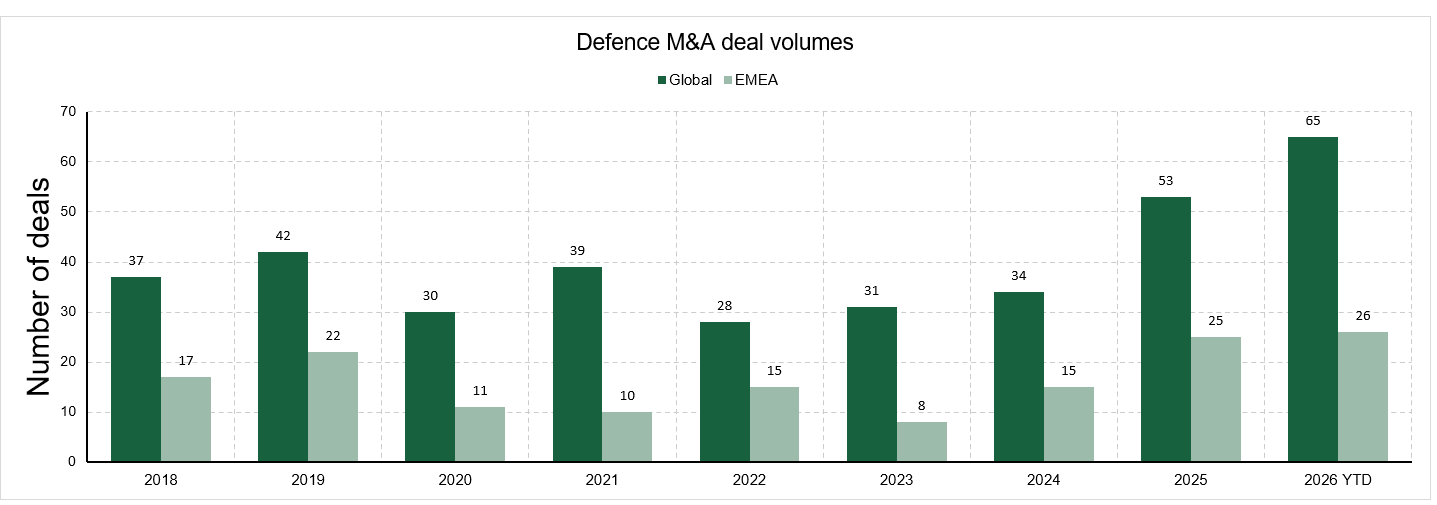
- White & Case and Mergermarket recorded 65 global defence transactions in the first nine months of 2026, against 52 during all of 2025.
- Third-quarter global deal value reached US$4.2bn, including US$2.8bn in EMEA across seven transactions.
- A separate survey of 250 UK defence-sector decision-makers identified £19.75bn of intended investment, not committed expenditure.
White & Case and Mergermarket recorded 65 global defence mergers and acquisitions during the first nine months of 2026, exceeding the 52 deals reported for the whole of 2025. Their analysis places the January–September deal count above every complete annual total in the dataset since 2018, although the latest reporting period covers only nine months.
The figures, supplied by White & Case in a release dated 21 October, also show 34 transactions during 2024. The 2026 count is therefore approximately 25% above full-year 2025 and 91% above 2024. These comparisons concern recorded transaction numbers, not the number of additional factories built or defence contracts won by the companies involved.
Global disclosed deal value reached US$7bn during January–September, matching the total value reported for 2025. Deal numbers have risen more sharply than their aggregate value across those periods, demonstrating that the frequency of transactions and the capital committed to them are distinct measures of market activity.
The third quarter accounted for US$4.2bn of the nine-month total, compared with US$0.6bn during the same quarter of 2025. The reported sevenfold increase in value accompanied a rise in transactions from twelve to seventeen. Approximately 60% of the value recorded for 2026 to date was concentrated in July–September.
EMEA represented the largest share of disclosed value during that quarter, with seven transactions worth US$2.8bn. The figure was twice the US total of US$1.4bn across six deals and more than double EMEA’s US$1.3bn for the whole of 2025. The comparison is sensitive to the size and timing of individual transactions, particularly in a quarter containing relatively few deals.
Across January–September, EMEA and the United States each recorded 26 transactions. The US remained ahead by value over the longer period at US$3.6bn, compared with US$3.1bn in EMEA. The figures therefore show a particularly strong EMEA third quarter rather than a sustained lead over the US throughout the year.
Mergers and acquisitions can change how defence technology and manufacturing capacity are owned without immediately changing the number of systems available to customers. Acquiring an established supplier may secure a specialist workforce, qualified manufacturing processes, intellectual property or access to an existing customer programme; increasing delivered output still depends on investment and operational integration.
The transfer of technology between businesses can involve controls over sensitive information, customer approvals and restrictions on exports. A purchaser may also need to retain qualified technical personnel and maintain component traceability or process accreditation. These requirements can limit how quickly an acquired capability is incorporated into another production organisation.
Technology-led acquisitions have different industrial objectives from purchases focused primarily on factory capacity. Businesses developing sensors, autonomous systems, communications or specialist software may be valued for engineering knowledge and protected designs even before they reach high-volume manufacture. Turning those assets into fielded equipment requires further qualification, integration and programme funding.
White & Case links the stronger activity to rising military expenditure and competition for new defence capabilities. Patrick Sarch, its head of UK public M&A, describes manufacturers seeking technology and production scale, while investors compete for companies positioned to supply future government demand. These are the firm’s interpretations of its transaction analysis, rather than verified explanations for every deal in the dataset.
The law firm has separately examined prospective investment by British defence businesses. Censuswide surveyed 250 senior decision-makers between 17 and 24 September 2026, covering established suppliers, defence technology companies and start-ups. White & Case reports that respondents collectively planned £19.75bn of investment during the following twelve months.
That £19.75bn is an aggregate of stated intentions from the surveyed businesses. It is neither audited capital expenditure nor a verified forecast for the whole UK defence industry, and the firms could amend their plans in response to contracts, financing conditions or production constraints.
The same survey found that 97% of respondents planned to raise significant external funding over the coming year. Separately, 94% expected capital expenditure and investment of more than £50m. Those results describe the intentions of a defined respondent group and do not show that funding has already been secured or expenditure approved.
Increasing production can require working capital long before a military customer accepts finished equipment. Suppliers may need specialised machinery, qualified materials, additional engineers and testing facilities, while revenue can depend on acceptance milestones and procurement schedules. Equity funding and acquisitions offer different ways of meeting those costs, with different consequences for ownership and financing risk.
White & Case partner Michael Evans has identified continued access to research and development capital as an issue for UK and European defence technology companies seeking to compete internationally. A growing pool of potential buyers or investors may offer more opportunities, but prospective acquisitions remain subject to valuation, financing, due diligence and regulatory decisions.
The deal analysis identifies stronger transaction activity rather than proving that European sovereign manufacturing capacity has increased by an equivalent amount. The industrial results will depend on whether new owners retain engineering capabilities, finance production and secure the orders needed to make the acquired businesses sustainable.
The remaining quarter will determine the final 2026 total. On the figures supplied for the nine months to 30 September, the global defence sector has already exceeded the preceding full-year deal count, while the distribution of investment by value remains concentrated in a relatively small number of transactions.