IN Brief:
- The 11,500m² Telford factory has begun manufacturing barrels and breeches for 120mm and 155mm weapon systems.
- Rheinmetall specifies peak annual capacity of 245 barrels and more than 50 breeches, rather than current achieved output.
- British employees trained at Rheinmetall's Unterlüß facility, with the Telford workforce expected to expand.
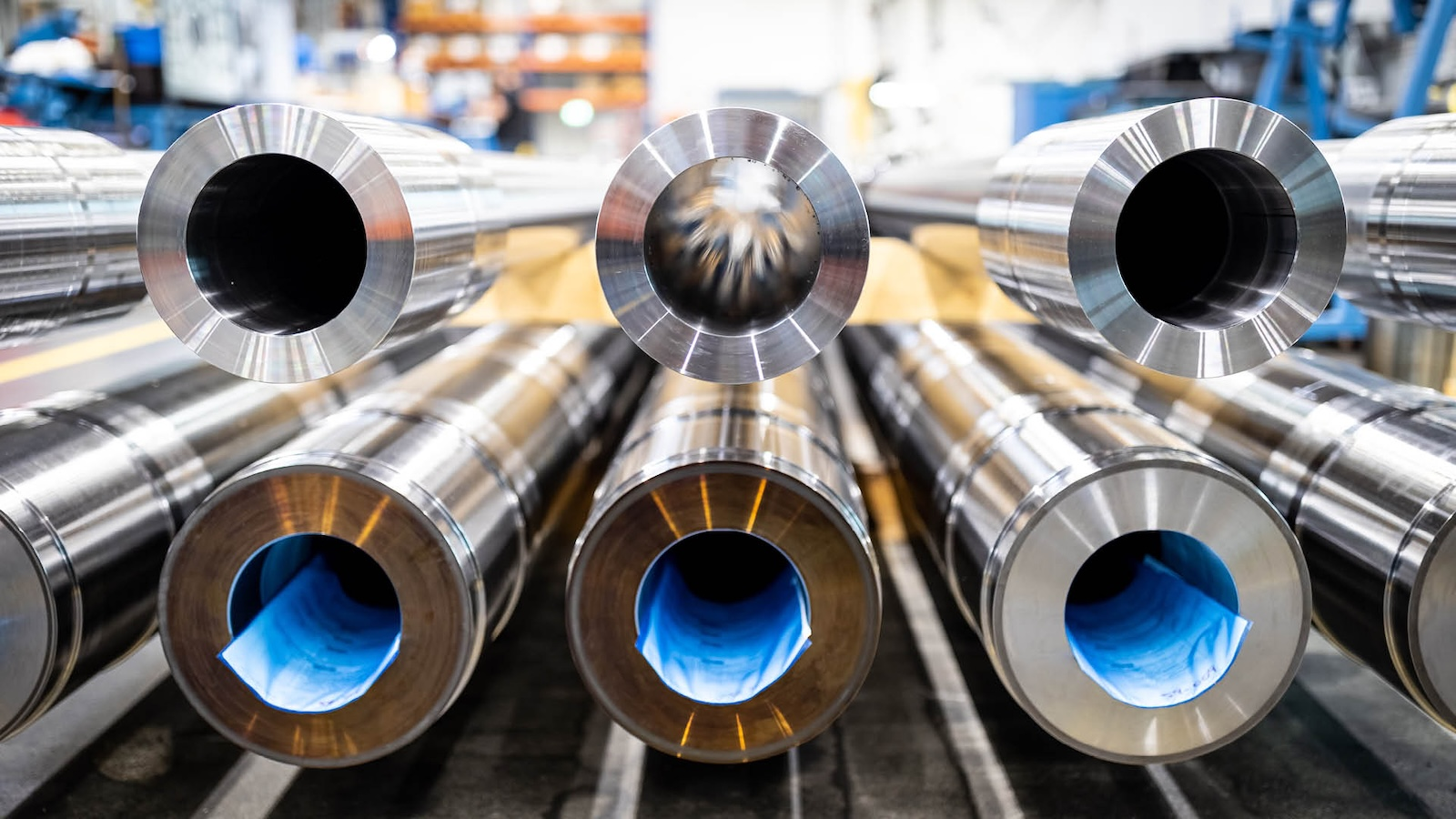
Rheinmetall has opened its UK Gun Hall in Telford, restoring British production of large-calibre gun barrels and breeches after approximately twenty years. The 11,500m² facility is already manufacturing components for 120mm and 155mm weapon systems, with the company specifying a peak annual capacity of up to 245 barrels across the two calibres and more than 50 breeches.
Defence Secretary Wes Streeting formally opened the factory on 22 October alongside Rheinmetall chief executive Armin Papperger and Chief of the General Staff General Sir Roly Walker. The opening follows the conversion of an empty industrial building into an operating production site, involving the installation and commissioning of specialist equipment and the transfer of manufacturing expertise from Germany.
Rheinmetall began making breeches and breech blocks in May 2026, followed by barrel production in June. The reported capacities are the output the plant is designed to achieve at its peak, not an independently verified account of barrels delivered over a full year. Its present production activity should likewise be distinguished from its planned workforce expansion.
The Gun Hall currently employs approximately 35 people, according to contemporary coverage of the opening, with around 100 skilled positions expected when activity expands. Staff recruited in Britain undertook training at Rheinmetall’s Unterlüß site in Germany, learning precision manufacturing, inspection and quality procedures before operating the new Telford equipment. The Ministry of Defence describes the investment as supporting 100 jobs, a figure reflecting the facility’s planned scale rather than its initial headcount.
The equipment is intended to support British artillery requirements, notably the Boxer-mounted RCH 155 remote controlled howitzer, as well as 120mm gun systems associated with the Challenger 3 tank programme. These applications share a requirement for large, accurately manufactured components but use different calibres, configurations and acceptance criteria. Making both types at one site does not mean the production processes or equipment are fully interchangeable.
A gun barrel must retain its specified internal geometry while tolerating the demanding pressures and temperatures encountered during firing. Manufacturing starts with appropriately specified material and proceeds through controlled machining, inspection and finishing. The exact production sequence depends on the weapon design, while the finished component must meet stringent dimensional and material requirements before integration.
The breech forms part of the mechanism that closes the rear of the weapon and accommodates the forces generated during firing. Breech components require compatible geometry and mechanical properties, and must work with the barrel and other elements of the weapon assembly. Establishing domestic production of barrels and breeches therefore provides important industrial capability without establishing that every part of a completed gun is made at Telford.
The facility is connected to procurement decisions made earlier in 2026. In March, the Organisation for Joint Armament Co-operation awarded ARTEC a £53 million contract for long-lead production of 37 RCH 155 weapon systems. Defence Equipment and Support identified £30 million of that value as supporting development of the Telford Gun Hall. Those figures describe an earlier procurement and its industrial allocation, not additional contracts awarded at the October opening.
The March package concerns weapon assemblies including barrels, muzzle brakes, breeches, recoil equipment and trunnions. It was followed in May by the British government’s announcement of a nearly £1 billion contract for 72 RCH 155 howitzers, including initial training and service support. The larger order provides a substantial programme context for the investment, while individual component schedules and future output will depend on production and customer requirements.
Material supply remains part of the planned localisation. Rheinmetall intends to use British steel from Sheffield Forgemasters in its gun manufacturing, supporting a more domestic supply chain for specialised components. Rheinmetall has not confirmed that every barrel currently produced uses British steel. Qualification of materials and processes is necessary before a supplier can support a particular weapon programme.
Even where a facility has installed the required machinery, sustained output depends on the availability of qualified steel, tooling, inspection resources and trained operators. Heavy machining and quality checks can become constraints if production is increased faster than the supporting processes. The stated 245-barrel capacity consequently represents a manufacturing objective whose utilisation depends on orders, inputs and successful process control.
The new operation adds to Rheinmetall’s existing British industrial activities, which include work related to Boxer and Challenger 3 in Telford. It also follows other investments in engineering and testing equipment. Those activities are complementary but should not be treated as identical to the newly established manufacture of large-calibre barrels and breeches.
The Gun Hall forms part of the industrial cooperation envisaged by the UK-Germany Trinity House Agreement. In this instance, the arrangement brings German manufacturing experience and training together with a British workforce and site, with the aim of rebuilding a capability that had been sourced abroad. Its value to domestic supply resilience will depend in part on the continued development of the local workforce and qualified suppliers.
Rheinmetall has established an operating manufacturing site and confirmed the start of barrel and breech production. The next measurable stages will be growth in actual output, further recruitment and the incorporation of British materials where approved. The 245-barrel output and 100-person workforce remain targets rather than completed milestones.