IN Brief:
- MKE has presented a larger PIRANA configuration at Euronaval, distinct from its original expendable attack vessel.
- The displayed design has a reported 1,000kg mission bay and an eight-drone tube-launch arrangement.
- Detailed launch qualification, production status, and customer commitments remain unconfirmed.
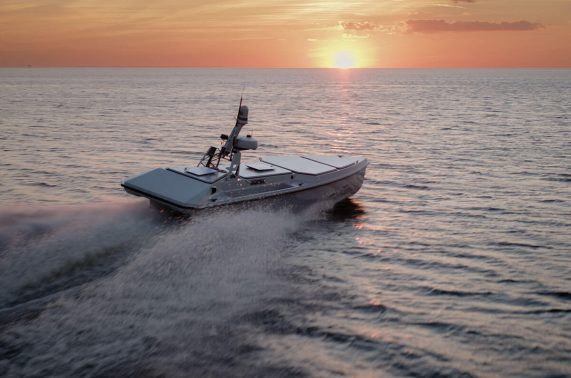
Makine ve Kimya Endüstrisi (MKE) has displayed a larger PIRANA unmanned surface vessel at Euronaval 2026, extending the Turkish manufacturer’s existing expendable attack-drone family towards a platform able to carry mission equipment and coordinate other uncrewed systems. The new configuration was presented in Paris on 3 November.
The enlarged vessel differs from the original PIRANA kamikaze craft, whose principal mission is to approach a surface target and detonate its onboard charge. The new armed unmanned surface vessel, or AUSV, has been described as approximately three times heavier than the earlier design and capable of carrying ten times its payload, with an internal bay rated for up to 1,000kg.
The Euronaval display showed eight tube-launched aerial drones packaged within the payload bay. This illustrates a possible role as a carrier and controller of smaller unmanned systems, with reconnaissance and other mission equipment also envisaged. Neither the displayed eight-drone arrangement nor the enlarged vessel has been linked publicly to a production order, and the exhibit does not itself demonstrate the launch system at sea.
MKE’s new design is reported to have a maximum speed above 35 knots and an operating range of around 400 nautical miles. Those figures concern the larger exhibited configuration and should be kept separate from performance claims for the compact PIRANA KUSV, which has a different hull, propulsion installation, payload and intended mission.
The original KUSV is a small diesel-powered, waterjet-propelled surface vehicle. MKE’s published product information describes a displacement of about 1,200kg, a range exceeding 200 nautical miles and a fast, remotely operated or semi-autonomous attack profile. Its official technical material also describes a multi-part explosive payload. Later exercise reporting has used different warhead figures, underscoring the need to identify the precise variant and test configuration when comparing specifications.
The larger bay allows different combinations of equipment, but a 1,000kg weight rating does not establish their compatibility. Surveillance sensors and communications payloads require suitable power distribution, cooling, mounting points and unobstructed antenna positions; electronic warfare equipment can add further constraints on interference and separation. These interfaces will shape which mission packages can be fitted without changes to the vessel.
The command-and-control concept draws on radio-frequency links, satellite communications and LTE connectivity. Multiple bearers can provide alternative communication paths, but their use depends on coverage, electromagnetic conditions and the ability to maintain a secure and sufficiently reliable data link. Running a swarm also requires the operator to monitor the status and position of individual vehicles without creating unmanageable control traffic.
Tests involving the original PIRANA establish experience with remote control through an airborne relay, although they do not qualify the larger AUSV. During a 2025 demonstration involving the amphibious ship TCG Anadolu, a Bayraktar TB3 aircraft relayed communications between the operators and the smaller surface craft. The aircraft extended the link beyond the ship’s direct radio horizon.
More recent trials involved the original attack variant, rather than the new high-payload AUSV. MKE reported a successful engagement during the September 2026 Denizkurdu exercise, followed by another in October’s TURNAs-2026 exercise using a Bayraktar TB2 as the communications relay. These events demonstrate elements of remote control and target engagement, but they do not establish that the enlarged carrier and swarm-management configuration has completed equivalent qualification.
Airborne relay is important for small vessels because the sea surface limits the usable horizon of many direct radio links. Raising the communications node on an aircraft can extend coverage, while satellite connectivity offers another route where supported. The engineering trade-off involves additional network equipment, mission planning and potential points of failure in the control chain.
Launching smaller aircraft from a moving surface vessel introduces constraints that are absent from its earlier one-way attack mission. Tube-launched drones need a safe separation path, a suitable launch orientation and tolerances for the vessel’s motion in waves. The eight-tube exhibition arrangement illustrates the intended packaging, but MKE has not published completed launch trials or environmental limits for that installation.
Sustaining a craft that carries mission modules would place greater emphasis on access to components, standardised electrical and software connections, and repeatable checks after equipment swaps. The exhibition model indicates the intended modular layout, but MKE has not published a qualified catalogue of interchangeable payloads. The extent of any mission flexibility will depend on further hardware integration and testing.
MKE first showed concepts for an expanded PIRANA at IDEF 2025. The Euronaval presentation provides a more specific illustration of the heavier, payload-carrying configuration, including the drone-launch arrangement and its intended role in coordinated unmanned operations. The manufacturer continues to promote the smaller KUSV separately, so the two should not be described as a single platform with interchangeable performance figures.
The enlarged PIRANA remains at a displayed-design stage in the available reporting. Demonstrations of its payload connections, communications equipment and aircraft launch arrangement would establish how much of the concept is ready for maritime use. For now, the distinct development at Euronaval is the proposed payload-carrying AUSV alongside the existing, separately tested expendable KUSV.