IN Brief:
- KNDS presented FENNEK AIR at the NEDS exhibition in Rotterdam on 18 November.
- The prototype combines sensor fusion, adjustable AI support, adaptive camouflage, and a 30mm ARX30 weapon station.
- Its modular counter-UAS mission kit is intended for existing FENNEK vehicles and potentially other platforms, with no production order announced.
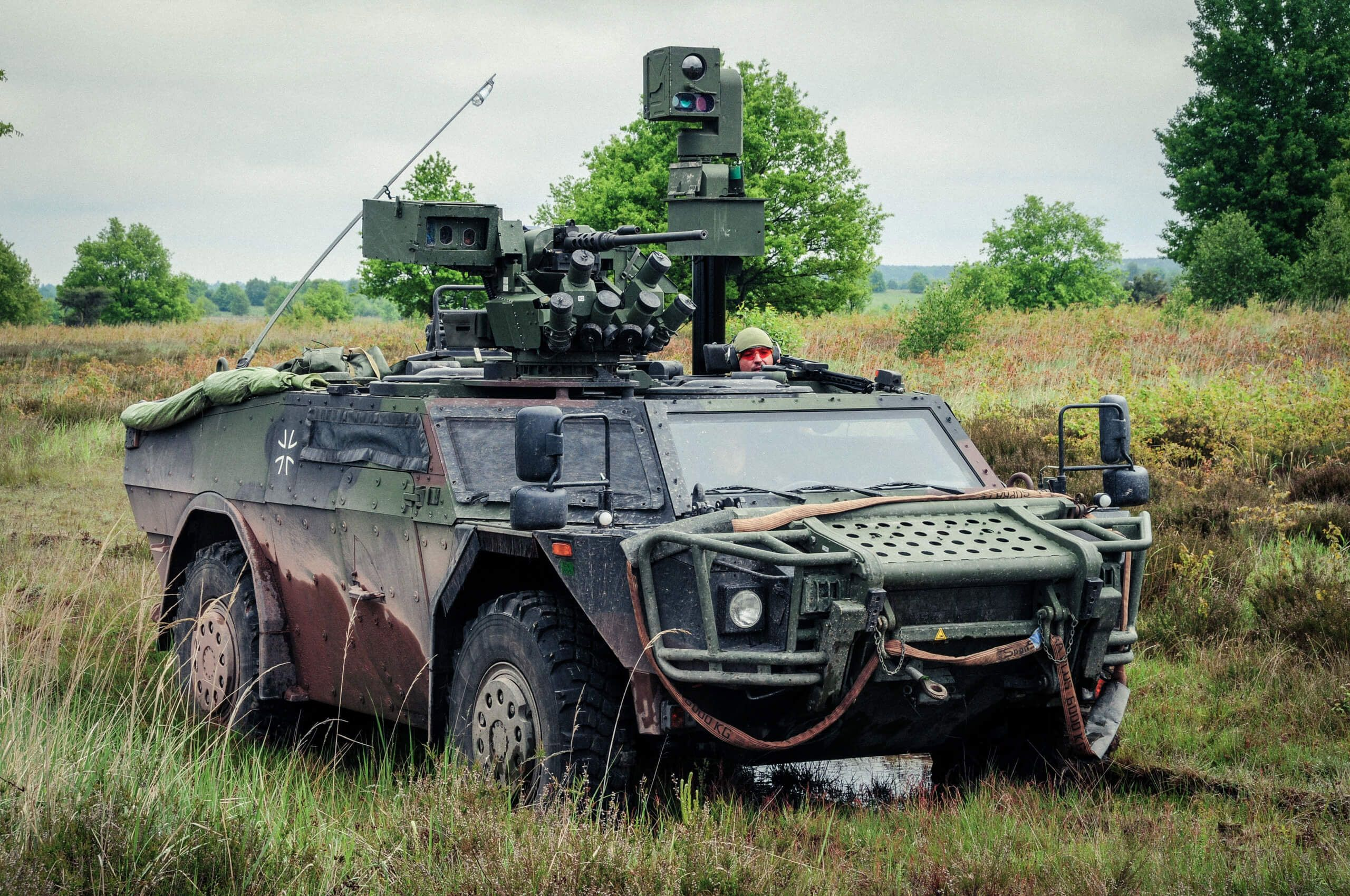
KNDS has unveiled FENNEK AIR, a mobile counter-drone prototype combining its established reconnaissance vehicle with sensor fusion, AI-supported target processing, adaptive camouflage, and a remotely operated 30mm cannon. The system was presented at the NIDV Exhibition Defence & Security in Rotterdam on 18 November 2026 as a proposed component of layered protection against unmanned aircraft.
FENNEK AIR takes its name from Artificial Intelligence Revolvergun, reflecting the combination of software-based processing and a gun-based engagement system. Developed by KNDS Deutschland, the prototype uses the existing FENNEK vehicle architecture alongside a counter-uncrewed systems mission kit that the manufacturer intends to make adaptable to other platforms.
The system’s principal weapon is the ARX30 Remote Controlled Weapon System developed by KNDS France. Its 30mm automatic cannon uses 30×113mm ammunition and forms the physical engagement component of the new configuration. Detection, target processing, and operator decision functions are supported by an integrated software architecture that processes information from multiple sensors.
KNDS describes the AI component as adjustable according to the level of support selected by the crew. Depending on its configuration, the software can assist with detecting, tracking, and engaging drones, reducing the processing demands placed on operators. The company claims that AI-supported processing can shorten the interval between initial detection and engagement to seconds, although no independently verified trial figures have been published.
The distinction between operator support and autonomous operation requires careful treatment. The manufacturer identifies several potential levels of AI assistance, but it has not disclosed the complete control logic, operational authorisations, or safeguards applicable to every configuration. The prototype’s software capabilities should not be interpreted as confirmation that an operational customer has authorised independent weapon engagement.
Combining information from several sensors is intended to improve the surveillance picture available to the system. Small unmanned aircraft can be difficult to track because they often operate at low altitude, may have limited radar signatures, and can appear against complex backgrounds containing buildings, terrain, and moving objects. Sensor fusion can help associate observations with individual tracks where the available information is sufficiently reliable.
KNDS has not published the complete sensor fit installed on FENNEK AIR. Specific radar, optical, infrared, or radio-frequency equipment cannot therefore be assigned to the prototype without further confirmation. The disclosed architecture establishes multi-sensor processing as a core capability but leaves the characteristics of individual detection systems unspecified.
The software is also designed to exchange information between FENNEK AIR platforms through a connected, mesh-based intelligence arrangement. Such an architecture can allow observations collected by one vehicle to contribute to the surveillance picture available to other participating vehicles, subject to the communications links and data interfaces connecting them.
Sharing tracks across vehicles introduces technical requirements beyond those of a single installation. Information must be sufficiently consistent to identify the same object when observed by different sensors, while timing, position, and measurement uncertainty influence the quality of the combined picture. Communications interruptions and differences between sensor coverage areas can affect the continuity of shared information.
KNDS describes the system as a closed architecture intended to preserve customer sovereignty over the software. The company has not disclosed the precise hosting, update, access-control, or information-security arrangements behind that description. The statement therefore establishes the manufacturer’s intended approach rather than evidence of a particular completed national security accreditation.
A further feature of the prototype is adaptive camouflage linked to the AI and weapon-system architecture. KNDS states that the equipment can change the vehicle’s apparent outline and help it blend with its surroundings. This extends the design beyond the conventional use of static camouflage patterns, although the company has not provided measured detection or recognition performance under representative conditions.
The camouflage system must coexist with the vehicle’s surveillance equipment and weapon station. Any equipment intended to change the vehicle’s external appearance has to accommodate sensor fields of view, weapon movement, maintenance access, and the physical operating conditions of the platform. The prototype announcement does not establish how these requirements are resolved across every proposed configuration.
For engagement, the ARX30 brings a remotely operated gun system to a vehicle originally designed for reconnaissance and observation. A remote weapon station allows weapon functions to be managed from a protected operator position, with the vehicle’s control and surveillance systems contributing to the engagement process. Effective operation depends on suitable target information, weapon control, stabilisation, and the performance of the ammunition selected.
The specific ammunition configuration used with the FENNEK AIR demonstrator has not been established beyond the announced 30×113mm calibre. KNDS’s wider ARX30 portfolio includes counter-drone applications, but performance claims associated with other installations cannot automatically be transferred to the new prototype.
FENNEK provides an established vehicle basis for the system. The reconnaissance platform is already associated with German and Dutch military operations, offering mobility, observation capabilities, and an existing support structure. Integrating a new mission kit onto such a vehicle could provide an upgrade route for existing fleets, although installation and qualification requirements would depend on the starting configuration.
Additional electronic equipment and a new weapon station also impose physical demands. Power availability, equipment weight, cooling, electromagnetic compatibility, and crew access all influence the feasibility of an installation. These requirements will need to be assessed if the counter-UAS kit is adapted to other vehicles or introduced into existing FENNEK fleets.
The concept differs from the TYTAN and KNDS Dingo counter-drone vehicle reported earlier in November. FENNEK AIR uses a separate host vehicle, software architecture, and specifically identified ARX30 engagement system. Both developments address mobile counter-drone requirements, but no common production programme has been announced.
KNDS has not identified a launch customer, contracted quantity, production start date, or operational qualification programme for FENNEK AIR. The Rotterdam exhibition establishes the prototype’s public presentation rather than acceptance into military service.
Further development will need to demonstrate how the integrated sensing, processing, communications, camouflage, and weapon functions perform under representative conditions. Those results, together with customer procurement decisions, will determine whether FENNEK AIR develops from a demonstration vehicle into a fielded counter-drone system.