IN Brief:
- ARX Robotics has reported its 400th unmanned ground system delivery to Ukraine.
- The company's production expansion involves DEUTZ manufacturing in Germany and a joint venture with Ukraine's Roboneers.
- ARX aims to supply several thousand further vehicles over the next year, with actual production and deliveries still to be established.
German defence technology company ARX Robotics has reported delivery of its 400th unmanned ground system to Ukraine, marking another milestone in the expansion of its military robotics business. The company is increasing production through partnerships with established manufacturers and Ukrainian technology suppliers, with plans to deliver several thousand additional systems over the next 12 months.
The milestone was disclosed during a NATO Innovation Fund and DIANA media event in İzmir, Turkey, ahead of NATO Edge 2026. A company representative described ARX’s Ukrainian deployments as the largest fleet of Western-built unmanned ground vehicles in the country. That comparison is the manufacturer’s assessment and has not been independently established across every competing supplier.
The reported 400-unit figure represents a cumulative delivery milestone. ARX has not published a complete breakdown of the systems included by vehicle configuration, customer, or delivery date. Its main Ukrainian vehicle is the GEREON, while the company is also developing production arrangements for HECTOR and the Rys Pro family.
Unmanned ground vehicles can perform tasks involving equipment transport, logistics, reconnaissance, casualty evacuation, and other functions where physical access would otherwise require personnel. Their usefulness depends on the vehicle’s mobility, payload capacity, communication arrangements, and the equipment installed for a particular mission.
ARX develops its vehicles around a software-defined architecture, with its Mithra operating system supporting the control and integration of robotic platforms. The company also offers software intended to introduce selected autonomous functions into existing military vehicles, subject to their technical compatibility. A common software foundation can support coordination across different platforms without making their physical capabilities identical.
GEREON is a modular tracked vehicle family intended to carry different mission equipment. Tracked mobility provides an alternative to wheeled arrangements where the vehicle must distribute its weight across a larger contact area, although performance still depends on ground conditions, mass, suspension, powertrain, and track design.
HECTOR provides a different vehicle configuration within the manufacturer’s portfolio, with an emphasis on a larger wheeled platform and longer-range mobility requirements. Rys Pro originates from Ukrainian manufacturer Roboneers and is being developed for expanded industrial production through cooperation with ARX. These systems have different engineering characteristics, so the company’s overall production ambitions should not be interpreted as a plan to manufacture a single standard vehicle.
Increasing output across several vehicle families requires coordination of common and platform-specific components. Control electronics, communications equipment, computing hardware, sensors, batteries, and mechanical assemblies may share technologies, but their integration differs according to the vehicle’s size, mobility system, and intended payload.
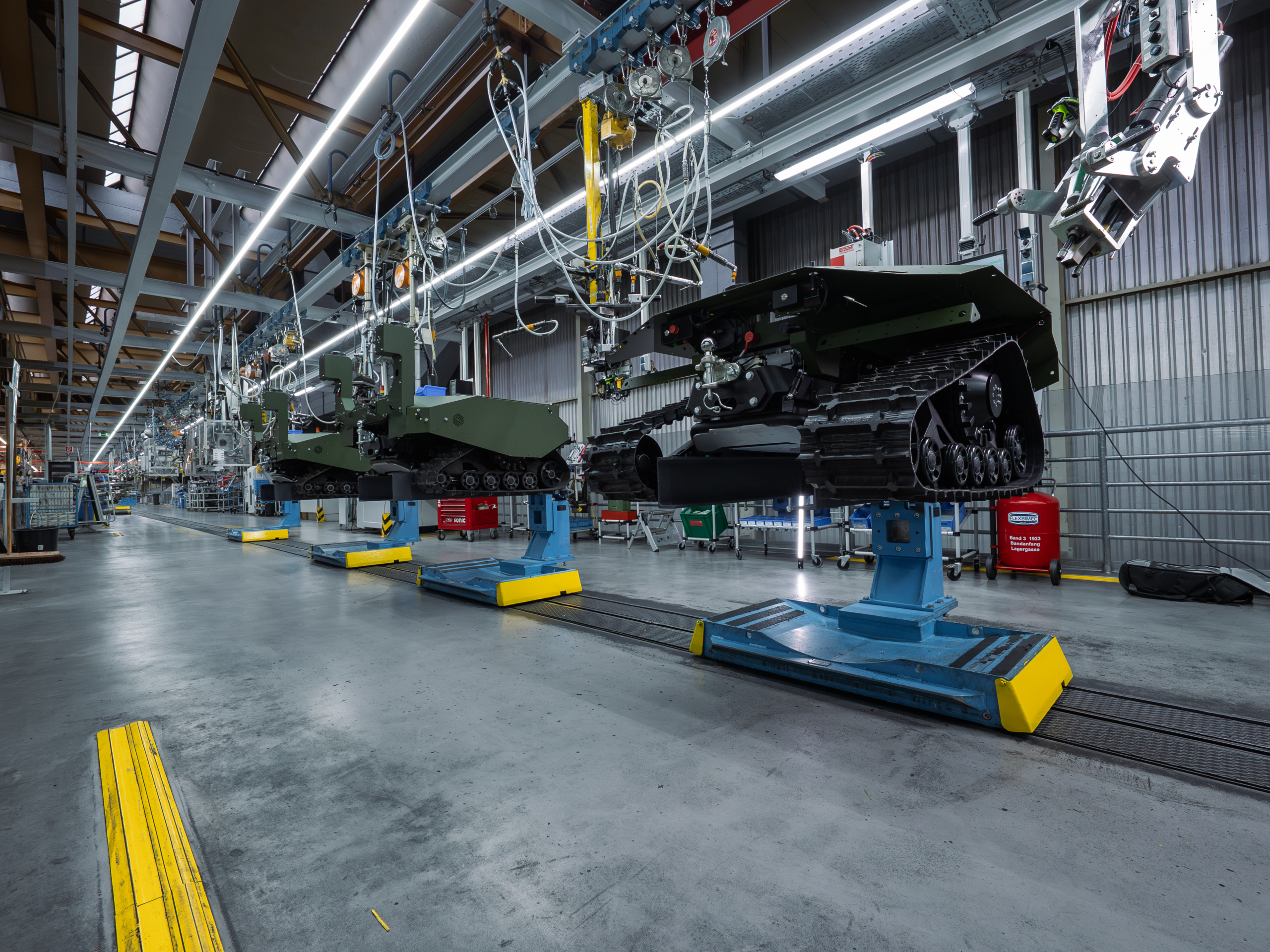
ARX’s relationship with German engine manufacturer DEUTZ provides one route to scaling production. The companies delivered their first jointly manufactured GEREON systems from the DEUTZ plant in Ulm in September 2026, approximately 12 weeks after the production ramp-up began. The initial vehicles were destined for Ukraine as part of a larger order.
That arrangement demonstrates how established industrial facilities can contribute to newer defence technology programmes. Vehicle production involves manufacturing and assembly processes that may be familiar to experienced industrial suppliers, although the addition of specialised electronics, autonomy functions, and military integration requirements creates further work beyond conventional machinery production.
A production line must maintain consistent quality while component deliveries and vehicle configurations change. Manufacturing documentation, inspection arrangements, software versions, and technical acceptance procedures must remain aligned with the equipment actually being produced. The task becomes more demanding when work is shared between factories using different equipment and production systems.
ARX is also expanding its relationship with Ukrainian manufacturer Roboneers. The companies agreed in June 2026 to establish ARX Industries, a joint venture intended to industrialise production of the Rys Pro unmanned ground vehicle in Germany and Ukraine. Their cooperation combines ARX’s manufacturing and software activities with Roboneers’ experience developing robotic systems for Ukrainian military requirements.
The first jointly produced Rys Pro vehicles were reported as delivered in November, adding another manufacturing activity to the broader partnership. These deliveries are separate from the initial DEUTZ-built GEREON production milestone, and the companies have not disclosed a consolidated monthly output figure covering all participating facilities.
Integration work between the partners extends to mission equipment. In October, ARX and Roboneers reported initial interoperability testing involving the SABER remote weapon module and the GEREON platform. Such projects require mechanical mounting, electrical power, control interfaces, and software compatibility to be assessed together before a completed configuration can be accepted.
ARX has not established that every vehicle supplied to Ukraine carries a weapon module or operates with the same degree of autonomy. Equipment configurations depend on the mission and the customer’s requirements, while the capabilities of the software are constrained by the hardware, sensors, and controls available on the individual platform.
There is also a British industrial dimension to the company’s expansion. In September, ARX Robotics UK and General Dynamics Land Systems-UK announced a collaboration to explore crewed and uncrewed teaming involving the British Army’s Ajax armoured vehicle and robotic platforms. The work includes examining how an existing crewed vehicle could command and monitor additional autonomous systems.
The collaboration may create future requirements for UK manufacturing, integration, and support, although it does not establish a confirmed domestic production order for a particular quantity. Adapting software and communications equipment to an existing armoured platform also requires systems engineering work to establish compatible interfaces and appropriate command arrangements.
As the number of delivered robots increases, sustaining the installed fleet becomes a larger industrial requirement. Batteries, propulsion components, control electronics, sensors, and communications equipment must remain serviceable, while damaged or worn assemblies require repair or replacement. Maintaining sufficient spare parts and technical support can become as important as increasing new vehicle assembly rates.
Software support adds another layer to that requirement. Different vehicle configurations may receive updates to navigation, control, or mission functions, but changes must remain compatible with installed hardware and the customer’s approved operating arrangements. Maintaining accurate records of equipment configurations helps reduce the risk of introducing incompatible components or software into an established fleet.
The company has indicated an ambition to deliver several thousand additional ground systems to Ukraine over the following 12 months. Actual output will depend on production capacity, component supply, procurement commitments, and the ability to integrate additional manufacturing partners. The ambition should not be counted as completed deliveries or a fully disclosed order backlog.
The reported 400-system milestone establishes the scale of ARX’s Ukrainian deliveries as described by the company. Further production figures from Ulm, the Roboneers partnership, and other facilities will provide a clearer measure of how quickly its manufacturing network can expand while maintaining equipment quality and supportability.