IN Brief:
- RAF Brize Norton's three-kilometre runway has been replaced following a 16-week construction programme.
- VolkerFitzpatrick used pavement quality concrete and grooved Marshall asphalt, with AECOM providing technical services.
- The wider £180 million project includes taxiway, lighting, and drainage improvements, with completion planned for late 2027.
The Defence Infrastructure Organisation has completed the replacement of RAF Brize Norton’s three-kilometre runway, allowing aircraft to return following a 16-week construction programme. The work forms the principal completed element of a £180 million airfield modernisation project intended to improve the durability, safety, and operational resilience of the Royal Air Force’s main air mobility hub.
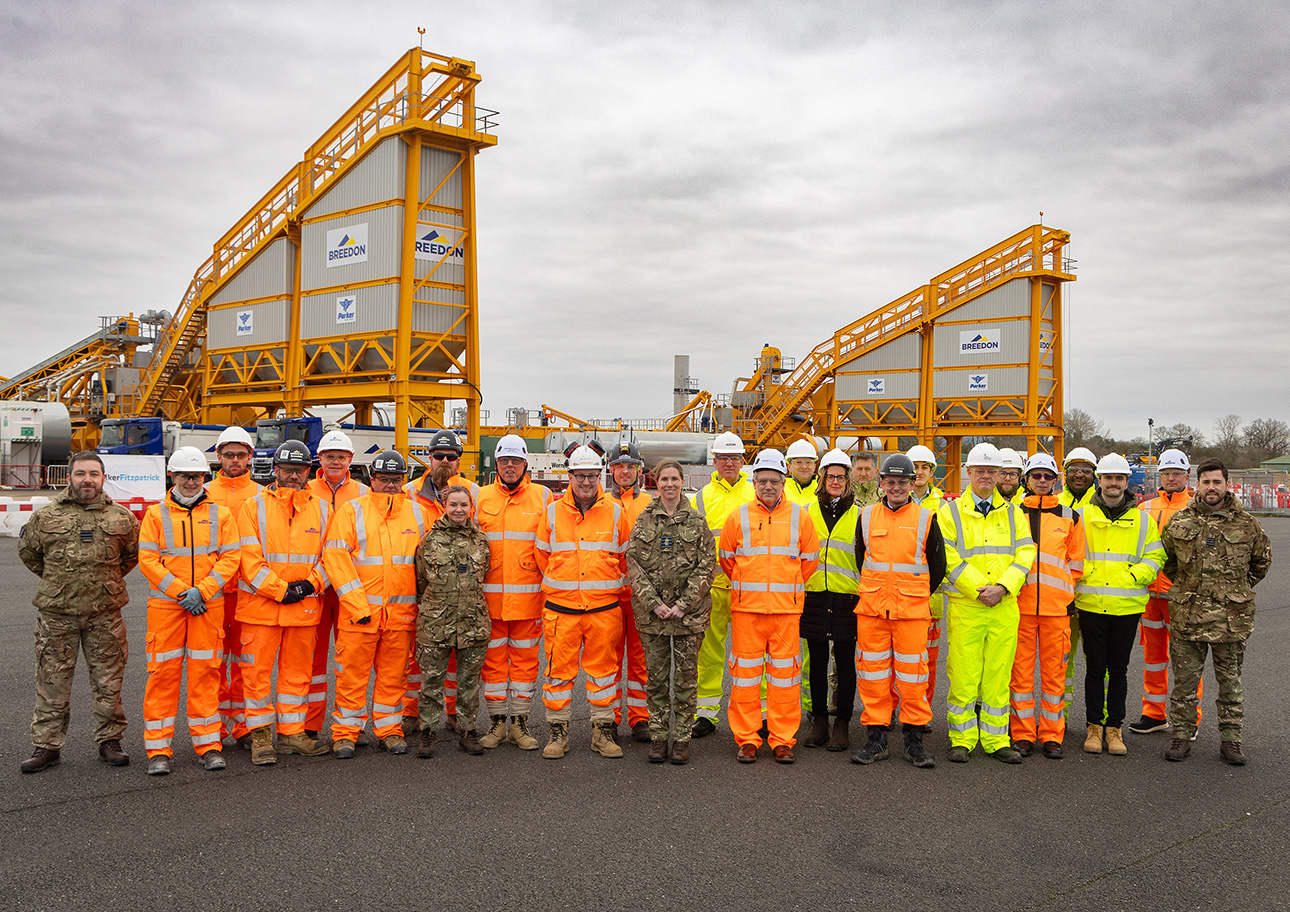
The first aircraft landed on the replacement runway on Friday 13 November 2026, with DIO confirming the completed works on 18 November. VolkerFitzpatrick delivered the construction programme, supported by AECOM’s technical services, while Air Commodore Phil Reid, the RAF’s Head of Air Infrastructure, received the runway on behalf of the service.
The project required the full replacement of the existing runway surface while RAF Brize Norton’s aircraft and associated support functions continued operating from alternative locations. Construction proceeded over 16 weeks, with the wider programme still scheduled to include taxiway refurbishment, airfield lighting upgrades, drainage improvements, and supporting infrastructure works through late 2027.
The replacement runway incorporates pavement quality concrete and grooved Marshall asphalt. DIO selected these materials to improve resilience to higher temperatures and changing climatic conditions, while increasing the expected operating life of the surface. The organisation estimates that the use of pavement quality concrete will more than double the runway’s service life compared with the materials previously installed.
Runway pavement is subject to demanding and repeated mechanical loading. Aircraft place concentrated forces through their landing gear, particularly during landing, braking, and manoeuvring, while variations in temperature and moisture influence how the surface and underlying structure respond. The design must accommodate those stresses without unacceptable deformation, cracking, or deterioration.
Pavement quality concrete provides a rigid structural surface intended to distribute wheel loading through the pavement and its supporting layers. The performance of such a construction depends on concrete properties, structural thickness, joint design, underlying support, and the quality of installation. DIO has not disclosed the complete pavement design or individual layer dimensions used at Brize Norton.
The grooved asphalt element addresses a different aspect of airfield operation. Surface texture and drainage influence the behaviour of water beneath aircraft tyres, particularly during wet-weather conditions. Grooving provides channels that can assist water movement across the surface, although effective runway drainage also depends on the geometry of the pavement and the surrounding drainage infrastructure.
Both pavement types must perform under the operating conditions associated with a major military transport base. Brize Norton supports aircraft ranging from the Atlas A400M tactical transport to the larger C-17 Globemaster and Voyager tanker fleet, with different landing gear configurations and operating requirements. Their continued use places substantial demands on pavement condition and maintenance.
Higher temperatures present particular challenges for airfield surfaces. Asphalt materials can soften under sustained heat, increasing the risk of deformation when subjected to heavy loads, while concrete pavements require suitable provision for temperature-related movement and joint performance. The combination selected for the replacement runway is intended to improve the station’s ability to withstand future environmental conditions.
The projected improvement in service life remains an engineering expectation rather than an established record of long-term performance. Actual durability will depend on the construction as installed, aircraft movements, weather exposure, maintenance, and the condition of supporting infrastructure. Regular inspection and repair will remain necessary throughout the runway’s operating life.
Drainage improvements included in the wider project are closely related to pavement performance. Water accumulation can affect aircraft braking and create operational restrictions, while prolonged moisture exposure within pavement structures can contribute to deterioration. Addressing drainage alongside the main pavement replacement provides an opportunity to improve both surface operation and the condition of the supporting construction.
Airfield lighting is another substantial element of the modernisation programme. Runway and taxiway lighting must provide dependable visual guidance during darkness and reduced visibility, supported by electrical distribution, control, and monitoring systems. Installation work must be coordinated with other operating surfaces and the requirements of the aircraft using the base.
The project also involves associated taxiways and supporting infrastructure, allowing the runway replacement to form part of a broader renewal of the airfield rather than an isolated civil engineering intervention. AECOM’s role has included technical assurance, with the company working alongside DIO, the RAF, contractors, and specialist engineering partners.
Maintaining operations during the closure required a substantial dispersal of military aircraft and support resources. Under Operation Mace Vector, the RAF relocated aircraft to alternative airfields while retaining its worldwide air transport and refuelling commitments. Atlas and C-17 operations were supported principally from MoD Boscombe Down and other available facilities, while Voyager aircraft operated from a separate network of locations.
The dispersal involved much more than allocating aircraft to replacement runways. Engineering support, maintenance equipment, spares, fuel, ground handling, communications, and personnel arrangements had to be established at the receiving locations. Each aircraft type has specific technical and support requirements, creating additional coordination demands when its normal operating infrastructure is unavailable.
The temporary arrangements enabled the RAF to continue moving personnel and equipment while the principal operating surface was reconstructed. They also demonstrated the scale of the support system required to sustain a transport fleet across several bases. Returning aircraft to Brize Norton allows those arrangements to be progressively reversed and normal operations restored.
The station has a central role in British military air mobility, supporting strategic transport, tactical airlift, and air-to-air refuelling. Its runway is therefore used by aircraft performing different missions, including the movement of military equipment and personnel to overseas operations. Long-term pavement reliability contributes directly to the availability of that transport infrastructure.
The £180 million investment covers the broader airfield programme, not solely the runway replacement. DIO has not published a separate final cost for the completed pavement works. The programme forms part of the Defence Investment Plan, which includes renewal of critical infrastructure across the military estate.
Completion of the runway within the 16-week construction period establishes a significant delivery milestone, but further infrastructure work remains. The next phase will continue improvements to taxiways, lighting, drainage, and associated operating facilities, with overall completion scheduled for late 2027.
With aircraft now using the replacement surface, the focus moves to completing those remaining works while maintaining the station’s operational commitments. The runway’s actual service life and performance under repeated military aircraft loading will provide the long-term measure of the pavement design and construction choices.