IN Brief:
- Schiebel and OSIRIS Poland demonstrated airborne deployment of an HSCD-1 drone from a CAMCOPTER S-100.
- The larger aircraft carried, released, and subsequently relayed communications for the smaller drone.
- The inert-aircraft trial established a proof of concept, with operational interception and weapons integration remaining unproven.
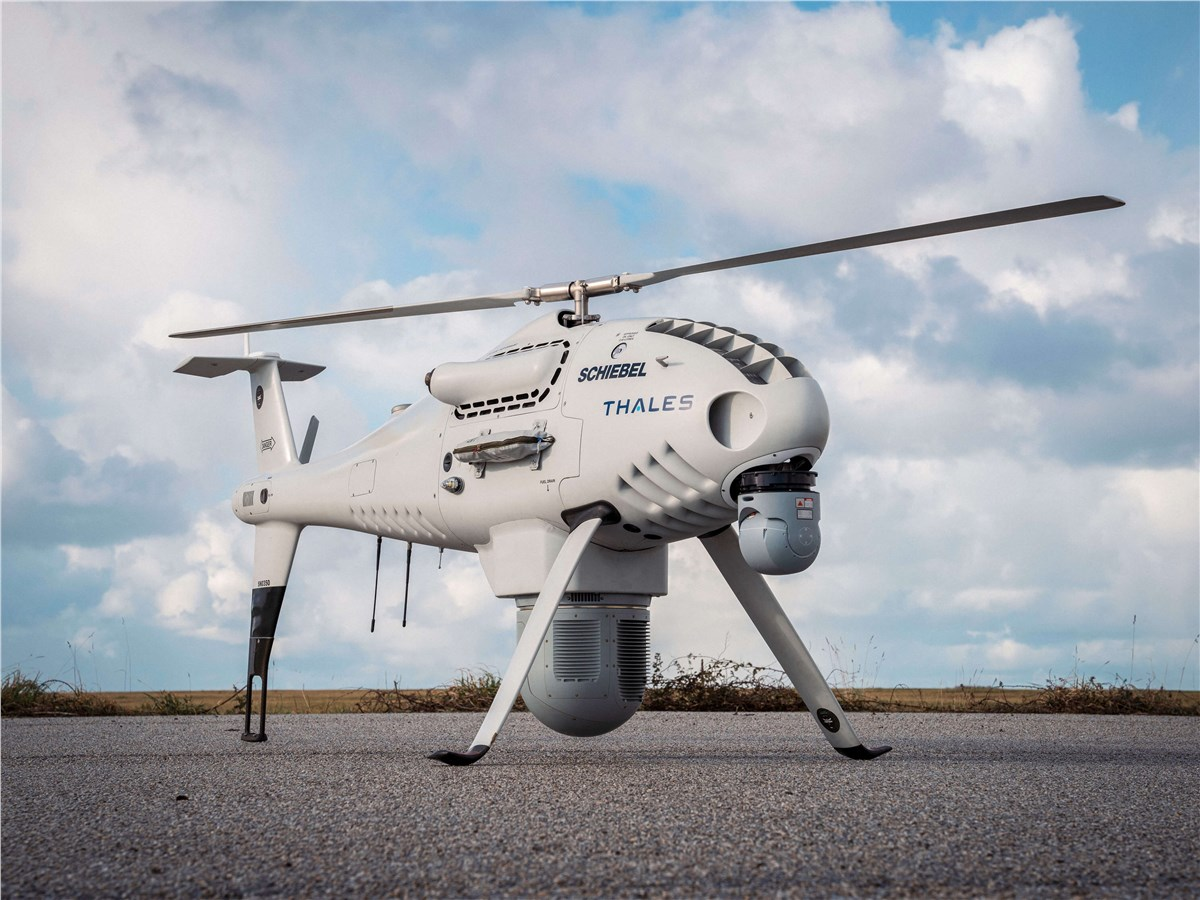
Schiebel has demonstrated its CAMCOPTER S-100 unmanned helicopter operating as an airborne carrier and communications relay for a smaller drone. Working with OSIRIS Poland, the Austrian manufacturer carried and released an HSCD-1 High-Speed Camera Drone during forward flight, before maintaining control and video communications through equipment aboard the larger aircraft.
The proof-of-concept demonstration took place in Austria and was disclosed on 18 November 2026. It established three functions within the same flight arrangement: transport of a smaller unmanned aircraft, airborne deployment, and subsequent communications relay. The demonstration used an inert version of the HSCD-1 and did not involve a live weapon or an operational interception.
The CAMCOPTER S-100 is a rotary-wing unmanned aircraft developed for missions including surveillance and maritime reconnaissance. Its ability to take off and land vertically allows it to operate without the runway infrastructure normally required by conventional fixed-wing aircraft. The new demonstration adds a potential payload deployment function to a platform already designed to carry sensors and communications equipment.
Carrying another aircraft changes the relationship between the payload and the host platform. Conventional mission equipment generally remains attached throughout a flight, while an airborne deployment system must secure its payload during transport and release it under conditions that allow the smaller vehicle to separate safely.
Successful release requires the carrier’s flight condition and the mechanical arrangement of the payload to be compatible. Relative airflow, mounting geometry, aircraft movement, and the smaller drone’s ability to establish controlled flight all influence whether the sequence can be completed reliably. The participating companies have not disclosed the release mechanism, deployment altitude, airspeed, or the number of trials undertaken.
The HSCD-1 was carried while the S-100 was moving forward, establishing that deployment is possible without a stationary hover. This creates a different operating arrangement from systems that require a carrier to stop over a release point. The range of speeds and flight attitudes within which deployment can occur remains to be established through further testing.
Following separation, the smaller drone was operated through a communications connection relayed by the S-100. The relay function provides an intermediate airborne node between the operator and the deployed aircraft, allowing control and video information to pass through the larger unmanned helicopter rather than relying solely on a direct connection.
The quality of such a connection depends on the radio system, antennas, operating frequency, relative positions, and surrounding environment. Moving a relay above ground level can change the available line of sight and potentially reduce some terrain-related communications restrictions. It does not guarantee uninterrupted connectivity or remove the limitations imposed by interference, signal strength, and distance.
Control and video data also have different transmission requirements. Control instructions need to reach the smaller aircraft within an appropriate interval, while video can demand substantially more bandwidth depending on its resolution and encoding. A relay handling both streams must maintain sufficient connectivity as the relative position of the two aircraft changes.
Schiebel and OSIRIS have confirmed that the link operated during the demonstration but have not published measured latency, transmission range, data rates, or communications reliability figures. These parameters would be relevant to any future system intended to support multiple smaller aircraft or operate in an environment with degraded connectivity.
The concept combines the operating range and endurance of the CAMCOPTER platform with the different performance characteristics of a smaller unmanned aircraft. A carrier can transport a specialised payload towards a required operating area before deployment, potentially reducing the distance the smaller vehicle must cover independently.
That arrangement does not remove the smaller aircraft’s own endurance and payload limits. It changes the starting point of its mission and adds the ability to use the larger aircraft as a communications relay. The practical improvement would depend on the carrier’s route, release position, smaller drone performance, and the time available for the intended task.
Schiebel identifies counter-drone operations as one possible future application, including carriage of high-speed interceptors equipped with effectors. The inert HSCD-1 demonstration did not establish such a capability. An operational interception would require additional functions involving target information, guidance, command arrangements, and the integration of an appropriate interceptor payload.
Other potential applications include deploying smaller surveillance aircraft into areas where access from a ground launch location is restricted. A distributed arrangement could allow the carrier to remain at a different operating position from the smaller aircraft while continuing to provide communications support.
Integrating additional aircraft types would require engineering work beyond the completed proof of concept. Each payload would impose different demands on the carrier’s mass distribution, mounting system, electrical connections, and separation characteristics. The communications architecture would also need to support the control and data requirements of the particular aircraft.
Carriage affects the host platform’s performance as well. An externally mounted payload adds mass and may introduce aerodynamic resistance, while the release system and any supporting communications equipment consume installation space. The permissible operating configuration must remain within the carrier’s structural, flight-control, and payload limits.
Schiebel has considerable experience integrating mission equipment onto the S-100 for military and commercial users. That experience provides an existing engineering foundation, but every new airborne deployment arrangement requires its own testing and qualification. The aircraft’s history in surveillance operations does not establish automatic approval for carrying and releasing additional vehicles.
The November demonstration was a technical experiment rather than a customer procurement milestone. Neither company has announced a production order, operational deployment schedule, or military acceptance programme for the combined S-100 and HSCD-1 configuration.
The completed trials demonstrate that carriage, airborne release, and subsequent communications relay can operate together in one experimental arrangement. Further testing will need to establish repeatability, operating limits, compatibility with additional payloads, and the reliability required for any future military application.